How Much Does Business Insurance Cost for Freelancers? (2026 Data)
In short: What freelancers pay for business insurance in 2026, by policy and by profession, with median costs, sample budgets and ways to lower your premium.


On this page
- Business insurance cost for freelancers: by policy
- Business insurance cost for freelancers: by profession
- What affects the cost of freelancer insurance
- Which insurance does a freelancer actually need?
- Sample annual budgets
- General vs. professional liability: the difference that drives your price
- How to lower your business insurance cost
- Business insurance cost for freelancers as a share of revenue
- How to compare business insurance quotes
- Monthly vs annual payment
- Red flags when insurance looks too cheap
- Questions to ask before you buy
- Business insurance cost for freelancers by business stage
- What happens to your premium after a claim?
- Should you buy through a broker or online?
- Example: two freelancers, two very different quotes
- Insurance and taxes
- Is business insurance worth the cost for freelancers?
- Frequently asked questions
- Sources
If you’re a freelancer pricing business insurance for the first time, the quotes can feel random: $19 a month from one site, $140 from another. The difference usually comes down to which policy you’re looking at and what kind of work you do. This guide pulls together published 2026 data so you can see what freelancers actually pay, policy by policy and profession by profession. Here’s a realistic look at business insurance cost for freelancers in 2026.
Key takeaways
- General liability: median about $45/month across small businesses, and roughly $29–$38/month for most freelance professions.
- Professional liability (E&O): median about $88/month across small businesses, ranging from $42 for photographers to $94–$111 for tech freelancers.
- BOP (general liability + property): about $42–$67/month for freelancers.
- Your profession affects price more than anything else.
- Higher deductibles, annual payment and bundling can lower your premium.
Business insurance cost for freelancers: by policy
| Policy | Median / average monthly | Typical annual | What it covers | Source |
|---|---|---|---|---|
| General liability | $45 (all small businesses); $29 (independent contractors) | $344–$540 | Injuries, property damage, advertising injury | Insureon / TechInsurance |
| Professional liability (E&O) | $88 (all small businesses) | $1,051 | Mistakes, negligence, failure to deliver | Insureon |
| Tech E&O (independent contractors) | $59 | $713 | Professional liability for tech work | TechInsurance |
| Business Owner’s Policy (BOP) | $42 (independent contractors) | $500 | General liability + business property | TechInsurance |
| Workers’ compensation | $32 (independent contractors) | $384 | Employee injuries (required in most states with employees) | TechInsurance |
Insureon’s general liability data is based on more than 100,000 small business owners (updated March 2026); professional liability data was updated March 2026. TechInsurance figures are for independent contractors.
Business insurance cost for freelancers: by profession
Here are the median monthly premiums published for specific freelance professions. Follow the links for full guides on each one.
| Profession | General liability | Professional / media / tech E&O | Full guide |
|---|---|---|---|
| Photographers | $29 (Insureon), ~$19 (NEXT) | $42 | Photographer insurance |
| Consultants | $32 | $62 | Consultant insurance |
| Writers | $29 | $78 (media businesses) | Writer insurance |
| Graphic designers | $33–$36 | $70 | Graphic designer insurance |
| Web designers | $38 | $94 (tech E&O) | Web designer insurance |
| Software developers | $32 | $59–$111 (tech E&O) | Developer insurance |
Figures are medians or averages published by Insureon, TechInsurance and NEXT Insurance for policies sold through their platforms, with different update dates (2024–2026). They’re a guide, not a quote.
What affects the cost of freelancer insurance
Insurers use similar factors to price every policy. According to Insureon, the most important ones are:
- Industry and risk class. A web developer handling payments is riskier than a copywriter writing blog posts.
- Policy limits and deductible. $2M limits cost more than $1M; a $2,500 deductible costs less than $500.
- Claims history. Past claims usually increase premiums.
- Location. Insureon reports general liability ranging from about $42/month in states like California and Pennsylvania to $55/month in Florida.
- Revenue and employees. More revenue and staff mean more exposure.
- Experience. Years in business can lower your rate.
Which insurance does a freelancer actually need?
| If you… | Start with | Consider adding |
|---|---|---|
| Give advice, write, design or code for clients | Professional liability (E&O) | General liability if clients require it |
| Meet clients in person or work on-site | General liability | Professional liability |
| Have valuable equipment (cameras, computers) | BOP or equipment coverage | General + professional liability |
| Host, manage or access client data | Tech E&O + cyber | General liability |
| Hire employees | Workers’ compensation (usually required) | All of the above |
| Drive to client locations | Business-use auto coverage | Commercial auto if you have employees driving |
Many solo freelancers start with one policy, typically professional liability for knowledge work or general liability for on-site work, and add coverage when contracts or growth require it.
Sample annual budgets
Illustrative budgets based on the median figures above. Your quotes will differ.
| Freelancer type | Policies | Estimated monthly | Estimated annual |
|---|---|---|---|
| Remote copywriter | Media/professional liability | ~$50–$80 | ~$600–$960 |
| Wedding photographer | General liability + equipment | ~$70–$75 | ~$850–$900 |
| Independent consultant | General + professional liability | ~$95 | ~$1,130 |
| Freelance web developer | General liability + tech E&O + cyber | ~$240 | ~$2,900 |
General vs. professional liability: the difference that drives your price
Most confusion about freelancer insurance comes from mixing up the two main policies:
- General liability protects you from physical risks: a client trips over your bag, you damage a venue’s floor, or a competitor claims your ad defamed them. It’s cheap because most freelancers rarely cause physical harm.
- Professional liability protects you from financial harm your work causes: bad advice, a bug that takes down a store, a typo on 10,000 brochures, a missed deadline. It costs more because those claims are more common and more expensive for knowledge workers.
That’s why a freelance software developer may pay three times more than a photographer: the developer’s main risk is professional, and professional claims can be large. If a client contract only mentions “commercial general liability,” don’t assume that’s all you need. It’s often the cheapest box to tick, not the most important protection.
How to get quotes in under an hour
- Write a one-paragraph description of your services, industries and annual revenue.
- List any requirements from client contracts or your lease (limits, additional insured).
- Request quotes from at least three online insurers or one independent broker.
- Compare limits, deductibles, exclusions and the retroactive date, not just the monthly price.
- Buy, then download your certificate of insurance and save it with your contract templates.
How to lower your business insurance cost
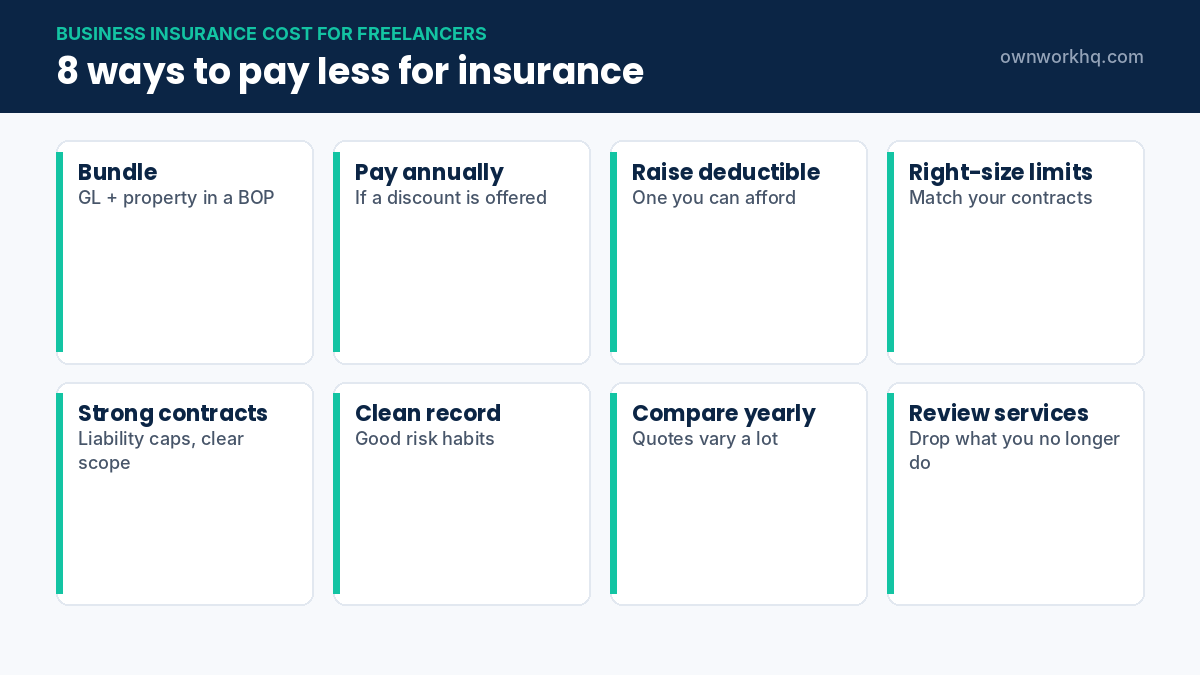
- Bundle policies with one insurer, or choose a BOP.
- Raise your deductible if you have an emergency fund to cover it.
- Pay annually when a discount is offered.
- Buy the limits you need. Match contract requirements instead of over-insuring.
- Compare at least three quotes every year at renewal.
- Reduce risk on paper with clear contracts, approvals and documentation, which can help you avoid claims altogether.
- Check association plans (for example, PPA for photographers) that bundle insurance with membership.
Is business insurance tax deductible?
For self-employed people, premiums for business insurance are generally deductible as an ordinary and necessary business expense on Schedule C. Health insurance follows different rules. Confirm your situation with a tax professional or the IRS guide to business expenses.
Business insurance cost for freelancers as a share of revenue
Looking at insurance as a percentage of revenue makes it easier to budget. Using the typical $70–$150 monthly range from this guide:
| Annual revenue | At $70/month ($840/yr) | At $150/month ($1,800/yr) |
|---|---|---|
| $50,000 | 1.7% | 3.6% |
| $80,000 | 1.1% | 2.3% |
| $120,000 | 0.7% | 1.5% |
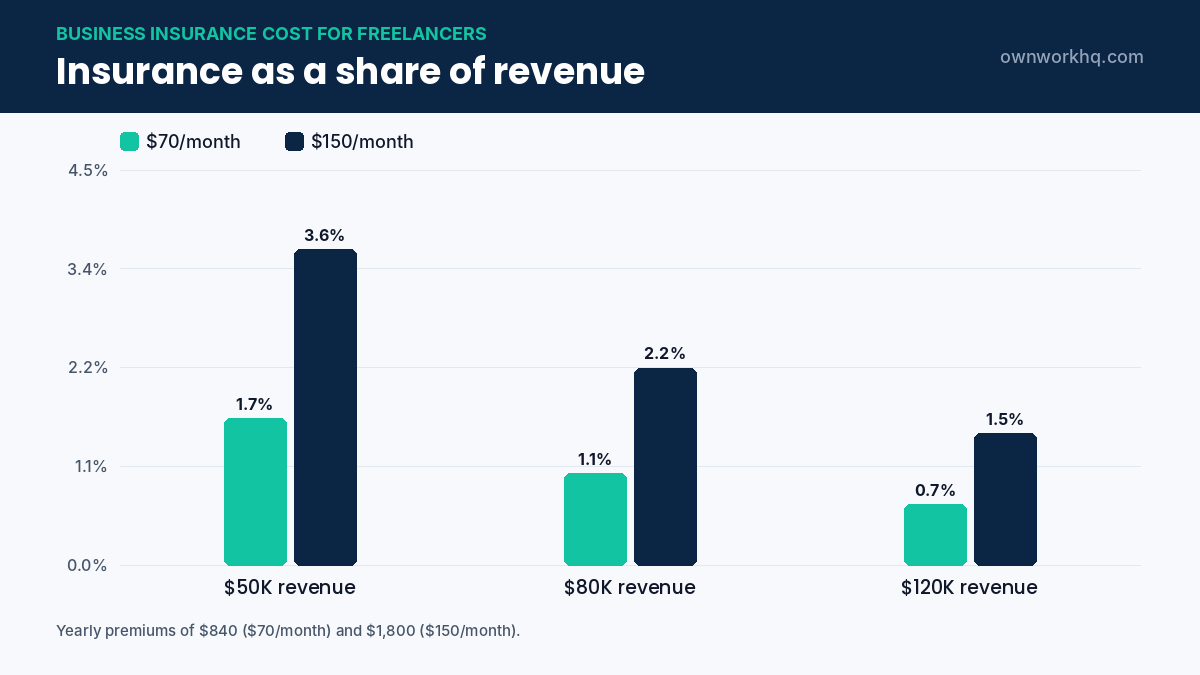
For most established freelancers, insurance lands between 1% and 3% of revenue. Build it into your rates the same way you include software and taxes; see how to set freelance rates.
How to compare business insurance quotes
| Compare | Why it matters |
|---|---|
| Limits | Two quotes are only comparable if the per-claim and aggregate limits match |
| Deductible | A lower price may simply mean a higher deductible |
| Retroactive date | For claims-made policies, an earlier date protects more past work |
| Exclusions | IP, cyber or contract claims may be excluded in one quote and covered in another |
| Defense costs | Inside limits reduces what’s left for settlements; outside limits is better |
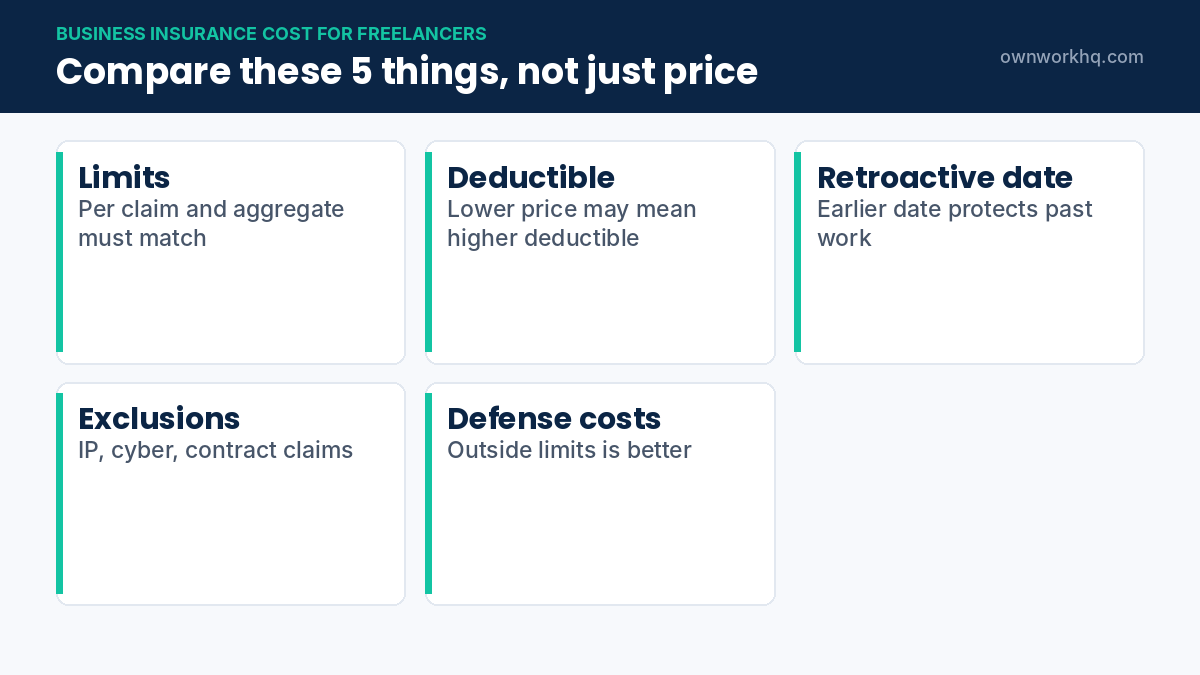
A quote that’s $10 a month cheaper but excludes your most likely claim isn’t a saving. Line up the details in a simple table before deciding.
Monthly vs annual payment
Most online insurers let you pay monthly or annually. Monthly payments help cash flow and make it easy to cancel if your business changes. Annual payment is sometimes slightly cheaper and avoids failed-payment lapses. Either way, set a renewal reminder; a lapse in a claims-made policy can leave past work uncovered.
Red flags when insurance looks too cheap
- Very low limits, such as $250,000, when clients ask for $1 million.
- Broad exclusions for the exact work you do.
- Defense costs inside a small limit, which can exhaust coverage quickly.
- No retroactive coverage for work done before the policy started.
- Unclear insurer: check that the company is licensed in your state through your state insurance department.
The NAIC directory of state insurance departments links to each state’s license lookup.
Questions to ask before you buy
- Which of my services are covered, and which are excluded?
- Is the policy occurrence or claims-made? What is the retroactive date?
- Are defense costs inside or outside the limit?
- Can I add clients as additional insureds, and is there a fee?
- How do I get certificates of insurance, and how fast?
- What discounts are available for bundling or paying annually?
Asking these questions in writing gives you a record of what you were told, which is useful if you ever need to make a claim.
Business insurance cost for freelancers by business stage
| Stage | Typical coverage | Approximate monthly budget |
|---|---|---|
| Just starting, low-risk remote work | General liability or professional liability only | $30–$60 |
| Steady clients with contracts | General + professional liability | $70–$150 |
| Handling client data or systems | Add cyber insurance | $150–$250 |
| Studio, equipment or employees | BOP, workers’ compensation, higher limits | $200+ |
Use the ranges as a planning guide based on the median figures in this article. Real quotes depend on your profession, state, revenue and claims history.
What happens to your premium after a claim?
A claim doesn’t automatically double your price, but it can raise renewal premiums, increase your deductible or, in some cases, lead an insurer not to renew. That’s why many freelancers handle very small issues directly with clients while still reporting any potential claim to the insurer as the policy requires. Never hide a known incident when renewing or switching insurers; it can void coverage.
Should you buy through a broker or online?
| Online marketplace or insurer | Independent broker | |
|---|---|---|
| Speed | Minutes to buy and get a certificate | Days, depending on complexity |
| Advice | Limited; you choose coverage yourself | Personal guidance on gaps and wording |
| Best for | Standard freelance risks and limits | Unusual work, high limits or complex contracts |
Many freelancers start online and move to a broker as contracts get bigger. Either way, the five comparison points above still apply.
Example: two freelancers, two very different quotes
| Freelance copywriter | Freelance developer | |
|---|---|---|
| Revenue | $70,000 | $120,000 |
| Main risk | Content errors and IP claims | Code errors and data access |
| Policies | Professional/media liability + general liability | Tech E&O with cyber + general liability |
| Typical budget | Lower end of the $70–$150 range | Above $150 per month |
Both freelancers work from home and have no employees, yet their business insurance cost differs mainly because of what could go wrong in their work. That’s the single biggest driver of price, ahead of location or revenue.
Insurance and taxes
Business insurance premiums are generally deductible on Schedule C, which lowers the real cost. In the 22% federal bracket, plus self-employment tax savings on the reduced profit, a $1,200 yearly premium can effectively cost several hundred dollars less. Health insurance is handled differently, through the self-employed health insurance deduction; see health insurance for self-employed freelancers.
Is business insurance worth the cost for freelancers?
Think of it as protection against a low-probability, high-cost event. Defending even a groundless claim can cost thousands of dollars in legal fees, which is often more than several years of premiums. For freelancers whose contracts require coverage, it’s simply a cost of winning the work. For everyone else, the question is how much a single claim would hurt your savings; if the answer is “a lot”, the business insurance cost for freelancers is usually worth paying.
Frequently asked questions
How much does business insurance cost for a freelancer per month?
Most freelancers pay roughly $30–$45 per month for general liability and $40–$110 per month for professional liability, depending on their profession. Combined, a typical solo freelancer budgets around $70–$150 per month.
What’s the cheapest business insurance for freelancers?
General liability is usually the least expensive policy, often under $40 per month. But the cheapest policy isn’t always the right one: knowledge workers usually need professional liability more than general liability.
Can I get insurance for just one project?
Some insurers offer short-term or project-based policies, which can make sense for occasional work. If you freelance regularly, an annual policy is usually more cost-effective and keeps claims-made coverage continuous.
Do I need business insurance if I have an LLC?
Usually yes. An LLC can help separate personal and business assets, but it doesn’t pay legal fees or settlements. Insurance does, and many clients require it regardless of your structure.
Why did my quote differ from these numbers?
Medians hide a wide range. Your profession, state, revenue, limits, deductible and claims history all change the price. Use the figures here as a benchmark when comparing quotes.
Is business insurance cost for freelancers tax deductible?
Generally yes. Premiums for business policies such as general liability, professional liability and cyber are deductible business expenses on Schedule C.
Why do quotes vary so much between insurers?
Each insurer weighs risk factors differently, offers different limits and deductibles, and excludes different claims. Comparing quotes with identical limits and deductibles shows the real difference.
Does my homeowners insurance cover my freelance business?
Usually only to a very limited extent, and many policies exclude business activities. A BOP or a home-business endorsement is typically needed for business equipment and liability.
How can I get the cheapest business insurance as a freelancer?
Buy only the policies your work and contracts require, choose a deductible you can afford, pay annually if it’s discounted, and compare several quotes with identical limits. Bundling in a BOP can also save money.
Do I need insurance before I sign my first client?
Not legally in most cases, but if the client contract requires it you’ll need a certificate before work starts. Buying early also starts your claims-made history sooner.
Can I cancel business insurance at any time?
Most policies can be cancelled, often with a prorated refund for annual payments. Before cancelling a claims-made policy, check whether you need tail coverage for past work.
Does business insurance cost more in some states?
Yes. State laws, legal costs and claim trends affect prices, so the same coverage can cost noticeably more in some states than in others.
Is professional liability more expensive than general liability?
Usually yes. Professional liability covers the financial consequences of your work, which can be large, so its median price is roughly double that of general liability for many freelance professions.
Sources
- Insureon: General liability insurance cost (updated March 2026)
- Insureon: Professional liability insurance cost (updated March 2026)
- TechInsurance: Independent contractor insurance cost
- IRS: Deducting business expenses
Disclaimer: This article is for informational purposes only and is not insurance, legal or financial advice. OwnWork HQ is not a licensed insurance agent. Coverage, prices and eligibility vary by insurer and state and can change at any time, so always confirm details with the insurer or a licensed broker before you buy.
About OwnWork HQ Editorial
We write plain-English guides for US freelancers and check every rate, limit and deadline against IRS and state agency publications. We are not CPAs or financial advisors; for advice on your situation, talk to a qualified professional.