
Use this free income tax calculator to estimate your 2026 federal income tax, self-employment tax or FICA, and state income tax in one place. It’s built for freelancers, independent contractors and people with a side business, but it works just as well if you only have a W-2 job. Enter your filing status, state and income, and the results update instantly.
2026 Income Tax Calculator
Federal, self-employment (or FICA) and state income tax, for freelancers and employees.
- Federal
- FICA
- State
- Take-home
| Tax | Marginal | Effective | Amount |
|---|---|---|---|
| Federal income tax12% bracket | |||
| Self-employment taxSocial Security + Medicare | |||
| State income taxTexas | |||
| Total |
Estimate for tax year 2026 using IRS brackets, the standard or itemized deduction, the QBI deduction, the child tax credit and 2026 state rates (Tax Foundation). State figures use simplified deductions, exemptions and credits, and local income taxes are not included. Not tax advice.
How to read your results: the effective rate is your total tax divided by your income, while the marginal rate shows how much of your next dollar goes to tax. For freelancers, the marginal federal rate is often lower than the bracket because the QBI deduction and half of self-employment tax reduce taxable income.
On this page
How this income tax calculator works
The calculator follows the same order the IRS uses on Form 1040, simplified to the items that matter most for freelancers and employees:
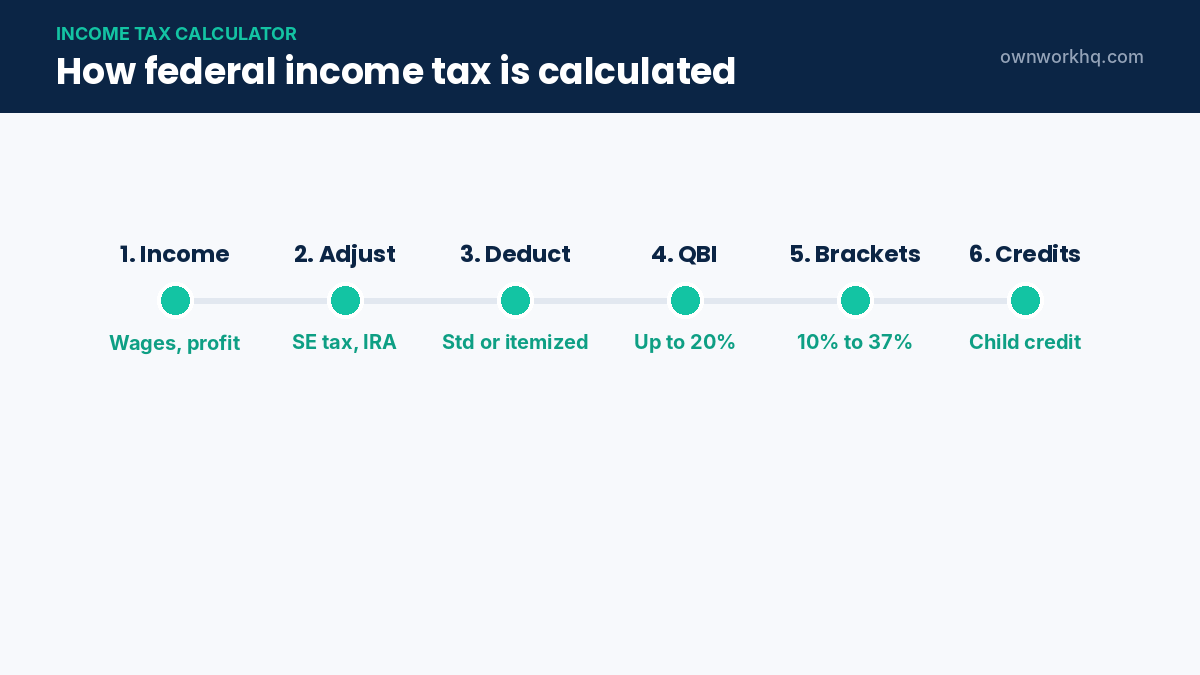
- Total income: W-2 wages plus net self-employment profit from Schedule C.
- Adjustments: half of self-employment tax, traditional or SEP IRA contributions, 401(k) deferrals, HSA contributions and self-employed health insurance premiums. The result is your adjusted gross income (AGI).
- Deduction: the larger of the 2026 standard deduction or the itemized deductions you enter.
- QBI deduction: up to 20% of qualified business income for freelancers, phased out at higher incomes, with a $400 minimum when your business income is at least $1,000.
- Tax brackets: the 2026 federal rates from 10% to 37% applied to your taxable income.
- Credits: the child tax credit of up to $2,200 per child under 17, partly refundable.
Self-employment tax or FICA is calculated separately on your earnings, and state income tax starts from your AGI using each state’s 2026 brackets, standard deduction and exemptions.
2026 federal income tax brackets
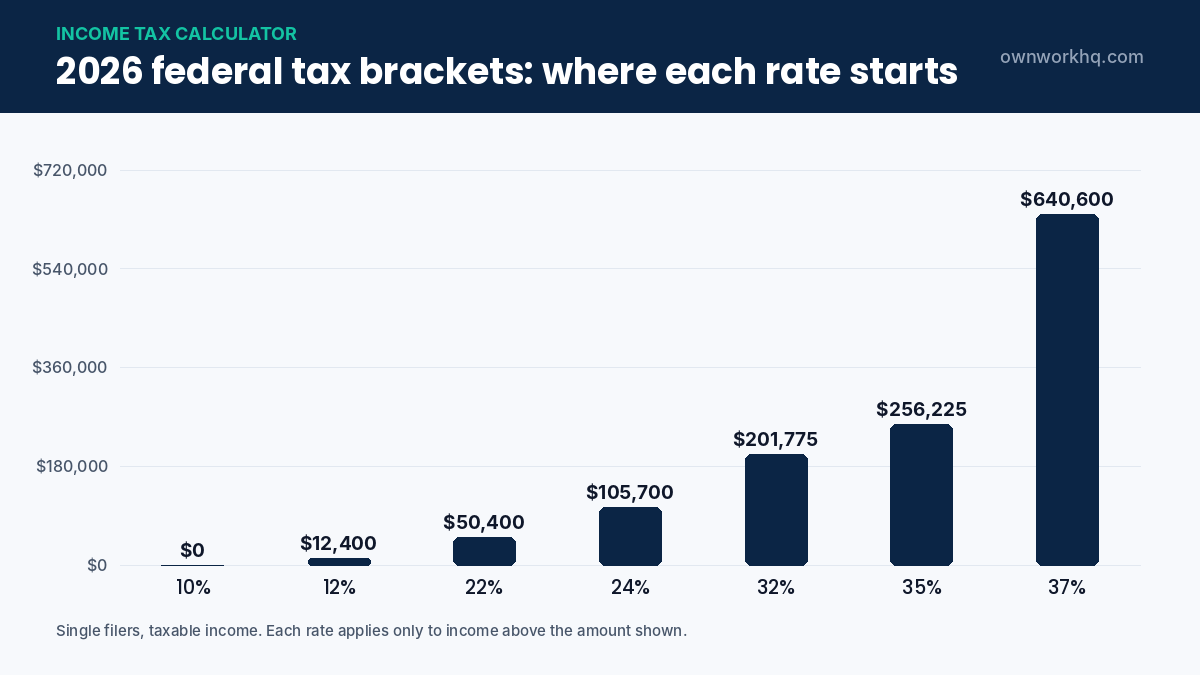
Federal income tax is progressive: each rate applies only to the income within its bracket. These are the 2026 brackets the income tax calculator uses, as published by the IRS.
| Rate | Single | Married filing jointly | Head of household |
|---|---|---|---|
| 10% | $0 – $12,400 | $0 – $24,800 | $0 – $17,700 |
| 12% | $12,401 – $50,400 | $24,801 – $100,800 | $17,701 – $67,450 |
| 22% | $50,401 – $105,700 | $100,801 – $211,400 | $67,451 – $105,700 |
| 24% | $105,701 – $201,775 | $211,401 – $403,550 | $105,701 – $201,750 |
| 32% | $201,776 – $256,225 | $403,551 – $512,450 | $201,751 – $256,200 |
| 35% | $256,226 – $640,600 | $512,451 – $768,700 | $256,201 – $640,600 |
| 37% | Over $640,600 | Over $768,700 | Over $640,600 |
Married couples filing separately use the single brackets up to the 35% rate, which ends at $384,350; income above that is taxed at 37%.
2026 standard deduction
| Filing status | Standard deduction |
|---|---|
| Single or married filing separately | $16,100 |
| Married filing jointly | $32,200 |
| Head of household | $24,150 |
Most freelancers take the standard deduction. Business expenses don’t affect this choice: they’re deducted on Schedule C before you get here, so you can deduct business costs and still take the standard deduction.
Self-employment tax vs FICA
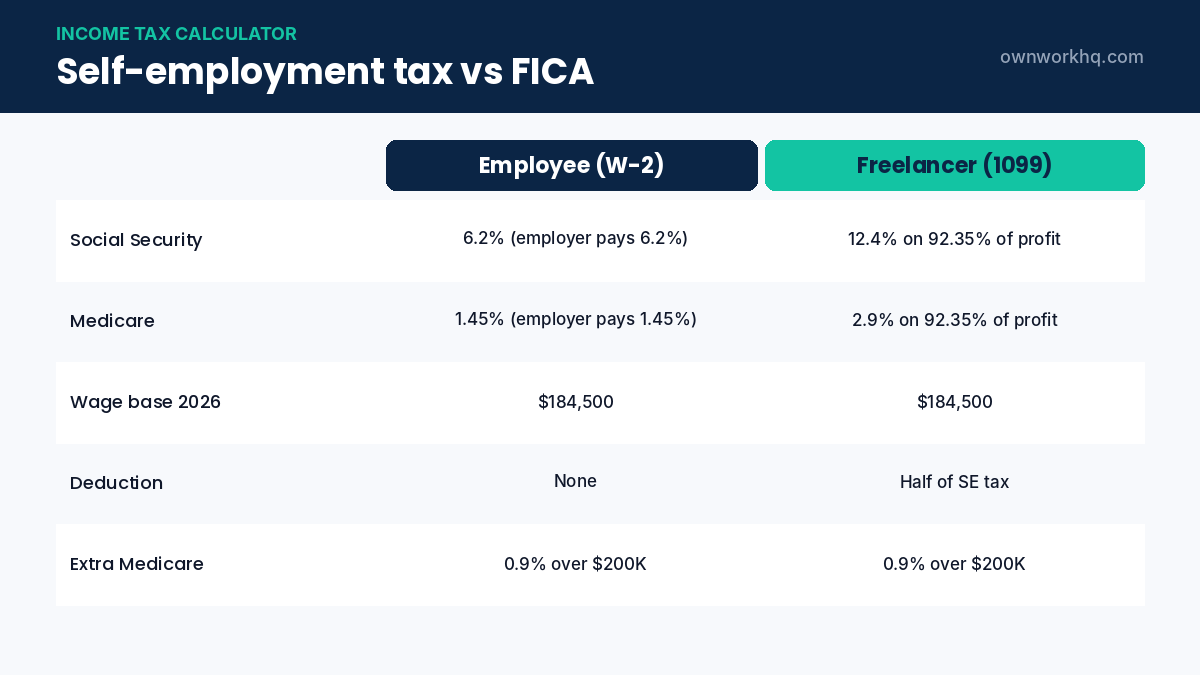
Employees pay 7.65% in FICA tax (6.2% Social Security and 1.45% Medicare), and their employer pays the same amount. Freelancers pay both halves as self-employment tax: 15.3% on 92.35% of net profit. Social Security tax stops at the 2026 wage base of $184,500, while Medicare continues on all earnings, plus an extra 0.9% above $200,000 for single filers ($250,000 for joint filers).
Half of self-employment tax is deductible when calculating income tax, which the calculator includes automatically. If you have both a job and freelance income, your W-2 wages count toward the Social Security wage base first. For a deeper comparison, see 1099 vs W-2.
Example: employee vs freelancer with the same income
Here’s how the same $80,000 compares for a single filer in Texas, which has no state income tax, using this tax calculator:
| Employee ($80,000 salary) | Freelancer ($80,000 profit) | |
|---|---|---|
| Federal income tax | $8,770 | $5,344 |
| FICA or self-employment tax | $6,120 | $11,304 |
| Total tax | $14,890 | $16,647 |
| Effective rate | 18.6% | 20.8% |
| Take-home pay | $65,110 | $63,353 |
The freelancer pays almost twice as much in payroll tax because there’s no employer paying half, but less federal income tax thanks to the deduction for half of self-employment tax and the QBI deduction. Keep in mind the employee’s employer also pays $6,120 in FICA on top of the salary, which is why freelance rates should be higher than an equivalent salary.
Example: a side hustle on top of a job
A single filer in North Carolina earns $65,000 from a job and adds $20,000 of freelance profit:
| Job only | Job + side hustle | |
|---|---|---|
| Federal income tax | $5,620 | $8,741 |
| FICA + self-employment tax | $4,973 | $7,798 |
| North Carolina income tax | $2,085 | $2,826 |
| Total tax | $12,677 | $19,366 |
The extra $20,000 adds about $6,700 in tax, roughly a third of the side income. That’s why it’s worth setting aside 25% to 35% of every freelance payment, and why the W-2 withholding from your job usually isn’t enough to cover side income. You can raise your withholding at work or make quarterly estimated payments.
Example: a family with a Solo 401(k)
A married couple in Colorado filing jointly, with two children under 17 and $120,000 of freelance profit, owes about $23,200 in total tax. If they contribute $15,000 to a Solo 401(k), the tax calculator estimates their total tax drops to about $21,100, a saving of roughly $2,100, while the $15,000 stays in their retirement account. Retirement contributions reduce income tax but not self-employment tax.
Filing status: which one applies to you
- Single: unmarried on December 31 and not qualifying as head of household.
- Married filing jointly: usually the lowest tax for married couples, with brackets twice as wide as single for most rates.
- Married filing separately: each spouse files their own return; it rarely saves tax but can make sense in specific situations, such as income-driven student loan payments.
- Head of household: unmarried and paying more than half the cost of keeping up a home for a qualifying person, such as a child.
The calculator applies state single brackets to head of household and married filing separately returns, which is close for most states but may differ slightly where a state has its own brackets for these statuses.
Marginal vs effective tax rate
- Effective rate: total tax divided by total income. It shows what share of everything you earned went to taxes.
- Marginal rate: the tax on your next dollar of income. It’s the right number for decisions like taking on an extra project or contributing to a retirement account.
- Tax bracket: the federal rate applied to the top slice of your taxable income. Your marginal rate can differ from your bracket because of deductions and credits that change with income.
For example, a single freelancer with $75,000 of profit in California is in the 12% federal bracket, but the federal marginal rate is lower than 12% because the QBI deduction and the deduction for half of self-employment tax rise with income. Add self-employment tax and state tax, and each extra $100 of profit costs about $30 in total tax.
State income tax in 2026
Where you live can change your tax bill by thousands of dollars. Nine states don’t tax wage or self-employment income, 15 states tax income at a single flat rate (a few exempt a first slice of income), and the rest use graduated brackets. The chart compares state income tax on the same $75,000 of freelance profit:
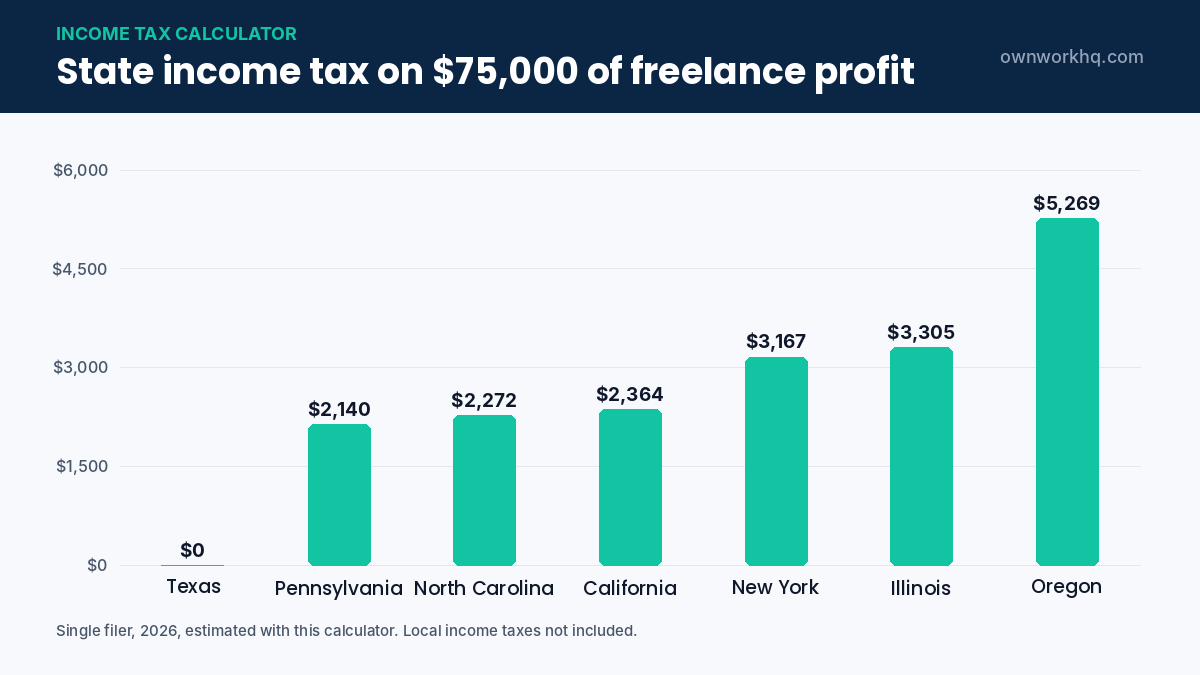
No income tax on earned income: Alaska, Florida, Nevada, New Hampshire, South Dakota, Tennessee, Texas, Washington and Wyoming. Washington taxes only certain capital gains.
Here is the top 2026 rate in every state, from the Tax Foundation table of rates in effect on January 1, 2026:
| State | Top rate | Type | Top rate applies to |
|---|---|---|---|
| Alabama | 5% | Graduated | Over $3,000 |
| Alaska | None | — | — |
| Arizona | 2.5% | Flat | All taxable income |
| Arkansas | 3.9% | Graduated | Over $4,600 |
| California | 13.3% | Graduated | Over $1,000,000 |
| Colorado | 4.4% | Flat | All taxable income |
| Connecticut | 6.99% | Graduated | Over $500,000 |
| Delaware | 6.6% | Graduated | Over $60,000 |
| District of Columbia | 10.75% | Graduated | Over $1,000,000 |
| Florida | None | — | — |
| Georgia | 5.19% | Flat | All taxable income |
| Hawaii | 11% | Graduated | Over $325,000 |
| Idaho | 5.3% | Flat | Over $4,811 |
| Illinois | 4.95% | Flat | All taxable income |
| Indiana | 2.95% | Flat | All taxable income |
| Iowa | 3.8% | Flat | All taxable income |
| Kansas | 5.58% | Graduated | Over $23,000 |
| Kentucky | 3.5% | Flat | All taxable income |
| Louisiana | 3% | Flat | All taxable income |
| Maine | 7.15% | Graduated | Over $64,849 |
| Maryland | 6.5% | Graduated | Over $1,000,000 |
| Massachusetts | 9% | Graduated | Over $1,083,150 |
| Michigan | 4.25% | Flat | All taxable income |
| Minnesota | 9.85% | Graduated | Over $203,150 |
| Mississippi | 4% | Flat | Over $10,000 |
| Missouri | 4.7% | Graduated | Over $9,436 |
| Montana | 5.65% | Graduated | Over $47,500 |
| Nebraska | 4.55% | Graduated | Over $24,760 |
| Nevada | None | — | — |
| New Hampshire | None | — | — |
| New Jersey | 10.75% | Graduated | Over $1,000,000 |
| New Mexico | 5.9% | Graduated | Over $210,000 |
| New York | 10.9% | Graduated | Over $25,000,000 |
| North Carolina | 3.99% | Flat | All taxable income |
| North Dakota | 2.5% | Graduated | Over $244,825 |
| Ohio | 2.75% | Flat | Over $26,050 |
| Oklahoma | 4.5% | Graduated | Over $7,200 |
| Oregon | 9.9% | Graduated | Over $125,000 |
| Pennsylvania | 3.07% | Flat | All taxable income |
| Rhode Island | 5.99% | Graduated | Over $186,450 |
| South Carolina | 6% | Graduated | Over $18,230 |
| South Dakota | None | — | — |
| Tennessee | None | — | — |
| Texas | None | — | — |
| Utah | 4.5% | Flat | All taxable income |
| Vermont | 8.75% | Graduated | Over $249,700 |
| Virginia | 5.75% | Graduated | Over $17,000 |
| Washington | None | — | — |
| West Virginia | 4.82% | Graduated | Over $60,000 |
| Wisconsin | 7.65% | Graduated | Over $332,720 |
| Wyoming | None | — | — |
Brackets shown are for single filers; many states use wider brackets for married couples. Some cities and counties add their own income tax, for example in Maryland, New York City, Pennsylvania and Ohio, which this calculator doesn’t include.
How freelancers can lower their tax bill
- Track every business expense. Lower profit reduces both income tax and self-employment tax.
- Contribute to a retirement plan. A Solo 401(k) or SEP IRA can cut income tax significantly; compare them in Solo 401(k) vs SEP IRA.
- Deduct health insurance premiums if you’re self-employed and not eligible for an employer plan; see health insurance for the self-employed.
- Use an HSA with a qualifying high-deductible health plan.
- Consider an S corp election at higher profits to reduce self-employment tax; run the numbers in S corp vs LLC.
Paying your taxes as a freelancer
No employer withholds tax from freelance income, so the IRS expects quarterly estimated payments. The 2026 due dates are April 15, June 15 and September 15, 2026, and January 15, 2027. The calculator shows an approximate quarterly amount whenever you enter freelance profit. Our guide to quarterly estimated taxes explains the safe harbor rules that help you avoid penalties, and you can pay online through IRS Direct Pay.
Most states with an income tax also require estimated payments. Check your state revenue department’s website for its schedule, because some states, such as California, use different percentages for each quarter.
Will you get a refund or owe tax?
This income tax calculator estimates your total tax for the year, not your refund. Whether you get money back depends on how much you already paid during the year:
- Employees have tax withheld from each paycheck based on their Form W-4. If withholding is higher than the total federal tax shown above, the difference is usually refunded.
- Freelancers pay through quarterly estimated taxes. If your four payments add up to more than your total tax, you get a refund; if they add up to less, you owe the balance by the April filing deadline.
- Refundable credits, such as part of the child tax credit, can produce a refund even when you owe little or no income tax.
To avoid a surprise, compare the total from the calculator with what you’ve paid so far each quarter, and adjust your next payment or your W-4. The IRS Tax Withholding Estimator can help employees fine-tune their paycheck withholding.
What this calculator doesn’t include
- Local and city income taxes.
- Credits other than the child tax credit, such as the earned income tax credit or education credits.
- Capital gains, dividends, rental income and other investment income.
- State-specific rules beyond the main brackets, standard deductions, exemptions and credits.
- The alternative minimum tax and special rules for very high incomes.
For a precise number, use tax software or a tax professional, especially if your situation includes any of the items above.
Frequently asked questions
How much tax will I pay on $75,000 as a freelancer?
As a single filer with $75,000 of net profit in 2026, you’d pay about $10,600 in self-employment tax and roughly $4,900 in federal income tax, about $15,500 in total before state tax. Enter your own numbers in the calculator above to include your state.
Is this income tax calculator accurate for 2026?
It uses 2026 federal brackets, standard deductions, the Social Security wage base and 2026 state rates. It’s an estimate: it simplifies some state rules and leaves out local taxes and less common credits.
Do I pay income tax and self-employment tax?
Yes. Freelancers pay federal income tax on taxable income and self-employment tax for Social Security and Medicare on net earnings. Most states also tax the same income.
What’s the difference between AGI and taxable income?
AGI is your total income minus adjustments such as half of self-employment tax and retirement contributions. Taxable income is AGI minus the standard or itemized deduction and the QBI deduction.
Which states have no income tax in 2026?
Alaska, Florida, Nevada, New Hampshire, South Dakota, Tennessee, Texas, Washington and Wyoming don’t tax wages or self-employment income. Washington taxes certain capital gains, and you still owe federal income tax and self-employment tax or FICA in every state.
How much should a freelancer set aside for taxes?
Many freelancers set aside 25% to 35% of each payment, depending on income and state. Use the effective rate from this tax calculator as your starting point, and add a little extra if your income is growing during the year.
Why is my marginal rate different from my tax bracket?
Your bracket is the federal rate on your top slice of taxable income. The marginal rate measures the total change in tax from earning more, which includes deductions and credits that change with income and, for freelancers, self-employment and state tax.
