Disability Insurance for Self-Employed Workers (2026): Cost, Coverage & How to Buy
In short: How disability insurance for self-employed workers works in 2026: typical costs, the policy features that matter, how SSDI fits in, and how freelancers prove income to qualify.


On this page
- Why freelancers need disability insurance
- How disability insurance for self-employed workers works
- Own-occupation vs any-occupation
- Riders worth considering
- How much does disability insurance cost?
- How freelancers prove income to qualify
- SSDI vs private disability insurance
- Short-term vs long-term disability insurance
- Business overhead expense insurance
- Taxes on premiums and benefits
- How to buy disability insurance as a freelancer
- Example: what a policy could pay
- Considerations by profession
- Alternatives and complements
- When to buy
- If your income changes
- Questions to ask before you sign
- What filing a claim looks like
- Common mistakes to avoid
- Frequently asked questions
- Sources
For most freelancers, the biggest asset isn’t a laptop or a client list. It’s the ability to work. If an illness or injury kept you from working for six months, your income would stop, but rent, health insurance and business expenses wouldn’t. Disability insurance for self-employed workers replaces part of your income when you can’t work, and unlike employees, you won’t get it through a job.
Key takeaways
- Social Security estimates a 20-year-old has a 1-in-4 chance of becoming disabled before full retirement age.
- Individual long-term disability policies commonly cost about 1% to 3% of covered income per year.
- Benefits usually replace 50% to 70% of income; insurers set limits based on what you can prove on tax returns.
- SSDI uses a strict definition, has a five-month wait and doesn’t cover partial disabilities.
- Premiums for personal disability insurance generally aren’t deductible, but benefits are then usually tax-free.
Why freelancers need disability insurance
Employees often get short- and long-term disability coverage as a workplace benefit. When you work for yourself, there’s no employer plan, no paid sick leave and no workers’ compensation for most solo businesses. If you can’t work, you have three options: savings, family support, or insurance.
The risk is higher than many people think. According to the Social Security Administration, studies show a 20-year-old worker has a 1-in-4 chance of developing a disability before reaching full retirement age. Most disabilities come from illnesses such as back problems, cancer and heart disease, not accidents, so being careful at work doesn’t remove the risk.
How disability insurance for self-employed workers works
You pay a monthly or annual premium. If you become disabled as defined by the policy, you wait through an elimination period, then the insurer pays a monthly benefit until you recover or the benefit period ends. Four choices drive both price and protection:
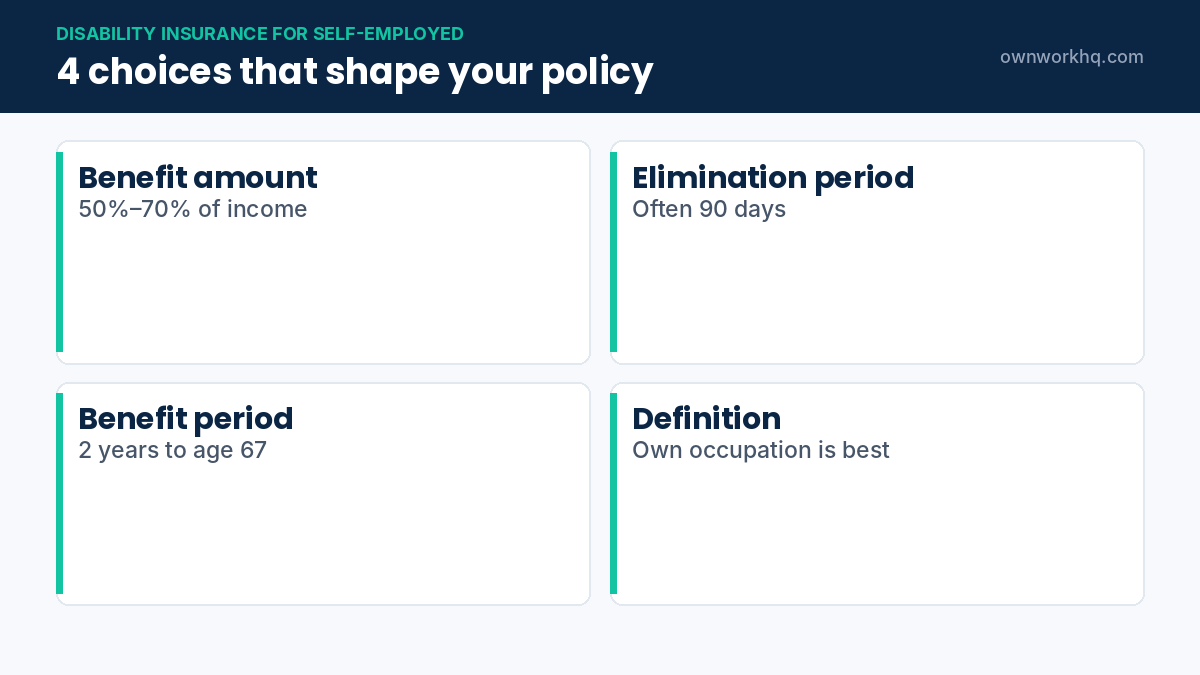
| Feature | Typical options | What to choose as a freelancer |
|---|---|---|
| Monthly benefit | Up to about 50%–70% of income | As much as the insurer allows and you can afford |
| Elimination period | 30, 60, 90, 180 or 365 days | 90 days is common; match it to your emergency fund |
| Benefit period | 2 years, 5 years, to age 65 or 67 | To retirement age for the strongest protection |
| Definition of disability | Own occupation, modified own occupation, any occupation | Own occupation if available for your profession |
Own-occupation vs any-occupation
This is the most important detail in the policy. It decides when you count as disabled:
- True own-occupation: you’re disabled if you can’t perform the main duties of your own occupation, even if you could work in another job. A graphic designer with a hand injury could collect benefits while teaching.
- Modified own-occupation: benefits are paid if you can’t do your own occupation and you’re not working in another one.
- Any-occupation: you’re disabled only if you can’t work in any job suited to your education and experience. This is cheaper but much harder to claim.
Some insurers don’t offer own-occupation coverage for every profession. Office-based freelancers, such as writers, designers, developers and consultants, usually have more options than people in physical trades.
Riders worth considering
- Residual or partial disability: pays a partial benefit if you can still work but earn less because of your condition. For freelancers, this is often the most valuable rider.
- Future increase option: lets you buy more coverage as your income grows, without new medical underwriting.
- Cost-of-living adjustment: increases benefits during a long claim to keep up with inflation.
- Non-cancelable and guaranteed renewable: the insurer can’t cancel the policy or raise your premium as long as you pay.
- Catastrophic disability: adds benefits if you can’t perform basic daily activities.
How much does disability insurance cost?
Individual long-term disability insurance commonly costs about 1% to 3% of the income it protects, though your quote can fall outside that range. For a freelancer earning $80,000, that’s roughly $800 to $2,400 a year. Price depends on:
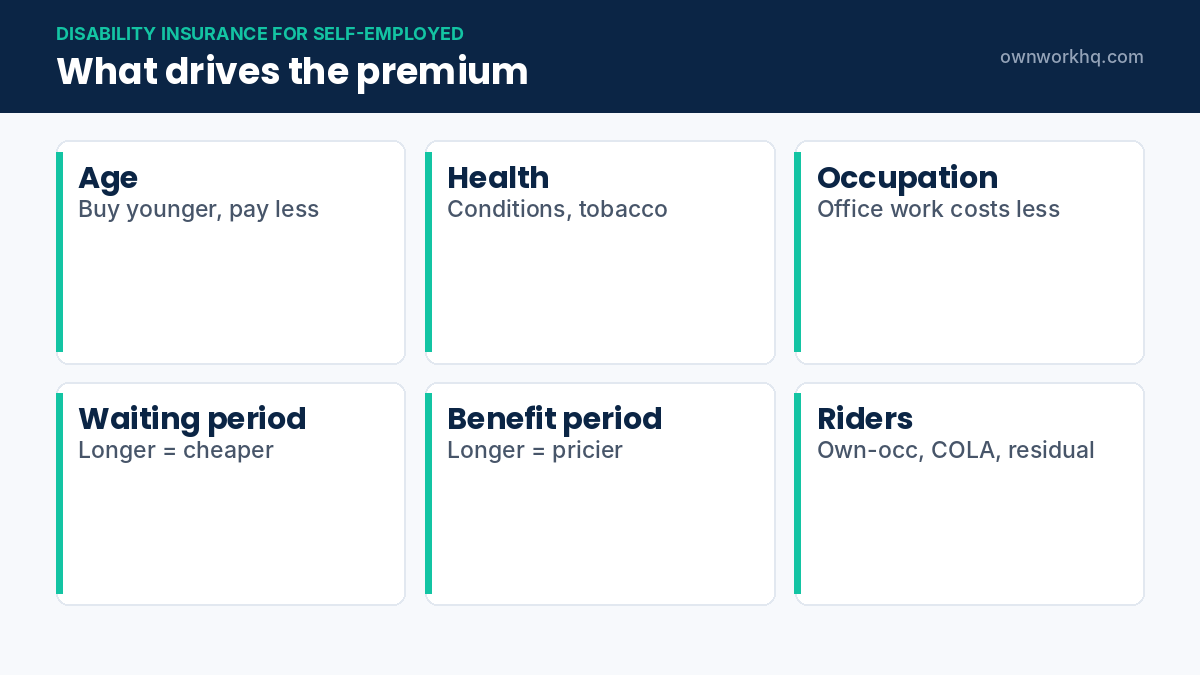
| Factor | Lower premium | Higher premium |
|---|---|---|
| Age | Younger when you buy | Older |
| Health and smoking | Good health, non-smoker | Health conditions, tobacco use |
| Occupation | Office-based work | Physical or higher-risk work |
| Elimination period | Longer (180 days) | Shorter (30 days) |
| Benefit period | 2 or 5 years | To age 65 or 67 |
| Riders | Few riders | Own-occupation, COLA, residual |
Buying younger locks in a lower premium on a non-cancelable policy. A longer elimination period is one of the easiest ways to cut cost if you have a solid emergency fund.
How freelancers prove income to qualify
Insurers base your maximum benefit on your earnings, so self-employed applicants usually need to provide tax returns, often for the last two years, including Schedule C. They generally look at net profit after business expenses, not gross revenue. That creates a trade-off: aggressive deductions lower your taxes but also lower the benefit you can buy.
- Keep clean books and file on time; insurers rely on your returns.
- If your income is growing fast, ask how the insurer averages recent years.
- New freelancers with less than a year or two of history may qualify for lower benefits or need to wait.
- Some insurers consider income from a prior W-2 job if you recently switched to freelancing.
SSDI vs private disability insurance
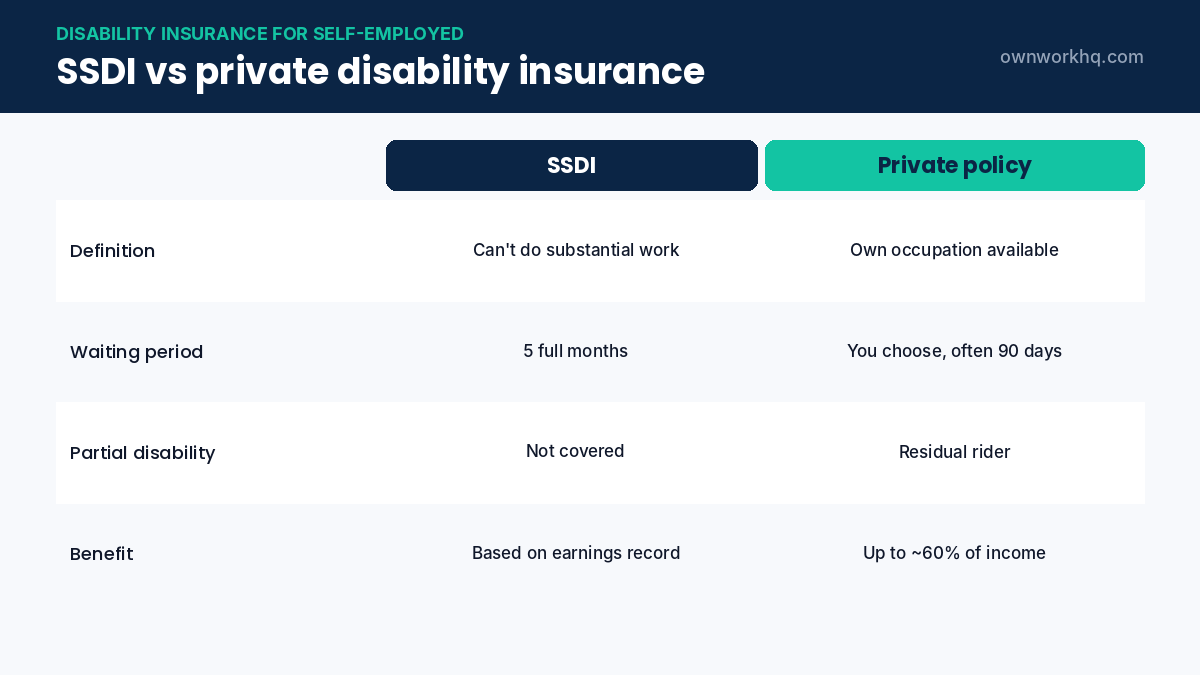
As a self-employed worker, you pay into Social Security through self-employment tax, so you may qualify for Social Security Disability Insurance (SSDI). It’s an important safety net, but it works very differently from a private policy:
| SSDI | Private disability insurance | |
|---|---|---|
| Definition of disability | Can’t do substantial work; expected to last at least a year or result in death | Defined in the policy; own-occupation available |
| Waiting period | Five full months | Chosen by you, often 90 days |
| Partial disability | Not covered | Covered with a residual rider |
| Benefit amount | Based on lifetime earnings record | Based on current income, up to the policy limit |
| Work while receiving benefits | Earnings above $1,690 a month (2026, non-blind) generally count as substantial work | Depends on the policy |
Many SSDI applications are initially denied, and the process can take months. A private policy fills the gap, especially for short and partial disabilities.
Short-term vs long-term disability insurance
Short-term disability covers a few months, usually after a waiting period of up to two weeks. It’s commonly an employer benefit and can be hard to buy individually. For freelancers, the better approach is usually a long-term policy combined with an emergency fund that covers the elimination period. Some professional associations offer group disability plans to members, which can be cheaper but are often less flexible than an individual policy.
Business overhead expense insurance
If you have fixed business costs, such as studio rent, software, staff or equipment loans, business overhead expense (BOE) insurance reimburses those costs while you’re disabled. It’s separate from personal disability insurance, which replaces your own income. BOE policies usually have shorter benefit periods, such as 12 to 24 months.
Taxes on premiums and benefits
- Personal disability insurance: premiums you pay with after-tax money generally aren’t deductible, and benefits are then generally tax-free. See IRS Publication 525.
- Business overhead expense insurance: premiums are generally deductible as a business expense, and benefits are taxable income.
- S corp owners: if the company pays the premium, the tax treatment depends on whether it’s included in your wages. Ask your tax preparer.
Tax-free benefits are one reason a 60% income replacement can cover more of your take-home pay than it sounds.
How to buy disability insurance as a freelancer
- Calculate your need: monthly expenses you’d have to cover, including health insurance and taxes.
- Choose your elimination period based on how many months your savings can cover.
- Get quotes from several insurers, ideally through an independent broker who specializes in disability insurance.
- Compare definitions and riders, not just price.
- Apply with tax returns and medical history ready; expect a medical exam or records review.
- Read the final policy carefully, including exclusions and how it defines your occupation.
Example: what a policy could pay
Consider a freelance designer with $90,000 of net profit who buys a policy with a $4,500 monthly benefit, a 90-day elimination period and benefits to age 67. The figures below are illustrative, not a quote:
| Scenario | What happens |
|---|---|
| Broken wrist, out of work 6 weeks | No benefit: the disability ends before the 90-day elimination period |
| Back surgery, out of work 7 months | About 4 months of benefits after the 90-day wait: roughly $18,000, generally tax-free |
| Chronic illness, can work half-time | With a residual rider, a partial benefit based on the income lost |
| Permanent disability at 45 | $4,500 a month until 67, or more with a cost-of-living rider |
The first scenario shows why an emergency fund still matters. The last shows why a long benefit period is the core of the protection: it’s the long, expensive disabilities that can derail a freelance career and retirement savings.
Considerations by profession
- Writers, editors and consultants: usually in the best occupation classes. A hand, vision or cognitive condition can still end the ability to work, so own-occupation coverage is valuable.
- Designers and developers: repetitive strain injuries are a real risk. Ask how the policy treats conditions such as carpal tunnel syndrome and whether a residual rider applies.
- Photographers and videographers: physical work, travel and carrying equipment can mean higher premiums or fewer options. Compare several insurers.
- Virtual assistants and remote support: generally office-class work, but verify how the insurer classifies your duties.
Describe your duties accurately on the application. Your occupation class affects the premium and, later, how a claim is assessed.
Alternatives and complements
- Emergency fund: three to six months of expenses covers short disabilities and the elimination period.
- Group coverage through associations: some professional associations offer member plans, usually cheaper but with less control over terms and the risk of losing coverage if you leave the group.
- Critical illness insurance: pays a lump sum for specific diagnoses; useful as a supplement, not a replacement for income protection.
- Accident-only policies: inexpensive but don’t cover illnesses, which cause most disabilities.
- A spouse’s income: helps, but consider what would happen if both incomes were needed.
When to buy
The best time to buy disability insurance for self-employed work is when you’re healthy and have at least a year or two of steady income on your tax returns. Premiums are based on your age when you buy, and new health conditions can lead to exclusions or higher prices. If you’re about to leave a job to freelance, ask whether a group policy can be converted, and consider applying for an individual policy while you still have W-2 income to show.
If your income changes
Freelance income moves around. If your income rises, a future increase option lets you add coverage without proving your health again. If your income falls, the policy keeps its benefit amount, but at claim time some insurers compare the benefit with your recent earnings. Review your coverage every year or two, especially after a big change in rates or clients.
Questions to ask before you sign
- How exactly does the policy define my occupation, and is it true own-occupation?
- Is the policy non-cancelable and guaranteed renewable to age 65 or 67?
- How does the residual rider calculate partial benefits for variable freelance income?
- Which income does the insurer use: last year, an average of two years, or the best of several years?
- Are mental health and substance use claims limited to a shorter benefit period?
- Are there exclusions for any pre-existing conditions in my application?
An independent broker can compare several insurers’ answers side by side. Ask for the full policy wording, not just a summary, before you commit.
What filing a claim looks like
If you become disabled, notify the insurer as soon as possible, even before the elimination period ends. You’ll usually need statements from your doctors, a description of your duties, and financial records showing how your income changed, such as profit and loss statements and tax returns. For freelancers, clear books make claims faster, because the insurer needs to compare your earnings before and after the disability. Keep copies of everything you send and note every phone call.
Common mistakes to avoid
- Buying any-occupation coverage to save money without understanding the trade-off.
- Skipping the residual rider, which matters when you can still work but earn less.
- Waiting until a health problem appears, which can lead to exclusions or a declined application.
- Under-reporting income on tax returns, which limits the benefit you can buy.
- Relying only on SSDI, with its strict definition and long wait.
Disability insurance works best alongside the rest of your safety net: an emergency fund, health insurance and the right business coverage. Our guide to business insurance costs covers the policies that protect your business rather than your income.
Frequently asked questions
Can self-employed people get disability insurance?
Yes. Freelancers and independent contractors can buy individual disability insurance directly from insurers or through brokers. You’ll usually need tax returns to show your income.
How much disability insurance should a freelancer buy?
Most insurers allow a monthly benefit of about 50% to 70% of your earnings. Aim to cover your essential monthly expenses, including health insurance premiums and savings for taxes.
Is disability insurance tax deductible for the self-employed?
Premiums for a personal disability policy generally aren’t deductible, but the benefits are then generally tax-free. Business overhead expense insurance premiums are usually deductible.
What’s a good elimination period?
Ninety days is a common balance between cost and protection. Choose a longer period if you have a large emergency fund, or a shorter one if your savings would run out quickly.
Can I get disability insurance as a new freelancer?
Often yes, but the benefit may be limited until you have a year or two of self-employment income on your tax returns. Some insurers will consider your previous salary if you recently left a job, so apply soon after the switch.
Does disability insurance cover pregnancy?
Many policies cover complications of pregnancy, but normal pregnancy and childbirth are often excluded or limited, especially if you buy the policy while already pregnant. Check the policy wording before you apply.
Does SSDI cover freelancers?
Yes, if you’ve paid enough Social Security tax through self-employment tax and meet SSA’s strict definition of disability. Benefits start after a five-month waiting period and don’t cover partial disabilities.
Sources
- SSA: Disability Benefits (publication 05-10029)
- SSA: Substantial gainful activity amounts
- IRS Publication 525: Taxable and Nontaxable Income
Disclaimer: This article is for informational purposes only and is not insurance, legal or financial advice. OwnWork HQ is not a licensed insurance agent. Coverage, prices and eligibility vary by insurer and state and can change at any time, so always confirm details with the insurer or a licensed broker before you buy.
About OwnWork HQ Editorial
We write plain-English guides for US freelancers and check every rate, limit and deadline against IRS and state agency publications. We are not CPAs or financial advisors; for advice on your situation, talk to a qualified professional.