Open Enrollment for Self-Employed (2027): Dates, Subsidies & How to Choose
In short: Open enrollment for self-employed workers runs November 1, 2026 to January 15, 2027. Dates, subsidy rules after the enhanced credits expired, and how to choose a plan.


On this page
- Open enrollment for self-employed: 2027 dates
- What changed for 2027
- How premium tax credits work for freelancers
- Example: the 400% cliff in action
- How to estimate your income as a freelancer
- Ways freelancers can lower MAGI
- Choosing a plan: metal levels explained
- Alternatives to a Marketplace plan
- Step-by-step: how to enroll
- Cost-sharing reductions: extra savings on silver plans
- Advance credit or claim it at tax time?
- Married freelancers and household income
- Leaving a job to freelance during the year
- Questions to ask before you pick a plan
- If your income ends up too low or too high
- Deducting your premiums
- Common mistakes to avoid
- Frequently asked questions
- Sources
If you work for yourself, nobody signs you up for health insurance. Open enrollment for self-employed workers is the yearly window to buy or change a Marketplace plan, and for 2027 coverage it runs from November 1, 2026 to January 15, 2027 on HealthCare.gov. This year it matters more than usual: the enhanced premium tax credits expired at the end of 2025, premiums are rising again, and the rules for estimating freelance income have real consequences at tax time.
Key takeaways
- HealthCare.gov open enrollment for 2027 coverage: November 1, 2026 to January 15, 2027. Enroll by December 15 for a January 1 start.
- Several state exchanges stay open longer, including California, New York, New Jersey and DC until January 31.
- The enhanced subsidies expired, so the 400% FPL cliff is back: $63,840 for a single person and $132,000 for a family of four.
- Subsidies are based on your projected MAGI, which for freelancers starts from net profit, not gross income.
- Repayment caps on excess advance credits ended starting with 2026, so underestimating income can be expensive.
- Bronze and catastrophic plans now count as HSA-eligible; the 2027 HSA limit is $4,500 self-only and $9,000 family.
Open enrollment for self-employed: 2027 dates
| Date | What happens |
|---|---|
| November 1, 2026 | Open enrollment starts on HealthCare.gov |
| December 15, 2026 | Last day to enroll or change plans for coverage starting January 1 |
| December 16 – January 15 | Enroll or change plans for coverage starting February 1 |
| January 15, 2027 | Open enrollment ends in HealthCare.gov states |
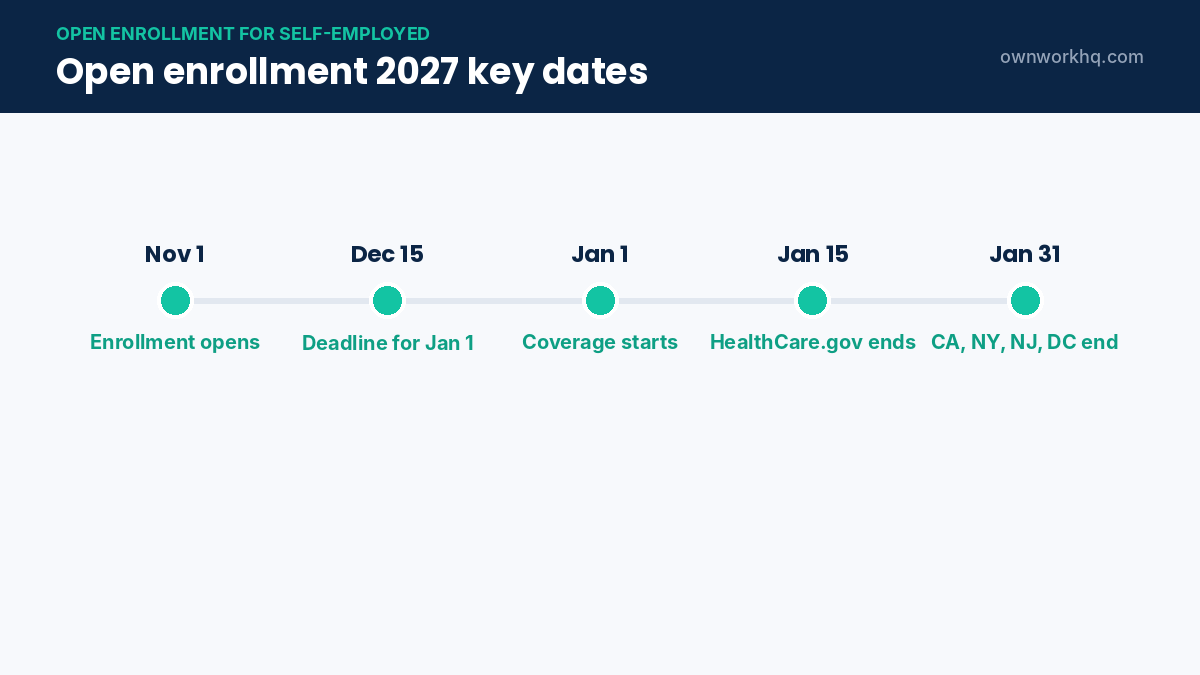
States that run their own exchange set their own deadlines. For 2027 coverage, several extend the window: California, New York, New Jersey and the District of Columbia stay open until January 31, while a few close earlier, such as Idaho on December 15. Check your state’s exchange website, which you can find from HealthCare.gov.
Outside open enrollment you can only enroll after a qualifying life event, such as losing other coverage, moving, marrying or having a baby. Leaving a job to freelance counts as losing coverage, which gives you a 60-day special enrollment period.
What changed for 2027
- Enhanced subsidies are gone. The extra premium tax credits available from 2021 through 2025 expired. As of September 2026, Congress had not passed an extension, so the original rules apply for 2027.
- The 400% income cliff is back. Households above 400% of the federal poverty level don’t qualify for any premium tax credit.
- Higher out-of-pocket limits. The maximum out-of-pocket for Marketplace plans rises to $12,000 for an individual and $24,000 for a family, from $10,600 and $21,200 in 2026.
- No cap on repaying excess credits. Starting with tax year 2026, the limits on paying back excess advance credits were removed, so the full difference is due if your income comes in higher than estimated.
- HSA-eligible bronze plans. Bronze and catastrophic Marketplace plans are now treated as high-deductible plans for HSA purposes.
- Premiums are rising. Insurers filed double-digit average increases for 2027 in many states, and some carriers left the Marketplace, so review your plan rather than letting it renew automatically.
How premium tax credits work for freelancers
A premium tax credit lowers your monthly Marketplace premium. It’s based on the cost of the second-lowest-cost silver plan in your area (the benchmark) and the share of income you’re expected to pay. For 2027, the IRS set that expected contribution between 2.15% and 10.22% of income, depending on where you fall relative to the federal poverty level (FPL):
| Household income (% of FPL) | Expected contribution (2027) |
|---|---|
| Under 133% | 2.15% |
| 133% – 150% | 3.23% – 4.30% |
| 150% – 200% | 4.30% – 6.78% |
| 200% – 250% | 6.78% – 8.66% |
| 250% – 300% | 8.66% – 10.22% |
| 300% – 400% | 10.22% |
| Above 400% | No credit |
For 2027 coverage, the 2026 poverty guidelines apply. These are the key income lines for the 48 contiguous states:
| Household size | 100% FPL | 400% FPL (subsidy limit) |
|---|---|---|
| 1 | $15,960 | $63,840 |
| 2 | $21,640 | $86,560 |
| 3 | $27,320 | $109,280 |
| 4 | $33,000 | $132,000 |
Alaska and Hawaii use higher guidelines. If your household income is between 100% and 400% of FPL and you don’t have access to affordable coverage through a job, you can generally qualify for a premium tax credit.
Example: the 400% cliff in action
Imagine a single freelancer in a county where the benchmark silver plan costs $650 a month ($7,800 a year). These figures are illustrative; your county’s premium will differ:
| Projected MAGI | % of FPL | Expected contribution | Annual premium tax credit |
|---|---|---|---|
| $30,000 | 188% | About 6.2% ($1,855) | About $5,945 |
| $40,000 | 251% | About 8.7% ($3,472) | About $4,330 |
| $55,000 | 345% | 10.22% ($5,621) | About $2,180 |
| $63,000 | 395% | 10.22% ($6,439) | About $1,360 |
| $64,500 | 404% | No credit | $0 |
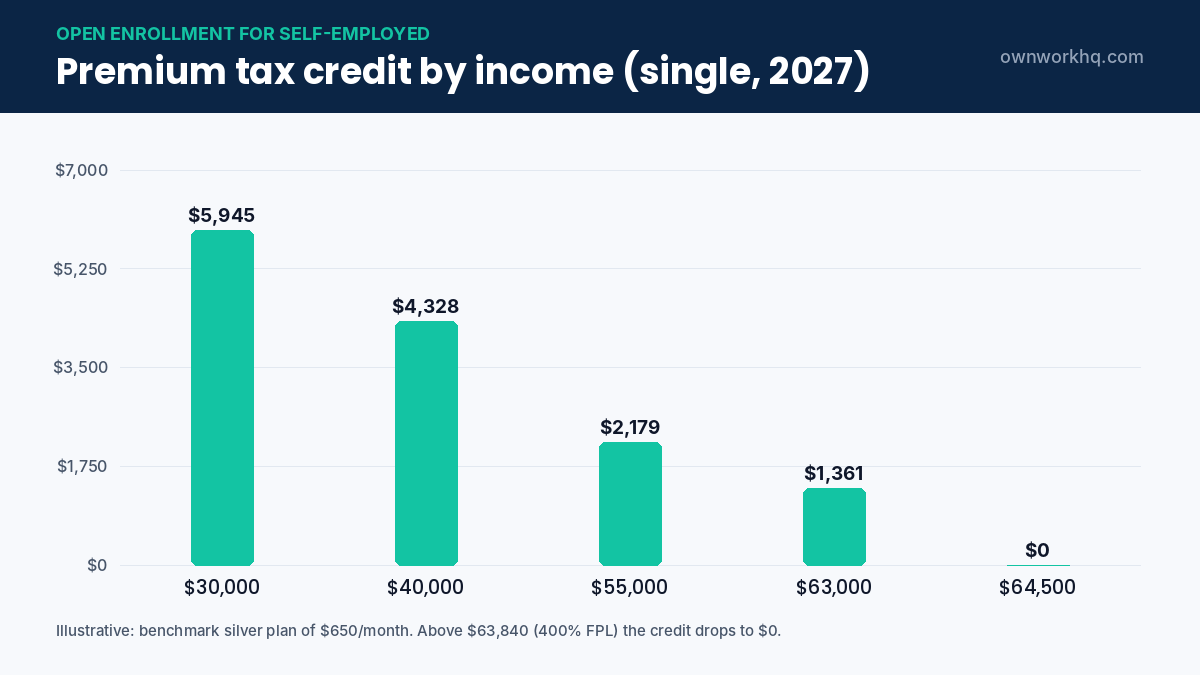
Moving from $63,000 to $64,500 of income costs this freelancer about $1,360 in lost subsidy. That’s why the way you estimate and manage income matters so much for open enrollment for self-employed workers in 2027.
How to estimate your income as a freelancer
The Marketplace asks for your projected modified adjusted gross income (MAGI) for the coverage year. For most freelancers, MAGI is close to adjusted gross income, which starts from your net profit, not your gross revenue:
- Start with expected gross revenue for 2027.
- Subtract business expenses to get net profit (Schedule C).
- Subtract the deduction for half of self-employment tax.
- Subtract pre-tax retirement contributions to a SEP IRA or Solo 401(k), and HSA contributions.
- Add any other household income, such as a spouse’s wages.
Our income tax calculator shows your AGI along the way, which is a useful starting point. Freelance income is uneven, so use a realistic middle estimate and update your application during the year if your income changes significantly. Since there’s no longer a cap on repaying excess credits, reporting changes promptly helps you avoid a large bill when you file Form 8962.
Ways freelancers can lower MAGI
- Retirement contributions. Contributions to a SEP IRA or the employee and employer parts of a Solo 401(k) reduce AGI; see Solo 401(k) vs SEP IRA.
- HSA contributions. If you choose an HSA-eligible plan, you can contribute up to $4,500 self-only or $9,000 family for 2027.
- Business expenses. Every legitimate expense reduces net profit and MAGI.
- Self-employed health insurance deduction. The premiums you pay can be deducted, though the calculation interacts with the premium tax credit; tax software handles this.
These moves can keep you below the 400% line in a good year, but they shouldn’t drive bad business decisions. Contribute what you can afford to save anyway.
Choosing a plan: metal levels explained
| Metal level | Premium | Out-of-pocket costs | Good for |
|---|---|---|---|
| Bronze | Lowest | Highest; now HSA-eligible | Healthy freelancers who want low premiums and an HSA |
| Silver | Moderate | Moderate; extra savings if you qualify for cost-sharing reductions | Incomes up to 250% of FPL |
| Gold | Higher | Lower | Frequent doctor visits or prescriptions |
| Catastrophic | Very low | Very high | Under 30 or with a hardship exemption |
Compare the total yearly cost, not just the premium: add 12 months of premiums to the deductible you’d realistically hit. Check that your doctors and prescriptions are covered, because many Marketplace plans have narrow networks.
Alternatives to a Marketplace plan
- A spouse’s employer plan, often the cheapest option if available.
- COBRA, which keeps your old employer plan for up to 18 months, usually at full cost.
- Medicaid, if your income is low enough in a state that expanded the program.
- Short-term plans, which are cheaper but don’t have to cover pre-existing conditions or essential benefits.
- Health care sharing ministries, which are not insurance and don’t guarantee payment.
For a detailed comparison, read our guide to health insurance for self-employed freelancers.
Step-by-step: how to enroll
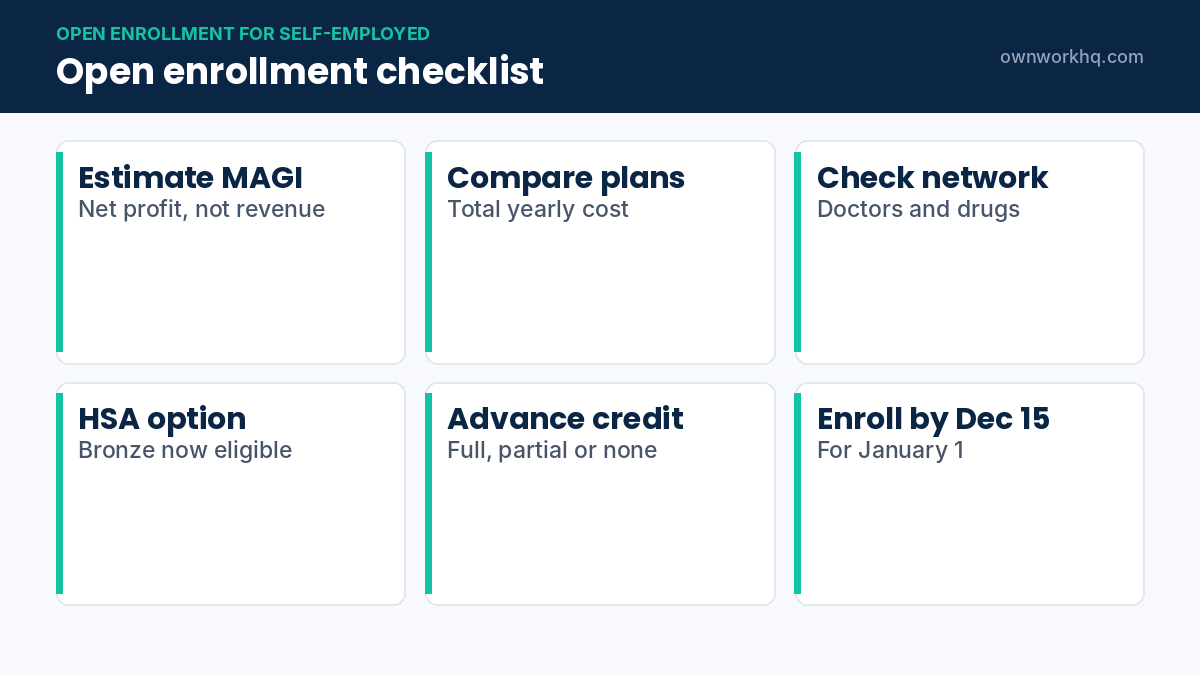
- Estimate your 2027 household MAGI and household size.
- Gather documents: last year’s tax return, income records and any current coverage details.
- Log in to HealthCare.gov or your state exchange and update or start your application.
- Compare plans by total yearly cost, network and drug coverage.
- Choose whether to take the premium tax credit in advance or claim it when you file.
- Enroll by December 15 for January coverage and pay your first premium.
If you’re already enrolled, don’t rely on automatic re-enrollment. Your plan’s premium, network and subsidy can change, and a better option may be available.
Cost-sharing reductions: extra savings on silver plans
If your income is between 100% and 250% of FPL, you may also qualify for cost-sharing reductions. They lower your deductible, copays and out-of-pocket maximum, but only on silver plans. For a single freelancer, that means MAGI up to about $39,900 for 2027 coverage. In that range, a silver plan often costs about the same premium as before but has much lower out-of-pocket costs than a bronze plan, so compare carefully before choosing bronze for the low premium.
Advance credit or claim it at tax time?
You can take the premium tax credit in advance, which lowers your monthly premium, or pay full price and claim the whole credit on your tax return. Freelancers with very unpredictable income sometimes take only part of the credit in advance to reduce the risk of repaying money in April. Either way, you’ll reconcile the credit on Form 8962 when you file.
| Option | Pros | Cons |
|---|---|---|
| Full advance credit | Lowest monthly premium | Repayment risk if income rises |
| Partial advance credit | Lower risk, still some help each month | Higher monthly premium |
| No advance credit | No repayment risk; full credit as a refund | You pay full premiums during the year |
Married freelancers and household income
The Marketplace looks at household income, not just yours. If you’re married, you generally must file jointly to claim the premium tax credit, and your spouse’s wages and any other household income count toward MAGI. If your spouse has an employer plan that’s considered affordable for them, they usually can’t get a subsidy on the Marketplace, though family members may qualify in some situations. Enter everyone in the household on the application so the subsidy is calculated correctly.
Leaving a job to freelance during the year
If you quit a job with health insurance to start freelancing, you don’t have to wait for open enrollment. Losing employer coverage gives you a special enrollment period of 60 days. Compare a Marketplace plan with COBRA: COBRA keeps the same doctors and deductible progress, but you pay the full premium, while a Marketplace plan may be cheaper with a premium tax credit based on your lower expected income for the year.
Questions to ask before you pick a plan
- Are my current doctors, therapists and nearby hospitals in the network?
- Are my prescriptions on the plan’s drug list, and at what tier?
- What would I pay in a bad year: premiums plus the full out-of-pocket maximum?
- Is the plan HSA-eligible, and do I want to save in an HSA?
- Does the plan cover care when I travel for client work?
- Do I qualify for cost-sharing reductions that make silver a better deal?
Writing down the answers for two or three finalist plans makes the decision much easier than comparing dozens of options on the screen.
If your income ends up too low or too high
Freelance income rarely matches the estimate exactly. If your income ends up higher than expected, you’ll repay some or all of the advance credit when you file, with no cap from 2026 onward. If it ends up lower, you may get an additional credit as a refund. If your final income falls below 100% of FPL, you generally won’t have to repay advance credits you received in good faith, but in states that expanded Medicaid, very low income may make you eligible for Medicaid instead. Reporting changes to the Marketplace as soon as you know about them keeps these surprises small.
A simple habit helps: review your year-to-date profit each quarter when you pay quarterly estimated taxes, and update your Marketplace application if your projected income has moved by more than a few thousand dollars.
Deducting your premiums
Self-employed people who aren’t eligible for an employer plan can usually deduct health insurance premiums for themselves, their spouse and dependents as an adjustment to income on Schedule 1. The deduction can’t exceed your net profit from the business, and you can’t deduct the part of premiums paid by the premium tax credit. See the IRS premium tax credit basics for how the credit works.
Common mistakes to avoid
- Reporting gross revenue instead of net profit, which can cost you a subsidy you qualify for.
- Underestimating income to get a bigger subsidy, then owing the full difference at tax time.
- Letting a plan auto-renew without checking new premiums and networks.
- Missing December 15 and going a month without coverage.
- Forgetting to report income changes during the year.
Frequently asked questions
When is open enrollment for self-employed workers in 2027?
On HealthCare.gov it runs from November 1, 2026 to January 15, 2027. Enroll by December 15 for coverage starting January 1. Some state exchanges have later deadlines.
Can I get a subsidy if my freelance income is irregular?
Yes. Estimate your expected yearly MAGI as accurately as you can and update the Marketplace if it changes. The final credit is reconciled on your tax return using your actual income.
What income do freelancers report to the Marketplace?
Projected MAGI for the coverage year, which starts from net self-employment profit after business expenses, minus half of self-employment tax and pre-tax contributions, plus other household income.
Is there still a subsidy above 400% of the poverty level?
Not for 2027. The enhanced credits that removed the cliff expired at the end of 2025, and Congress had not extended them as of September 2026.
Can I open an HSA with a Marketplace bronze plan?
Yes, starting in 2026 bronze and catastrophic Marketplace plans are treated as HSA-eligible high-deductible plans. For 2027 you can contribute up to $4,500 for self-only coverage or $9,000 for family coverage, plus $1,000 if you’re 55 or older.
Do I need to update my application if I already have a plan?
It’s a good idea. Log in during open enrollment, update your projected income and household, and compare plans. Premiums, networks and subsidies change every year, and automatic re-enrollment may keep you in a plan that’s no longer the best value.
Can I enroll after January 15?
Only with a qualifying life event, such as losing other coverage, moving or a change in household. Otherwise you’ll need to wait for the next open enrollment.
Sources
- HealthCare.gov: Dates and deadlines for 2027 coverage
- IRS: The premium tax credit basics
- HHS ASPE: 2026 poverty guidelines
- Thomson Reuters: IRS Rev. Proc. 2026-26 (2027 percentages)
- IRS Rev. Proc. 2026-24 summary: 2027 HSA limits
Disclaimer: This article is for informational purposes only and is not insurance, legal or financial advice. OwnWork HQ is not a licensed insurance agent. Coverage, prices and eligibility vary by insurer and state and can change at any time, so always confirm details with the insurer or a licensed broker before you buy.
About OwnWork HQ Editorial
We write plain-English guides for US freelancers and check every rate, limit and deadline against IRS and state agency publications. We are not CPAs or financial advisors; for advice on your situation, talk to a qualified professional.