Self-Employment Tax Explained (2026): Rates, Examples & How to Pay Less
In short: How self-employment tax works in 2026: the 15.3% rate on 92.35% of profit, the Social Security wage base, worked examples at different incomes, Schedule SE and ways to lower it.


On this page
- What is self-employment tax?
- Self-employment tax rates for 2026
- How self-employment tax is calculated
- Self-employment tax examples for 2026
- If you also have a W-2 job
- The deduction for half of self-employment tax
- How to report and pay self-employment tax
- What you get in return: Social Security and Medicare credits
- Why only 92.35% of profit is taxed
- Married couples and partnerships
- State taxes on self-employment income
- A simple payment plan for the year
- Employee vs freelancer: who pays what
- Gig workers and online sellers
- What if your business has a loss?
- Records that support your numbers
- The full picture: $75,000 of freelance profit
- How it affects retirement contributions
- Legal ways to lower self-employment tax
- S corp example: when payroll beats SE tax
- Common self-employment tax mistakes
- How much to set aside
- Frequently asked questions
- Sources
When you work for yourself, you pay both halves of Social Security and Medicare. That’s self-employment tax: 15.3% of most of your net profit, on top of regular income tax. For many freelancers it’s a bigger bill than federal income tax itself, and it’s the main reason a first tax season as a freelancer can come as a shock.
Key takeaways
- The SE tax rate is 15.3%: 12.4% Social Security plus 2.9% Medicare.
- It applies to 92.35% of net profit, so the effective rate on profit is about 14.1%.
- Social Security stops at the 2026 wage base of $184,500; Medicare has no cap.
- An extra 0.9% Medicare tax applies above $200,000 (single) or $250,000 (married filing jointly).
- You can deduct half of SE tax from income, and you must pay it during the year through quarterly estimates.
What is self-employment tax?
Self-employment tax is how freelancers, independent contractors and sole proprietors pay into Social Security and Medicare. Employees split these taxes with their employer: each pays 7.65%. When you’re self-employed, you’re both the employee and the employer, so you pay the full 15.3% yourself. The IRS explains the basics on its self-employment tax page.
It’s separate from income tax. You can owe self-employment tax even if your income is low enough that you owe no federal income tax at all, because SE tax starts at just $400 of net earnings.
Self-employment tax rates for 2026
| Part | Rate | Applies to |
|---|---|---|
| Social Security | 12.4% | Net earnings up to $184,500 (combined with W-2 wages) |
| Medicare | 2.9% | All net earnings |
| Additional Medicare | 0.9% | Earnings above $200,000 single, $250,000 joint, $125,000 married filing separately |
The additional 0.9% Medicare tax is calculated on Form 8959, not as part of self-employment tax, but it’s paid the same way and applies to combined wages and self-employment earnings.
How self-employment tax is calculated
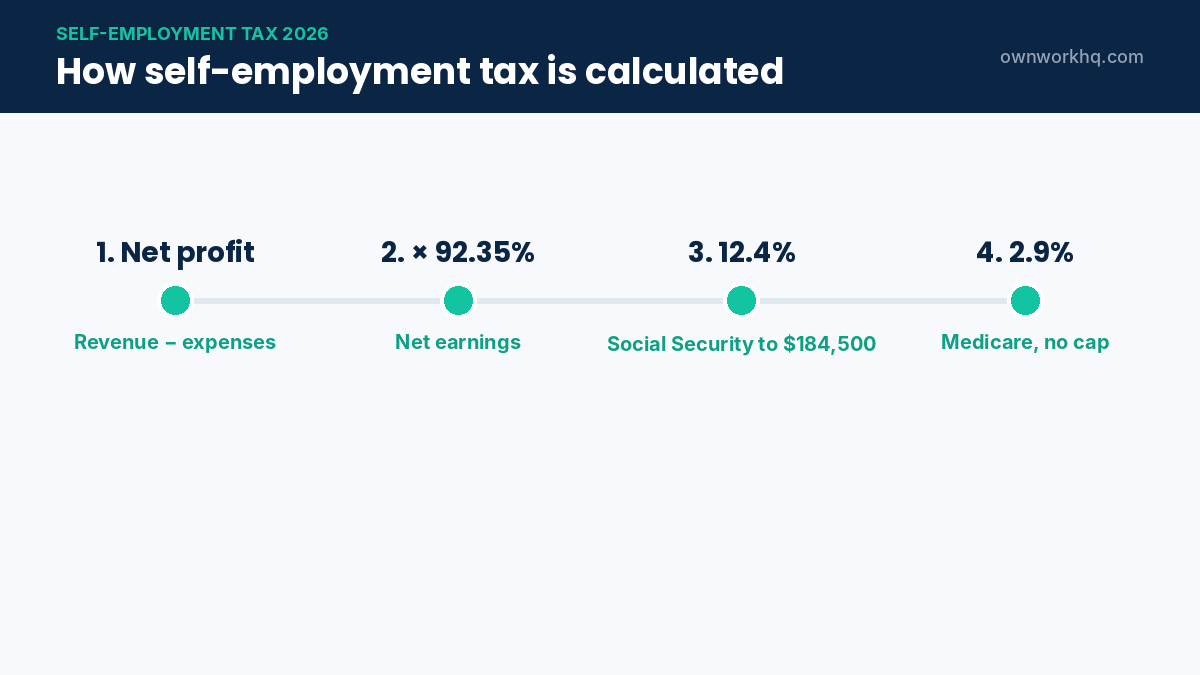
- Start with net profit from Schedule C: revenue minus business expenses.
- Multiply by 92.35% to get net earnings from self-employment. This adjustment mirrors the fact that employers deduct their half of payroll taxes.
- Apply 12.4% Social Security tax to net earnings up to the wage base, minus any W-2 wages that already paid Social Security tax.
- Apply 2.9% Medicare tax to all net earnings.
If your net earnings are under $400, you don’t owe self-employment tax. Our income tax calculator does these steps automatically and adds federal and state income tax.
Self-employment tax examples for 2026
| Net profit | Net earnings (92.35%) | Social Security | Medicare | Total SE tax | Deduction (half) |
|---|---|---|---|---|---|
| $30,000 | $27,705 | $3,435 | $803 | $4,239 | $2,119 |
| $60,000 | $55,410 | $6,871 | $1,607 | $8,478 | $4,239 |
| $100,000 | $92,350 | $11,451 | $2,678 | $14,130 | $7,065 |
| $150,000 | $138,525 | $17,177 | $4,017 | $21,194 | $10,597 |
| $200,000 | $184,700 | $22,878 (capped) | $5,356 | $28,234 | $14,117 |
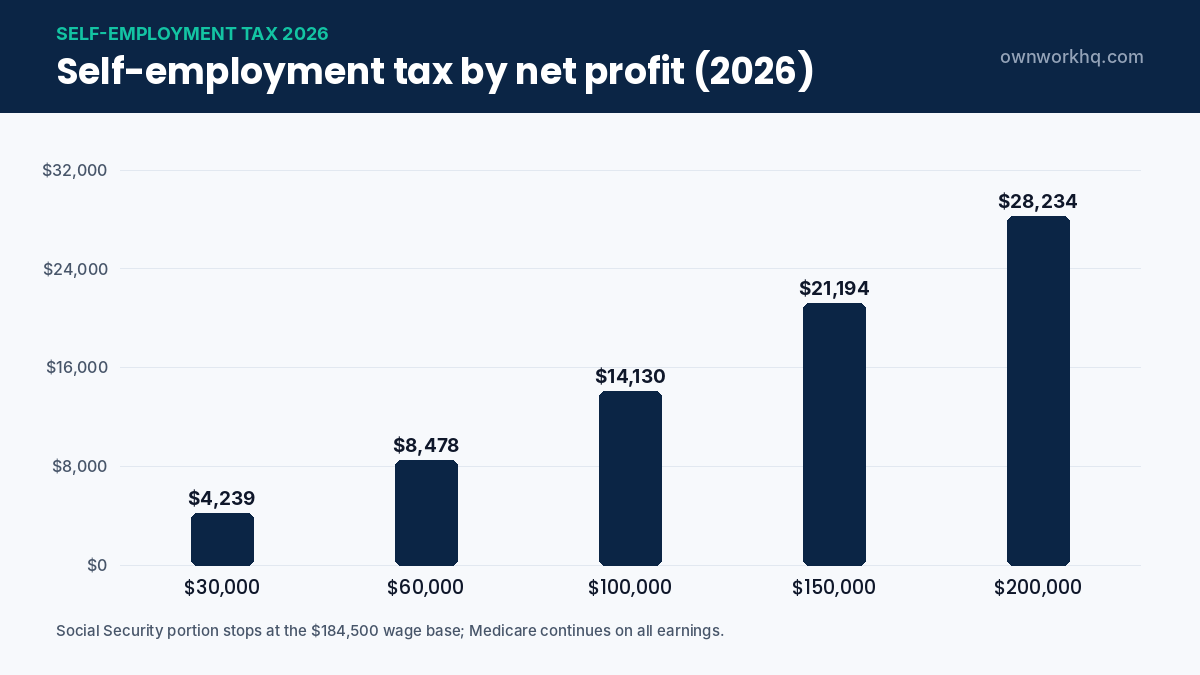
Above the wage base, only the 2.9% Medicare part keeps growing, so self-employment tax becomes a smaller share of income at higher profits. At $250,000 of profit, SE tax is about $29,573, plus about $278 of additional Medicare tax.
If you also have a W-2 job
Social Security tax applies to combined wages and self-employment earnings up to the wage base. If your W-2 wages already reach $184,500, you’ll only owe the 2.9% Medicare part on freelance income. Below that, your wages fill the wage base first:
| Situation | W-2 wages | Freelance profit | SE tax on side income |
|---|---|---|---|
| Side hustle | $60,000 | $20,000 | About $2,826 (full 15.3%) |
| High salary | $170,000 | $50,000 | About $3,137 (Social Security only on the first $14,500) |
Your employer withholds FICA from your paycheck, but nobody withholds SE tax on freelance income, so plan to cover it with estimated payments or extra withholding at your job. Our guide to 1099 vs W-2 compares both sides.
The deduction for half of self-employment tax
You can deduct half of your self-employment tax as an adjustment to income on Schedule 1. This mirrors the deduction employers get for their share of payroll taxes. It lowers your income tax, not the SE tax itself. With $60,000 of profit, for example, the $4,239 deduction saves about $500 in federal income tax for a single filer in the 12% bracket.
The deduction also lowers your adjusted gross income, which can matter for other benefits such as the premium tax credit on a Marketplace health plan.
How to report and pay self-employment tax
- Schedule C calculates your net profit.
- Schedule SE calculates self-employment tax from that profit.
- Form 1040 carries the SE tax to your total tax, and Schedule 1 takes the deduction for half of it.
- Form 8959 calculates additional Medicare tax if your earnings are high enough.
Because there’s no withholding, the IRS expects you to pay during the year. The 2026 estimated tax deadlines are April 15, June 15 and September 15, 2026, and January 15, 2027. Learn how much to pay and how to avoid penalties in our guide to quarterly estimated taxes.
What you get in return: Social Security and Medicare credits
The money isn’t just a cost. Paying into Social Security as a freelancer earns the same work credits an employee earns, and those credits determine whether you qualify for retirement, disability and survivor benefits. Most people need 40 credits, roughly ten years of work, to qualify for retirement benefits, and your benefit amount is based on your highest-earning years.
That’s one reason to think carefully before reducing reported earnings too aggressively. Lower taxes today can also mean a smaller Social Security check later. You can check your earnings record and estimated benefits in a free my Social Security account.
Why only 92.35% of profit is taxed
Employees don’t pay Social Security and Medicare on the employer’s share of those taxes. To treat freelancers the same way, the law first reduces net profit by 7.65%, half of the 15.3% rate, before applying the tax. That’s where 92.35% comes from. The result is that the effective rate on your full profit is about 14.13% below the wage base, not 15.3%.
Married couples and partnerships
- Each spouse is taxed separately. Even on a joint return, each spouse who has self-employment income files their own Schedule SE, and each has their own Social Security wage base.
- Couples running a business together may be able to elect a qualified joint venture so both spouses earn Social Security credits.
- Partners in a partnership or multi-member LLC generally pay the tax on their share of ordinary business income and guaranteed payments.
- Limited partners are usually exempt on their distributive share, apart from guaranteed payments for services.
State taxes on self-employment income
There’s no separate state version of this tax. States tax your freelance profit through their regular income tax, and a few cities add local income or business taxes. Nine states, including Texas and Florida, don’t tax wage or self-employment income at all. Your federal deduction for half of the tax often flows through to your state return as well, because many states start from federal adjusted gross income.
A simple payment plan for the year
| Payment | Covers income earned | 2026 due date |
|---|---|---|
| 1st quarter | January 1 – March 31 | April 15, 2026 |
| 2nd quarter | April 1 – May 31 | June 15, 2026 |
| 3rd quarter | June 1 – August 31 | September 15, 2026 |
| 4th quarter | September 1 – December 31 | January 15, 2027 |
Each payment should cover both income tax and self-employment tax for that period. If your income is uneven, you can pay more in strong quarters and less in slow ones; the annualized income method on Form 2210 can help you avoid a penalty when income is concentrated later in the year.
Employee vs freelancer: who pays what
| Employee | Freelancer | |
|---|---|---|
| Social Security | 6.2% (employer pays another 6.2%) | 12.4% |
| Medicare | 1.45% (employer pays another 1.45%) | 2.9% |
| Base | Gross wages | 92.35% of net profit |
| How it’s paid | Withheld from each paycheck | Quarterly estimated payments |
| Deduction | None for the employee | Half of the tax, on Schedule 1 |
This is why freelance rates need to be higher than an equivalent salary. An employer quietly pays 7.65% on top of every paycheck; as a freelancer, that cost is yours. Our guide to setting freelance rates shows how to build it into your pricing.
Gig workers and online sellers
Rideshare drivers, delivery workers, online sellers and creators who earn money as independent contractors owe the same tax as any other freelancer. It doesn’t matter whether you receive a Form 1099-NEC, a Form 1099-K or no form at all: what counts is net profit from the activity. Platform fees, mileage and supplies reduce that profit, so track them from the first dollar.
What if your business has a loss?
If your net profit is zero or negative, you don’t owe self-employment tax for that business, but you also don’t earn Social Security credits for the year. If you have more than one business, profits and losses are combined on Schedule SE, so a loss from one activity can reduce the tax on another. A W-2 job, however, can’t be offset by a business loss for Social Security purposes.
Records that support your numbers
- Invoices and payment records for every client.
- Receipts and bank statements for business expenses.
- A mileage log if you deduct vehicle use.
- Copies of Forms 1099 you receive.
- Proof of each estimated payment you make.
Good records make Schedule SE straightforward and protect your deductions if the IRS ever asks questions.
The full picture: $75,000 of freelance profit
To see how self-employment tax fits with income tax, here’s a single freelancer with $75,000 of net profit in 2026, living in a state with no income tax:
| Item | Amount |
|---|---|
| Net profit | $75,000 |
| Self-employment tax | $10,597 |
| Deduction for half of SE tax | −$5,299 |
| Standard deduction | −$16,100 |
| QBI deduction | −$10,720 |
| Taxable income | $42,881 |
| Federal income tax | $4,898 |
| Total federal tax | $15,495 (about 20.7% of profit) |
Self-employment tax is more than twice the federal income tax in this example. That’s typical at moderate incomes, and it’s why setting aside only for income tax leaves many first-year freelancers short in April.
How it affects retirement contributions
If you contribute to a SEP IRA or the employer side of a Solo 401(k), the maximum is based on net earnings after the deduction for half of self-employment tax. For a sole proprietor, the employer contribution works out to about 20% of net profit minus that deduction. Tax software and plan providers do this calculation for you, but it explains why your contribution limit is lower than 25% of your profit.
Legal ways to lower self-employment tax
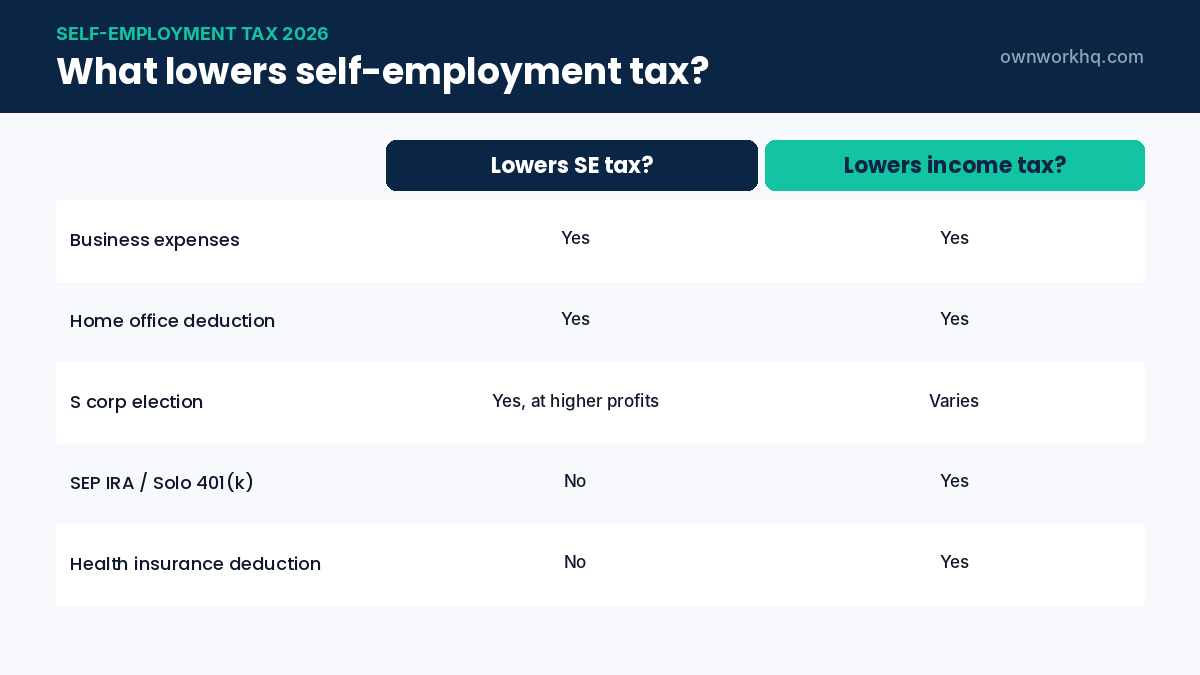
- Deduct every business expense. SE tax is based on net profit, so each legitimate expense reduces it by about 14.1 cents per dollar, on top of income tax savings.
- Elect S corporation status at higher profits. As an S corp owner you pay payroll taxes on a reasonable salary, not on all profit. See S corp vs LLC for freelancers.
- Claim the home office deduction if you qualify; it reduces Schedule C profit.
- Hire your children in a sole proprietorship under certain conditions; wages to a child under 18 can be exempt from Social Security and Medicare tax.
Some popular moves don’t reduce SE tax. Retirement contributions to a SEP IRA or Solo 401(k) and the self-employed health insurance deduction lower income tax but not self-employment tax, because they’re taken after Schedule SE.
S corp example: when payroll beats SE tax
A freelancer with $100,000 of profit pays about $14,130 in self-employment tax as a sole proprietor or single-member LLC. As an S corp paying a $50,000 reasonable salary, payroll taxes on that salary would be about $7,650 (employee and employer shares combined). The difference of roughly $6,500 is reduced by payroll costs, a separate business tax return and possible state fees, so the election usually starts to make sense at higher profits. The salary must be reasonable for the work you do.
Common self-employment tax mistakes
- Forgetting SE tax when setting aside money, and saving only for income tax.
- Paying nothing until April, then owing an underpayment penalty.
- Calculating 15.3% on gross revenue instead of net profit, which overstates the bill.
- Missing the deduction for half of SE tax.
- Assuming retirement contributions cut SE tax; they only reduce income tax.
How much to set aside
A good rule of thumb is to set aside 25% to 35% of every client payment for taxes, depending on your income and state. Roughly 14% of that covers self-employment tax, and the rest covers federal and state income tax. Run your own numbers in the income tax calculator and adjust your savings rate at least once a quarter.
Frequently asked questions
What is the self-employment tax rate for 2026?
15.3% of net earnings from self-employment: 12.4% for Social Security up to $184,500 and 2.9% for Medicare on all earnings. Net earnings are 92.35% of net profit.
Do I pay self-employment tax if I made less than $400?
No. If your net earnings from self-employment are under $400 for the year, you don’t owe self-employment tax, though you may still need to report the income.
Is self-employment tax the same as income tax?
No. Self-employment tax pays for Social Security and Medicare. Income tax is separate and based on your taxable income after deductions. Most freelancers owe both.
Can I deduct self-employment tax?
You can deduct half of it as an adjustment to income on Schedule 1. The deduction lowers income tax, not the self-employment tax itself.
How much self-employment tax will I pay on $50,000?
About $7,065 for 2026: $50,000 times 92.35% equals $46,175 of net earnings, and 15.3% of that is about $7,065. You’d also deduct about $3,533, half of the tax, when calculating income tax.
When is self-employment tax due?
It’s paid along with income tax through quarterly estimated payments during the year, then settled on your annual return. For 2026 income, the final return is due April 15, 2027, and the last estimated payment is due January 15, 2027.
Will the Social Security wage base change in 2027?
Usually yes. The Social Security Administration adjusts the wage base each year based on average wage growth and announces the new figure in the fall. The 2026 base is $184,500.
Does an LLC pay self-employment tax?
A single-member LLC is taxed like a sole proprietor by default, so the owner pays self-employment tax on profit. Electing S corp status changes how owner earnings are taxed.
Sources
- IRS: Self-employment tax (Social Security and Medicare taxes)
- IRS: About Schedule SE
- SSA: Contribution and benefit base
- IRS Topic 560: Additional Medicare tax
Disclaimer: This article is for informational purposes only and is not tax, legal or financial advice. OwnWork HQ is not a CPA or tax advisor. Tax rules change and depend on your situation, so confirm details with the IRS or a qualified tax professional before you act.
About OwnWork HQ Editorial
We write plain-English guides for US freelancers and check every rate, limit and deadline against IRS and state agency publications. We are not CPAs or financial advisors; for advice on your situation, talk to a qualified professional.