Home Office Deduction for Freelancers (2026): Rules, Examples & Which Method Wins
In short: How the home office deduction works for freelancers in 2026: the exclusive-use test, simplified vs regular method, examples for renters and homeowners, and what happens when you sell.

On this page
- Who qualifies for the home office deduction?
- Home office deduction for freelancers: the two methods
- How to calculate your business percentage
- Example: a freelance writer who rents
- Example: a designer who owns a home
- Depreciation and selling your home
- Income limit: when the deduction is capped
- What else counts as a home office expense?
- Records to keep
- Which method should you choose?
- How it works for different freelancers
- Separate structures and garages
- Moving or starting mid-year
- Where it goes on your tax return
- State taxes and local rules
- Side businesses and part-time freelancers
- How much the deduction is really worth
- Checklist before you claim it
- If the IRS asks about your home office
- Common home office mistakes
- Frequently asked questions
- Sources
If you work from a dedicated space at home, part of your rent or mortgage, utilities and insurance can become a business deduction. The home office deduction for freelancers is one of the most valuable write-offs for self-employed people, and because it reduces Schedule C profit, it lowers both income tax and self-employment tax.
Key takeaways
- Only self-employed people can claim it; W-2 employees can’t deduct a home office on their federal return.
- The space must be used regularly and exclusively for business, with a few exceptions.
- Simplified method: $5 per square foot, up to 300 square feet, no depreciation and minimal records.
- Regular method: the business percentage of rent or mortgage interest, utilities, insurance, repairs and depreciation.
- You can switch methods from year to year, and the deduction can’t create a loss under the simplified method.
Who qualifies for the home office deduction?
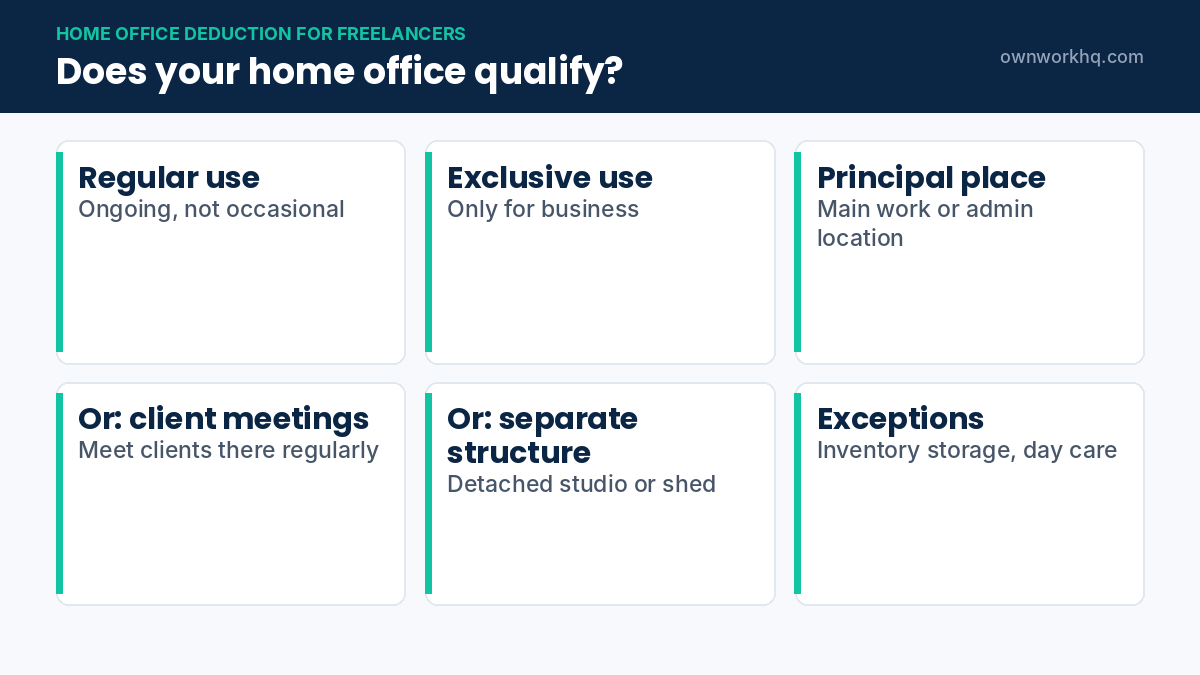
The IRS sets three main tests. Your workspace must meet all of them:
- Regular use: you use the space for business on a continuing basis, not occasionally.
- Exclusive use: the space is used only for your business. A desk in a guest room that guests also use doesn’t qualify; a separate room or a clearly defined area used only for work can.
- Principal place of business: it’s where you do most of your work, or where you handle administrative and management tasks such as billing, scheduling and bookkeeping when you have no other fixed location for them.
A space can also qualify if you meet clients there in the normal course of business, or if it’s a separate structure, such as a detached studio, used for your business. Storage of inventory or product samples and licensed day care are exceptions to the exclusive-use rule. See the IRS home office deduction page for the details.
Home office deduction for freelancers: the two methods
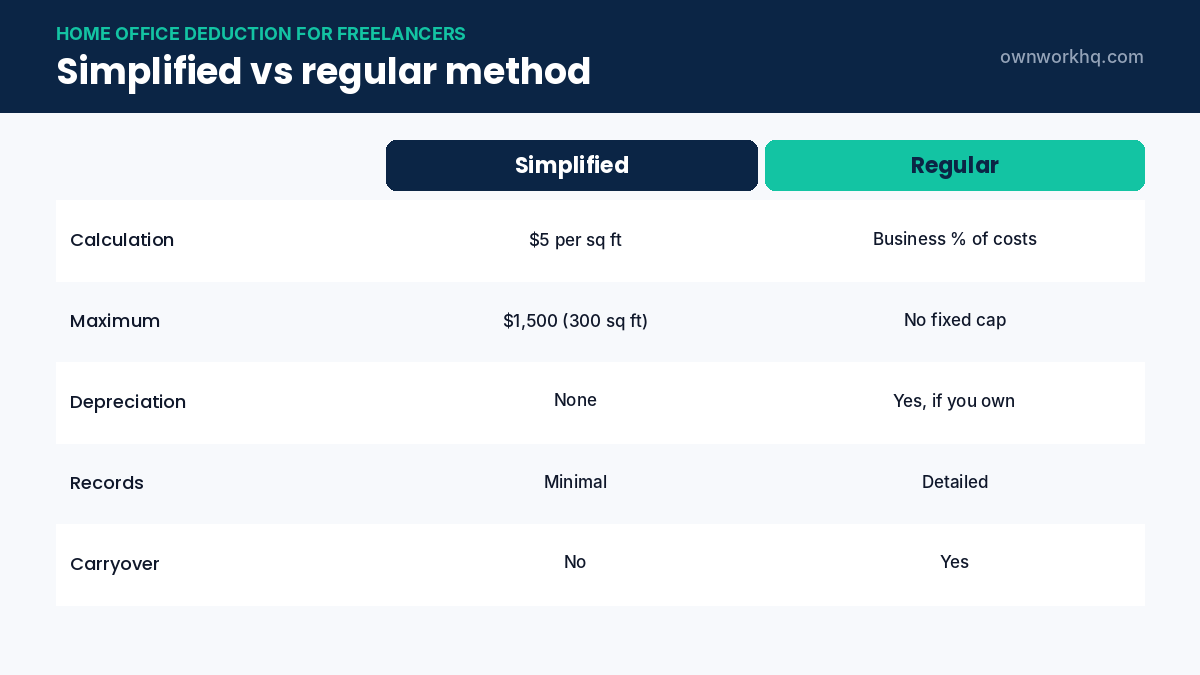
| Simplified method | Regular method | |
|---|---|---|
| How it’s calculated | $5 × square feet of office | Business percentage × actual home expenses |
| Maximum | 300 sq ft = $1,500 | No fixed cap; limited by business income |
| Expenses included | None separately | Rent or mortgage interest, real estate tax, utilities, insurance, repairs, depreciation |
| Depreciation | None | Yes, if you own the home |
| Carryover if limited by income | No | Yes, to future years |
| Form | Worksheet in Schedule C instructions | Form 8829 |
Mortgage interest and real estate taxes you don’t claim as home office expenses can still be itemized on Schedule A if you itemize. With the simplified method, you deduct those in full on Schedule A instead, subject to the usual limits.
How to calculate your business percentage
For the regular method, divide the office’s square footage by your home’s total square footage. A 150-square-foot office in a 1,500-square-foot apartment is 10% of the home. You apply that percentage to indirect expenses that benefit the whole home, such as rent and utilities. Direct expenses that only benefit the office, such as painting it, are deductible in full.
| Expense type | Examples | How much is deductible |
|---|---|---|
| Direct | Repairs or painting in the office only | 100% |
| Indirect | Rent, mortgage interest, real estate tax, utilities, homeowners or renters insurance, general repairs | Business percentage |
| Unrelated | Landscaping, repairs to rooms you don’t use for business | 0% |
Example: a freelance writer who rents
Maya rents a 1,500-square-foot apartment for $2,000 a month and uses a 150-square-foot second bedroom only as her office. Her business percentage is 10%.
| Expense | Annual amount | Business share (10%) |
|---|---|---|
| Rent | $24,000 | $2,400 |
| Utilities and internet for the home | $3,000 | $300 |
| Renters insurance | $300 | $30 |
| Total regular-method deduction | $2,730 | |
| Simplified method (150 × $5) | $750 |
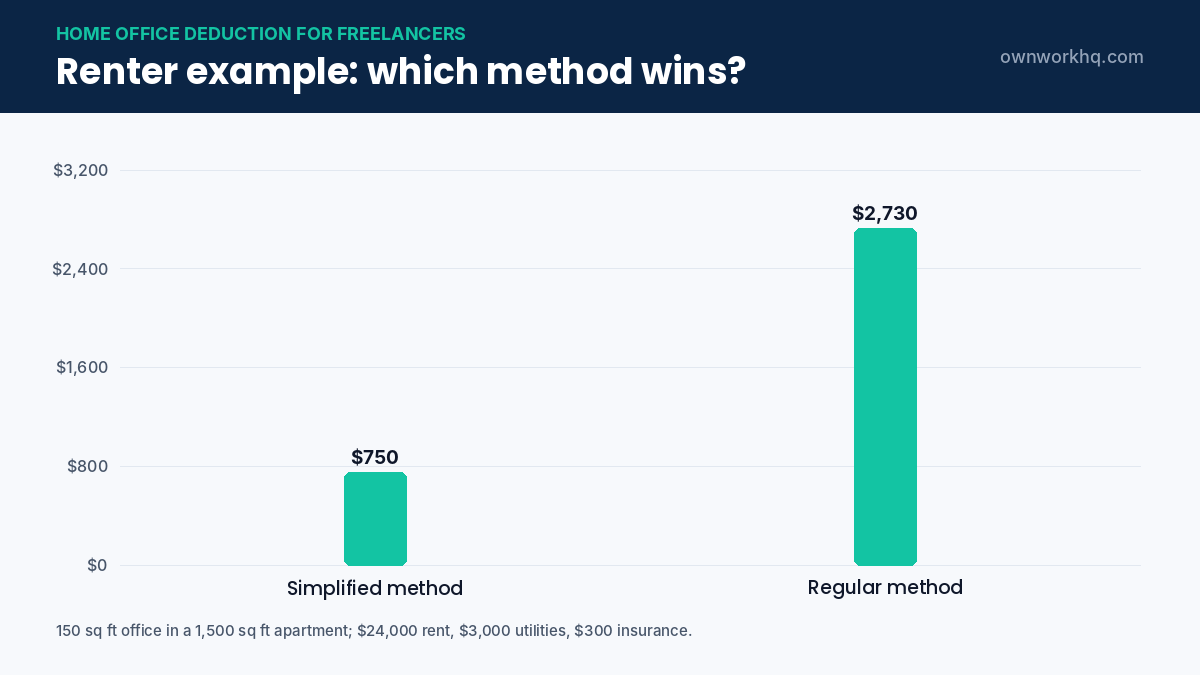
For renters in higher-cost areas, the regular method usually wins by a wide margin. With a combined federal, self-employment and state marginal rate of about 35%, Maya’s extra $1,980 of deductions saves roughly $690 in tax. Our income tax calculator can show your own marginal rate.
Example: a designer who owns a home
Alex owns a 2,000-square-foot house and uses a 200-square-foot room as a studio, so the business percentage is 10%. He pays $14,000 a year in mortgage interest, $5,000 in property tax, $3,600 in utilities and $1,400 in homeowners insurance. The home’s cost basis, excluding land, is $300,000.
| Expense | Annual amount | Business share (10%) |
|---|---|---|
| Mortgage interest | $14,000 | $1,400 |
| Real estate tax | $5,000 | $500 |
| Utilities | $3,600 | $360 |
| Insurance | $1,400 | $140 |
| Depreciation (10% of $300,000 over 39 years, full year) | About $769 | |
| Total regular-method deduction | About $3,169 | |
| Simplified method (200 × $5) | $1,000 |
The regular method gives Alex a bigger deduction, but it includes depreciation, which has consequences when he sells the home.
Depreciation and selling your home
If you own your home and use the regular method, you deduct depreciation on the business portion. When you sell, the depreciation you claimed, or could have claimed, after May 6, 1997 is generally taxed as unrecaptured section 1250 gain, at a maximum rate of 25%. The rest of the gain may still qualify for the home sale exclusion of up to $250,000, or $500,000 for married couples, if the office was inside the home rather than a separate structure.
That recapture is usually modest compared with years of deductions, but it’s worth knowing. The simplified method avoids depreciation entirely, which some homeowners prefer for simplicity.
Income limit: when the deduction is capped
The home office deduction can’t exceed the gross income from the business use of your home minus your other business expenses. Under the simplified method, any amount above the limit is lost. Under the regular method, the disallowed amount carries forward to future years. This mainly affects freelancers with very low profit or a business loss in a particular year.
What else counts as a home office expense?
- Furniture and equipment used in the office, such as a desk, chair and monitor, are deducted separately as business assets under either method.
- Internet and phone are usually deducted based on business-use percentage, separately from the home office calculation.
- Repairs to the office itself are direct expenses under the regular method.
- Security systems for the whole home are indirect expenses.
Don’t double count. If you deduct internet as a separate business expense, don’t include it again in your home office utilities.
Records to keep
- A floor plan or measurements of the office and the home.
- Photos showing the space is set up and used only for work.
- Rent statements or mortgage interest statements (Form 1098).
- Utility bills, insurance policies and receipts for repairs.
- Calendars or invoices showing you work there regularly.
Keep these records for as long as they support your return, and longer if you own the home and claim depreciation, since they’ll matter when you sell.
Which method should you choose?
| Choose the simplified method if… | Choose the regular method if… |
|---|---|
| Your office is small or your housing costs are low | You rent in a high-cost area |
| You want minimal paperwork | You’re comfortable keeping detailed records |
| You own your home and want to avoid depreciation recapture | Your actual expenses are well above $5 per square foot |
| Your business income is low and the deduction might be limited anyway | You want to carry forward any disallowed amount |
A quick test: divide your yearly rent or mortgage interest plus utilities and insurance by your home’s square footage. If the result is well above $5 per square foot, the regular method will likely give you a bigger home office deduction.
How it works for different freelancers
- Writers, developers and designers usually qualify easily if they have a dedicated room or a clearly separated area used only for work.
- Photographers may use a home studio, an editing room and a space to store equipment; a detached studio can qualify as a separate structure.
- Consultants who work mostly at client sites can still qualify if they do administrative work at home and have no other fixed location for it.
- Online sellers can deduct space used regularly to store inventory, even if it isn’t used exclusively for business, if home is the only fixed location of the business.
Separate structures and garages
A detached garage, shed or backyard studio used regularly and exclusively for your business can qualify even if it isn’t your principal place of business. The business percentage is then based on that structure. Keep in mind that a separate structure doesn’t share the home sale exclusion in the same way, so the gain on that part may be taxable when you sell. A converted space inside an attached garage is treated as part of the home.
Moving or starting mid-year
If you started freelancing or moved during the year, calculate the deduction only for the months the office qualified. Under the simplified method, you use the average monthly square footage, and months with fewer than 15 days of business use count as zero. Under the regular method, use expenses for the months of business use. If you had two homes during the year, you can use only one method per home for the same year.
Where it goes on your tax return
- Complete Form 8829 for the regular method, or the simplified method worksheet in the Schedule C instructions.
- Enter the result on line 30 of Schedule C.
- The deduction reduces your net profit, which flows to Schedule SE and Form 1040.
- If you itemize, enter the non-business share of mortgage interest and real estate taxes on Schedule A.
Tax software walks you through these steps, but it’s easier when you already have your measurements and annual totals ready.
State taxes and local rules
Most states follow the federal treatment because they start from federal income, so the deduction usually lowers state tax too. Some cities require a home occupation permit or business license for any business run from home, even without client visits. Check your city’s rules, especially if clients come to your home office.
Side businesses and part-time freelancers
You don’t need to freelance full time to qualify. If you have a W-2 job and a side business, a space used regularly and exclusively for the side business can qualify as the principal place of business for that business. The space can’t also be used for your W-2 work, because employee home office expenses aren’t deductible on a federal return. The deduction is also limited to the income from the side business, so it can’t create a loss under the simplified method.
How much the deduction is really worth
| Home office deduction | Marginal rate 25% | Marginal rate 35% |
|---|---|---|
| $750 | $188 | $263 |
| $1,500 | $375 | $525 |
| $3,000 | $750 | $1,050 |
| $5,000 | $1,250 | $1,750 |
Because the deduction reduces both income tax and self-employment tax, a freelancer’s combined marginal rate is often 25% to 35% or more. Multiply your deduction by your own rate to see the value.
Checklist before you claim it
- The space is used only for business; personal items and family use are removed.
- You work there on a regular basis throughout the year.
- It’s your principal place of business, or you meet clients there.
- You’ve measured the office and the whole home.
- You’ve chosen the method that gives the larger deduction for the effort.
- You have rent, mortgage, utility and insurance records ready if using the regular method.
If the IRS asks about your home office
An examiner will typically want to understand how the space is used and how you calculated the deduction. Be ready to show a floor plan with measurements, photos of the office, a short description of the work you do there, and the bills behind each expense. If you meet clients at home, a calendar or emails showing those meetings help. A clear, documented office set up only for work is the strongest support for the deduction, and it takes little time to prepare when you do it as you go rather than years later.
If you use the simplified method, the questions are usually limited to whether the space qualifies and its size, which is one reason many freelancers with small offices prefer it.
Common home office mistakes
- Claiming a shared space, such as a dining table or a guest room used by visitors.
- Using the whole home’s square footage instead of only the office.
- Claiming it as a W-2 employee, which isn’t allowed on a federal return.
- Deducting internet twice, once as utilities and once as a separate expense.
- Ignoring depreciation on an owned home: the IRS treats depreciation you could have claimed as taken when you sell.
Frequently asked questions
Can freelancers who rent claim the home office deduction?
Yes. Renters can deduct the business percentage of rent, utilities and renters insurance with the regular method, or use the simplified method at $5 per square foot up to 300 square feet.
Is the home office deduction a red flag for an audit?
Claiming a legitimate home office isn’t a reason to avoid it. Make sure you meet the exclusive and regular use tests and keep measurements, photos and expense records.
Can I switch between the simplified and regular methods?
Yes. You can choose either method each year. If you switch back to the regular method on a home you own, special depreciation rules apply.
Does the home office deduction reduce self-employment tax?
Yes. It reduces your Schedule C net profit, which lowers both income tax and self-employment tax.
What is the maximum home office deduction?
With the simplified method, the maximum is $1,500 per year (300 square feet at $5). With the regular method there’s no fixed cap, but the deduction can’t exceed the income from the business, with any excess carried forward.
Can I deduct a home office for an LLC?
A single-member LLC taxed as a sole proprietorship claims the home office on Schedule C, like any freelancer. An S corp owner usually uses an accountable plan to reimburse home office costs instead.
Can I claim a home office if I also rent a coworking space?
It’s harder. Your home office must be your principal place of business or a place where you regularly meet clients. If you do most work elsewhere, it may still qualify if you use it for administrative tasks and have no other fixed location for them.
Sources
Disclaimer: This article is for informational purposes only and is not tax, legal or financial advice. OwnWork HQ is not a CPA or tax advisor. Tax rules change and depend on your situation, so confirm details with the IRS or a qualified tax professional before you act.
About OwnWork HQ Editorial
We write plain-English guides for US freelancers and check every rate, limit and deadline against IRS and state agency publications. We are not CPAs or financial advisors; for advice on your situation, talk to a qualified professional.