Year-End Tax Planning for Freelancers (2026): 12 Moves Before December 31
In short: Twelve year-end tax moves for freelancers before December 31, 2026: retirement contributions, equipment purchases, income and expense timing, HSA, charitable giving and the January 15 estimate.

On this page
- Year-end tax planning for freelancers starts with a projection
- Key dates for year-end tax planning
- Move 1: max out retirement contributions
- Move 2: buy equipment you actually need
- Move 3: pay outstanding expenses before December 31
- Move 4: time your income
- Move 5: review your home office and vehicle records
- Move 6: use your HSA
- Move 7: make charitable gifts strategically
- Move 8: check your estimated payments
- Move 9: issue and collect tax forms
- Move 10: consider an S corp election for 2027
- Move 11: harvest investment losses
- Move 12: organize everything for filing
- Example: what year-end moves can save
- A year-end checklist by profit level
- Year-end moves for freelancers with health insurance
- What can wait until you file
- Working with a tax professional
- If 2026 was a slow year
- State tax considerations
- Planning ahead for 2027
- Common year-end mistakes
- Frequently asked questions
- Sources
December is the last chance to change your 2026 tax bill. Once the year ends, most decisions are locked in. Good year-end tax planning for freelancers isn’t about tricks: it’s about using the deductions and accounts the tax code already gives self-employed people, and timing income and expenses sensibly.
Key takeaways
- Start with a projection: estimate 2026 profit and your total tax before making any year-end move.
- Retirement contributions are usually the biggest lever. The 2026 Solo 401(k) limit is $72,000 in total, plus catch-ups.
- Equipment placed in service by December 31 can often be deducted in full in 2026.
- Freelancers using the cash method can shift deductions by paying expenses before year-end.
- Starting in 2026, non-itemizers can deduct up to $1,000 ($2,000 joint) of cash gifts to charity.
Year-end tax planning for freelancers starts with a projection
You can’t plan without a number. Total your revenue to date, add the invoices you expect to collect by December 31, and subtract year-to-date expenses. Then plug the estimated profit into our income tax calculator to see your federal, self-employment and state tax and your marginal rate.
Your marginal rate tells you what each move is worth. A freelancer in the 22% federal bracket who also pays self-employment tax and state tax may save 35 cents or more for every extra dollar of business deductions. Someone in the 12% bracket saves less, which might make deferring deductions to a higher-income year smarter.
Key dates for year-end tax planning
| Deadline | What must be done |
|---|---|
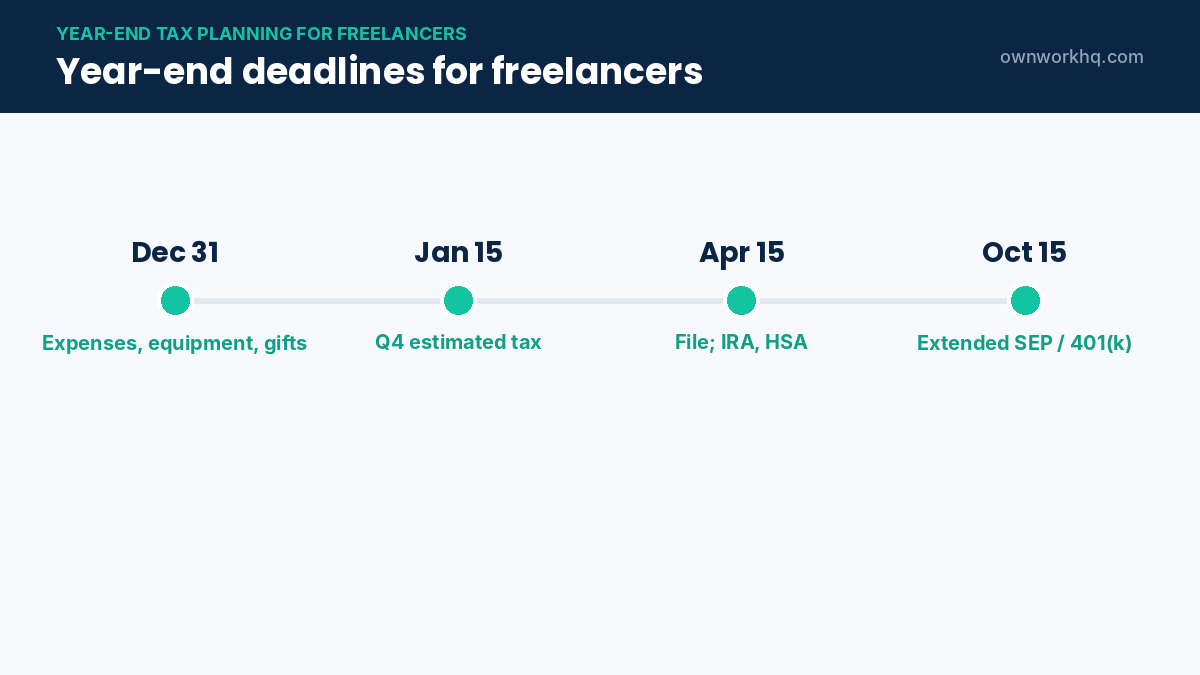
| December 31, 2026 | Pay deductible expenses, place equipment in service, make charitable gifts, establish a Solo 401(k) for 2026 employee deferrals |
| January 15, 2027 | Fourth-quarter estimated tax payment for 2026 |
| April 15, 2027 | File your 2026 return; fund traditional IRA and HSA for 2026; SEP IRA and Solo 401(k) employer contributions if you don’t extend |
| October 15, 2027 | Extended filing deadline; SEP and Solo 401(k) employer contributions if you filed an extension |
Move 1: max out retirement contributions
Retirement accounts let freelancers deduct far more than employees can and can shrink your tax bill quickly, and they’re the most powerful year-end tool for most people. The 2026 limits:
| Account | 2026 limit | Deadline to contribute |
|---|---|---|
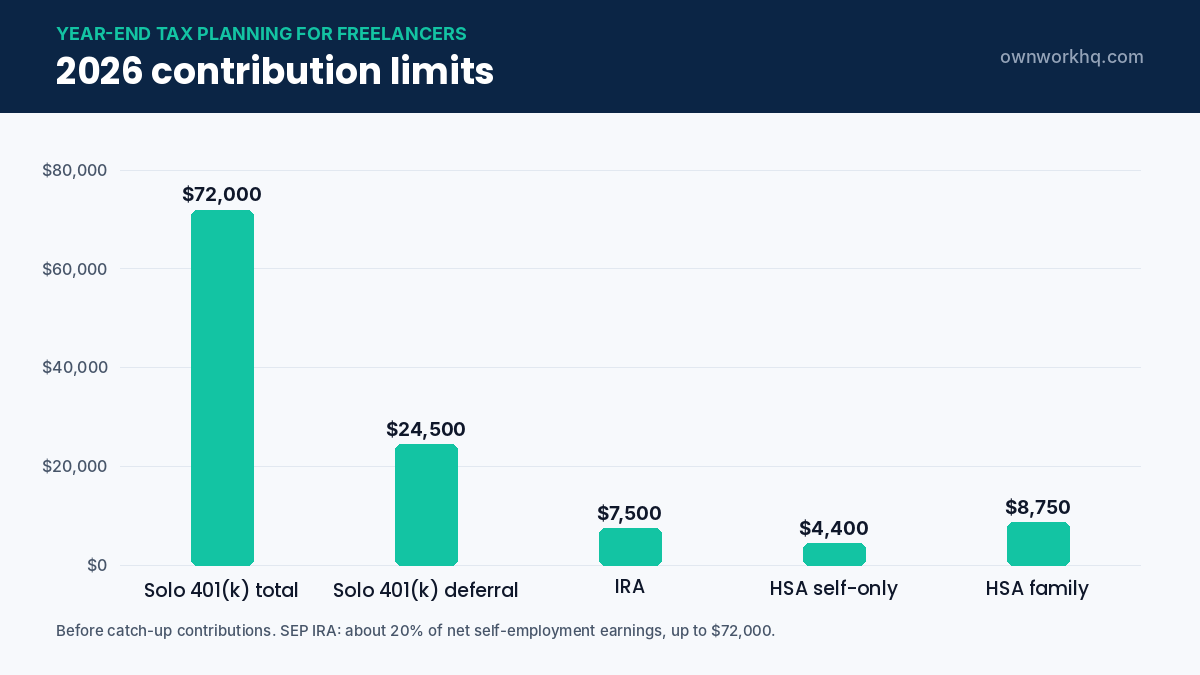
| Solo 401(k) employee deferral | $24,500 (+$8,000 age 50+, +$11,250 ages 60–63) | Usually elected by December 31; a brand-new plan for a sole proprietor may allow first-year deferrals until the filing deadline |
| Solo 401(k) employer contribution | About 20% of net self-employment earnings | Filing deadline, including extensions |
| Solo 401(k) total | $72,000 plus catch-ups | — |
| SEP IRA | About 20% of net self-employment earnings, up to $72,000 | Filing deadline, including extensions |
| Traditional or Roth IRA | $7,500 (+$1,100 age 50+) | April 15, 2027 |
| HSA (with an eligible plan) | $4,400 self-only, $8,750 family | April 15, 2027 |
If you want a Solo 401(k) for 2026, open it before year-end to be safe, even if you fund it later; providers have their own paperwork deadlines. For help choosing, see Solo 401(k) vs SEP IRA.
Move 2: buy equipment you actually need
If you were already planning to buy a laptop, camera, monitor or office furniture, buying and placing it in service by December 31 moves the deduction into 2026. Items costing up to $2,500 per item or invoice can generally be expensed under the de minimis safe harbor, and more expensive equipment can often be deducted in full with 100% bonus depreciation or Section 179.
Don’t buy things just to lower your tax bill. Spending $1,000 to save $300 in tax still leaves you $700 poorer. The goal is to time purchases you’d make anyway.
Move 3: pay outstanding expenses before December 31
This is one of the simplest year-end moves. Most freelancers use the cash method of accounting, which means expenses are deducted in the year you pay them. Paying January’s software subscriptions, a professional membership, a course you’ve already chosen or a contractor’s final invoice in December brings the deduction into 2026. Prepaying expenses that cover more than 12 months can be limited, so keep prepayments reasonable.
Move 4: time your income
Under the cash method, income counts when you receive it. If you expect to be in a lower bracket next year, sending December invoices a little later, so payments arrive in January, can defer tax. If you expect higher income in 2027, the opposite may make sense. You can’t refuse or hold payments that are already available to you, such as a check sitting in your mailbox, but you can choose normal billing dates.
Move 5: review your home office and vehicle records
- Home office: measure your office space and gather rent, utilities and insurance records if you’ll use the regular method; read our home office deduction guide.
- Vehicle: total your business miles. For 2026 the standard mileage rate is 72.5 cents per mile through June 30 and 76 cents per mile from July 1.
- Phone and internet: confirm the business-use percentage you’ll claim.
Clean year-end records make filing easier and support the deductions if the IRS asks questions.
Move 6: use your HSA
If you have an HSA-eligible health plan, contributions are deductible and grow tax-free for medical costs. You have until April 15, 2027 to contribute for 2026, but setting it up now avoids the rush. Starting in 2026, bronze and catastrophic Marketplace plans count as HSA-eligible, which opens this option to more freelancers.
Move 7: make charitable gifts strategically
Starting with 2026, people who take the standard deduction can deduct cash gifts to qualifying charities of up to $1,000, or $2,000 for married couples filing jointly. If you itemize, charitable deductions now only count above 0.5% of your adjusted gross income. Gifts must be made by December 31 to count for 2026, so add them to your year-end checklist.
Move 8: check your estimated payments
Compare what you’ve paid in estimated tax so far with your projected 2026 tax. To avoid an underpayment penalty, you generally need to have paid at least 90% of this year’s tax or 100% of last year’s tax (110% if your prior-year AGI was over $150,000). If you’re short, increase your January 15 payment to avoid adding a penalty to your tax bill, or raise withholding at a W-2 job, since withholding counts as if paid evenly through the year. Our guide to quarterly estimated taxes explains the safe harbor rules.
Move 9: issue and collect tax forms
If you paid an independent contractor $2,000 or more in 2026, you’ll need to send them a Form 1099-NEC by February 1, 2027, because January 31 falls on a Sunday. Collect a W-9 from each contractor as part of your year-end routine, before people disappear for the holidays. For more, read what is a 1099-NEC form.
Move 10: consider an S corp election for 2027
If your profit is high and steady, an S corp election can reduce self-employment tax. The election generally needs to be filed by March 15 to apply for the whole year, so year-end is the time to run the numbers with your accountant. Compare options in S corp vs LLC for freelancers.
Move 11: harvest investment losses
If you have taxable investment accounts, selling investments at a loss can offset capital gains and up to $3,000 of ordinary income. Watch the wash-sale rule, which disallows the loss if you buy a substantially identical investment within 30 days before or after the sale.
Move 12: organize everything for filing
- Reconcile your business bank and credit card accounts through December 31.
- Categorize every transaction using Schedule C categories.
- Download annual statements from payment platforms.
- Save receipts for large purchases and charitable gifts.
- Make a list of questions for your tax preparer.
- Write down your year-end decisions so you remember them at filing time.
Example: what year-end moves can save
Here is how a few year-end decisions add up. A single freelancer expects $95,000 of profit in 2026. Before December 31 she buys a $2,400 laptop she needed anyway, prepays $600 of January software, and plans to contribute $15,000 to a Solo 401(k). The $3,000 of business deductions reduces both income tax and self-employment tax, while the retirement contribution reduces income tax only. Together, these moves can cut her federal and state tax by several thousand dollars, depending on her state, and the $15,000 stays in her retirement account.
A year-end checklist by profit level
| Projected 2026 profit | Focus your year-end moves on |
|---|---|
| Under $40,000 | Organizing records, the IRA or Roth IRA, Marketplace subsidy planning and the January 15 payment |
| $40,000 – $100,000 | Retirement contributions, equipment timing, HSA and a full expense review |
| $100,000 – $200,000 | Maximizing a Solo 401(k), S corp analysis for 2027 and income timing |
| Over $200,000 | Professional advice, the QBI deduction phase-out, additional Medicare tax and S corp payroll |
Year-end tax planning looks different at each income level, so focus on the two or three moves that matter for your situation rather than trying everything.
Year-end moves for freelancers with health insurance
If you buy coverage on the Marketplace, your 2026 premium tax credit is reconciled using your final income. Retirement and HSA contributions reduce that income, which can increase your credit or reduce the amount you repay, especially if you’re close to 400% of the federal poverty level. December is also the end of open enrollment’s first deadline: enroll by December 15 for coverage starting January 1. Read our guide to open enrollment for self-employed workers for the 2027 rules.
What can wait until you file
- SEP IRA contributions can be made until your filing deadline, including extensions.
- Solo 401(k) employer contributions follow the same deadline.
- Traditional and Roth IRA contributions for 2026 can be made until April 15, 2027.
- HSA contributions for 2026 can also be made until April 15, 2027.
- An S corp election for 2027 is generally due by March 15, 2027.
That flexibility is useful: you can wait until your books are closed and you know your exact profit before deciding how much to contribute. The year-end deadline still matters for anything that depends on payment or purchase dates, such as expenses, equipment and charitable gifts.
Working with a tax professional
If your income changed a lot this year, you started an LLC, you’re thinking about an S corp, or you sold investments, a December meeting with a CPA or enrolled agent can pay for itself. Bring your year-to-date profit and loss statement, last year’s return, and a list of planned purchases. A professional can also check state-specific rules, which this guide doesn’t cover in detail.
If 2026 was a slow year
A low-income year changes the strategy. Instead of chasing deductions, consider whether it makes sense to accelerate income into 2026, delay purchases until a stronger year, or make Roth IRA contributions instead of traditional ones, since your tax rate is low now. If you had a net business loss, it can offset other income such as a spouse’s wages on a joint return, and a large loss may be carried forward. Make sure you still file Schedule C, even if you owe little or nothing.
A slow year is also a good time to fix the basics: open a separate business bank account, set up an accounting app and build a tax savings habit for next year. Our guide to tracking freelance expenses walks through a simple system.
State tax considerations
Most of these moves also reduce state income tax, because many states start from federal adjusted gross income. A few states don’t follow federal rules for bonus depreciation, so a big equipment purchase may be deducted more slowly on your state return. If you moved to another state during 2026, you may need to file part-year returns in both states and divide your freelance income between them. Year-end is a good time to gather the dates and records you’ll need.
Planning ahead for 2027
- Set a quarterly reminder to review profit and estimated payments.
- Decide on a retirement contribution target and automate monthly transfers.
- Raise your rates if your effective tax rate and costs have grown.
- Consider whether an LLC or S corp structure fits your 2027 plans.
The best year-end tax planning starts in January: a few minutes each month keeps December from becoming a scramble.
Common year-end mistakes
- Buying things you don’t need just to get a deduction.
- Missing the plan setup deadline for a Solo 401(k) with your provider.
- Forgetting the January 15 payment, which can trigger a penalty.
- Mixing personal and business purchases on the same card.
- Waiting until April to look at your numbers, when most options are gone.
Frequently asked questions
What should freelancers do before December 31?
Project your profit, pay planned business expenses, buy needed equipment, open a Solo 401(k) if you want one for 2026, make charitable gifts and review your estimated payments.
Can I still contribute to a SEP IRA after December 31?
Yes. SEP IRA contributions for 2026 can be made until your tax filing deadline, including extensions, as long as the plan is set up by then.
Does buying equipment in December reduce my taxes?
If you buy it and place it in service in your business by December 31, you can often deduct it in full for 2026. It only makes sense if you need the equipment anyway.
When is the last estimated tax payment for 2026?
January 15, 2027. Paying enough by then helps you avoid an underpayment penalty.
How much can year-end tax planning save?
It depends on your income and marginal rate. A freelancer with a combined marginal rate of 35% saves about $350 in tax for every $1,000 of additional deductible expenses or pre-tax retirement contributions, though retirement contributions don’t reduce self-employment tax.
Should I prepay my January 15 estimated tax in December?
Paying the fourth-quarter federal estimate in December doesn’t change your federal tax. Some itemizers prepay state estimated tax in December to deduct it in 2026, but the SALT deduction is capped, so it often makes no difference.
Can I deduct a laptop I buy on December 30?
Yes, if you buy it for your business and start using it by December 31. Keep the receipt and note the business use.
Is year-end tax planning worth it for small freelancers?
Yes. Even simple moves like timing expenses and contributing to an IRA can save hundreds or thousands of dollars, and organizing records in December makes filing much easier.
Sources
- IRS: One-participant 401(k) plans
- IRS: 2026 inflation adjustments
- IRS: Estimated taxes
- IRS Publication 946: How to depreciate property
Disclaimer: This article is for informational purposes only and is not tax, legal or financial advice. OwnWork HQ is not a CPA or tax advisor. Tax rules change and depend on your situation, so confirm details with the IRS or a qualified tax professional before you act.
About OwnWork HQ Editorial
We write plain-English guides for US freelancers and check every rate, limit and deadline against IRS and state agency publications. We are not CPAs or financial advisors; for advice on your situation, talk to a qualified professional.