Professional Liability Insurance for Writers: Cost & Coverage (2026)
In short: What professional and media liability insurance covers for freelance writers (defamation, copyright, privacy, errors), what it costs in 2026, and how to choose a policy.


On this page
- How much does professional liability insurance cost for writers?
- What professional liability insurance for freelance writers covers
- Media liability vs. professional liability vs. general liability
- Do freelance writers need professional liability insurance?
- Three scenarios where coverage matters
- Contract clauses every freelance writer should check
- How to buy professional liability insurance as a writer
- A simple risk workflow for every article
- AI tools and your liability as a writer
- Claims-made policies, retroactive dates and tail coverage
- How to read your policy before you buy
- Higher-risk niches for writers
- Professional liability insurance for writers: buying checklist
- Real claim scenarios for freelance writers
- How much does it cost compared with your income?
- Frequently asked questions
- Sources
As a freelance writer, your words are your product, and they’re also your biggest legal risk. A client says your article defamed a competitor. A brand gets a takedown letter over a quote you didn’t attribute. A financial claim in your copy turns out to be wrong and a reader sues. Professional liability insurance for writers, often sold as media liability, exists for exactly these situations.
Key takeaways
- Media / professional liability covers claims that your content caused harm: defamation, copyright or trademark infringement, invasion of privacy and errors.
- Median cost for media businesses: $78/month with $1M/$1M limits and a $1,000 deductible (Insureon).
- General liability (about $29/month for writers) covers injuries and property damage, not your writing.
- Agencies, publishers and corporate clients increasingly ask freelancers for proof of coverage.
- Policies are usually claims-made, so keep coverage continuous to protect past work.
How much does professional liability insurance cost for writers?
Insureon publishes median premiums for media and advertising businesses, a category that includes freelance writers, editors, copywriters and content marketers (data updated April 2025):
| Policy | Median monthly | Median annual | Typical limits / deductible |
|---|---|---|---|
| Media liability / professional liability | $78 | $930 | $1M / $1M, $1,000 deductible |
| General liability (all media businesses) | $33 | $394 | $1M / $2M, $500 deductible |
| General liability (writers specifically) | $29 | about $350 | $1M / $2M |
| Business Owner’s Policy (BOP) | $56 | $670 | $1M / $2M, $500 deductible |
| Cyber insurance | $108 | $1,295 | Varies |
For media liability, Insureon reports that 28% of customers pay less than $50 per month and 62% pay less than $100. Solo writers with modest revenue and low-risk niches (for example, B2B blog content) usually land at the lower end, while investigative journalists, ghostwriters for public figures and writers covering finance or health tend to pay more.
What professional liability insurance for freelance writers covers
The exact coverage depends on the policy, but media and professional liability for writers commonly includes:
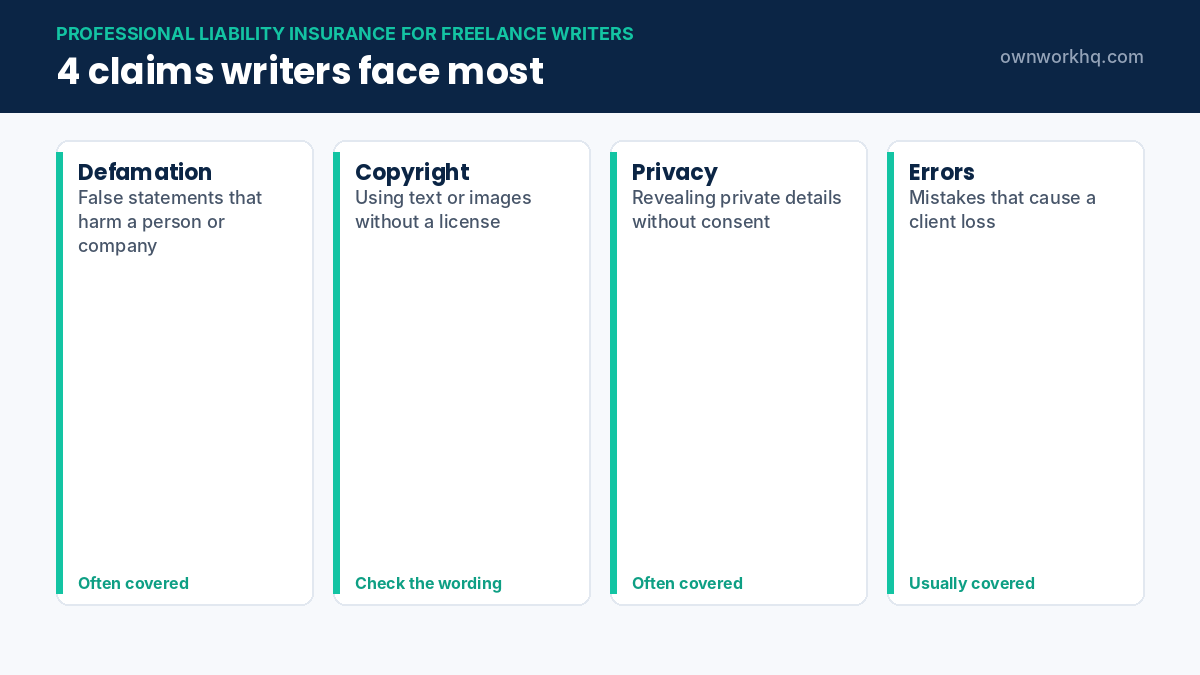
| Claim | Example | Typically covered? |
|---|---|---|
| Defamation (libel) | A client’s competitor sues over a comparison article you wrote | ✅ Yes |
| Copyright infringement | You used an image or passage without the right license | ✅ Often, check the wording |
| Trademark infringement | A slogan you wrote is too close to another brand’s | ✅ Often |
| Invasion of privacy | A case study reveals private details without consent | ✅ Yes |
| Errors and negligence | Incorrect figures in a white paper lead to a client loss | ✅ Usually, under professional liability |
| Missed deadlines / breach of contract | You deliver a product launch post late | ⚠️ Sometimes; many policies exclude pure contract disputes |
| Intentional plagiarism or knowingly false statements | Copying another writer’s work | ❌ No, intentional acts are excluded |
Coverage usually pays for legal defense, which is often the biggest cost even when a claim has no merit, plus settlements or judgments up to your policy limit.
Media liability vs. professional liability vs. general liability
These names get used loosely, so here’s a simple way to think about them:
- Media liability focuses on content risks: defamation, IP infringement and privacy. It’s the most relevant policy for writers.
- Professional liability (E&O) focuses on mistakes, negligence and failure to deliver professional services. Many writer policies combine both.
- General liability covers physical risks (bodily injury, property damage) and limited advertising injury in your own marketing. It does not cover the content you produce for clients.
If you also consult or advise clients on strategy, our guide to general liability insurance for consultants explains why liability for advice needs a separate policy.
Do freelance writers need professional liability insurance?
It’s not legally required, but it’s worth serious consideration if you:
- Write about real people or companies, including reviews, comparisons, investigations and profiles.
- Work in regulated or high-stakes niches such as finance, health, legal or insurance content.
- Write ad copy, landing pages or product claims that could be challenged.
- Ghostwrite for executives or public figures under their name.
- Have contracts with indemnification clauses, where you agree to cover the client’s losses if your content causes a claim.
- Work with agencies or enterprise clients that require a certificate of insurance.
Some publishers carry their own media liability policies, and in certain cases those may extend to freelance contributors. Don’t assume it. Ask the publisher in writing, and read your contract’s indemnification clause carefully.
Three scenarios where coverage matters
These are illustrative examples, not real claims.
- The comparison post. You write “Brand A vs. Brand B” for a SaaS client. Brand B’s lawyers send a demand letter claiming the post contains false statements about their product. Even if the claim is weak, responding with a lawyer can cost thousands. Media liability typically pays for that defense.
- The stock photo. You add an image from a free wallpaper site to a client’s blog post. Months later, the photographer’s agency demands a licensing fee plus damages from the client, who points to the indemnification clause in your contract. Depending on the policy, copyright infringement coverage can respond.
- The white paper error. You transpose two figures in a financial white paper. A prospect relies on the number, and the client claims the error cost them a deal. That’s an errors-and-omissions claim, covered under professional liability if your policy includes it.
Contract clauses every freelance writer should check
- Indemnification: try to limit it to claims caused by your own negligence, not anything the client edits or adds.
- Client-supplied information: the client is responsible for the accuracy of facts, data and materials they provide.
- Editing and final approval: the client reviews and approves the final version before publishing.
- Limitation of liability: cap your liability at the fees paid for the project.
- Rights and licenses: clarify who sources and pays for images and quotes.
How to buy professional liability insurance as a writer
- Describe your work accurately: blog content, copywriting, journalism, ghostwriting, technical writing, and niches.
- Check client requirements: limits, additional-insured wording and whether they want media liability specifically.
- Get at least three quotes from online insurers or a broker who handles media risks.
- Compare the details: covered claims (defamation, IP, privacy), exclusions, deductible and retroactive date.
- Keep coverage continuous. On a claims-made policy, a lapse can leave past articles uncovered.
- Save your certificate of insurance to send to clients when they ask.
How to lower your risk (and your premium)
- Keep source notes and links for every factual claim.
- Use licensed or public-domain images and save license receipts.
- Get written consent for testimonials, case studies and interviews.
- Avoid stating opinions as facts when writing about real people or companies.
- Choose a higher deductible if you can afford it.
A simple risk workflow for every article
Insurance is the safety net; a consistent workflow keeps you from needing it. Many experienced writers follow five steps:
- Source everything: keep links or notes for every fact, figure and quote.
- Check permissions for images, long quotes and brand assets.
- Fact-check claims about real people and companies, especially negative ones.
- Flag sensitive content for the client’s legal review, such as comparisons, financial claims and health advice.
- Keep records of drafts, approvals and client edits.
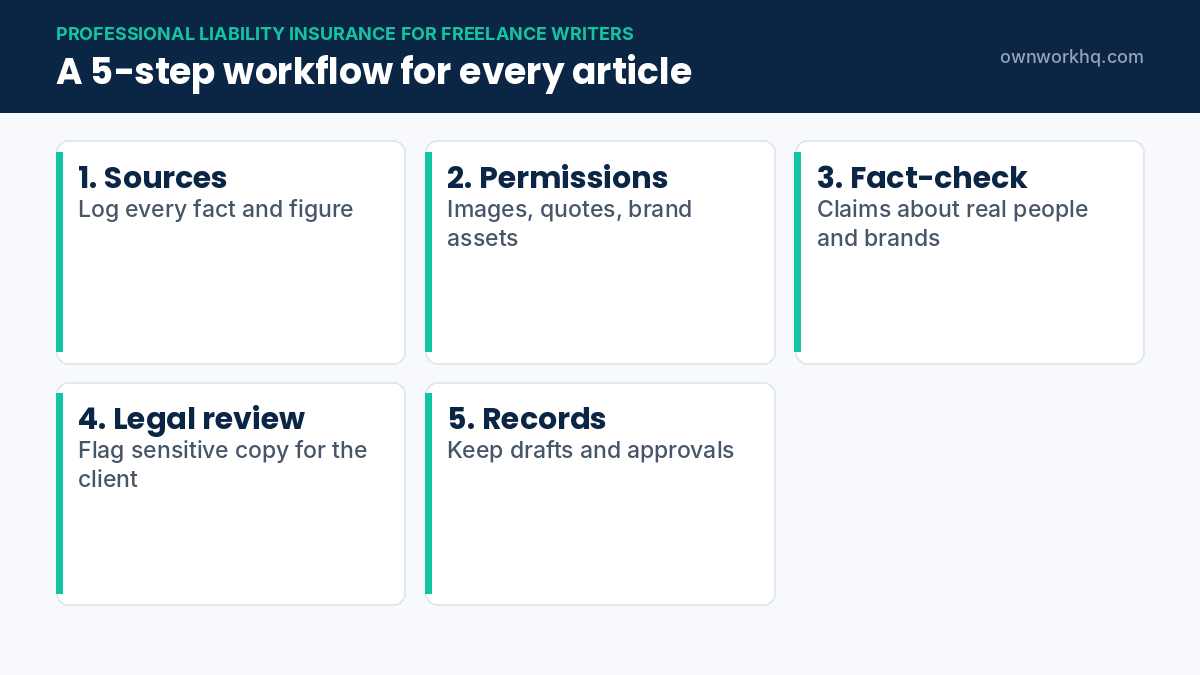
These records also help if a claim does arrive: they show what you wrote, what the client changed and what they approved.
AI tools and your liability as a writer
Many writers now use AI tools for research or drafts. That doesn’t change who is responsible for the final text: you are, under your contract. Practical safeguards:
- Verify every fact an AI tool produces; invented statistics and quotes are a known problem.
- Check originality before delivering, especially for long passages.
- Follow client rules: some contracts prohibit or restrict AI use, and breaking them can be a breach of contract.
- Ask your insurer how the policy treats AI-assisted content, as wording varies.
Claims-made policies, retroactive dates and tail coverage
Most media and professional liability policies are claims-made. A claim is covered only if it’s made while the policy is active and the work was done after the policy’s retroactive date. Articles stay online for years, so claims can arrive long after you were paid.
- Keep coverage continuous and renew on time.
- Keep your retroactive date when you switch insurers, if possible.
- Consider tail coverage (an extended reporting period) if you stop freelancing.
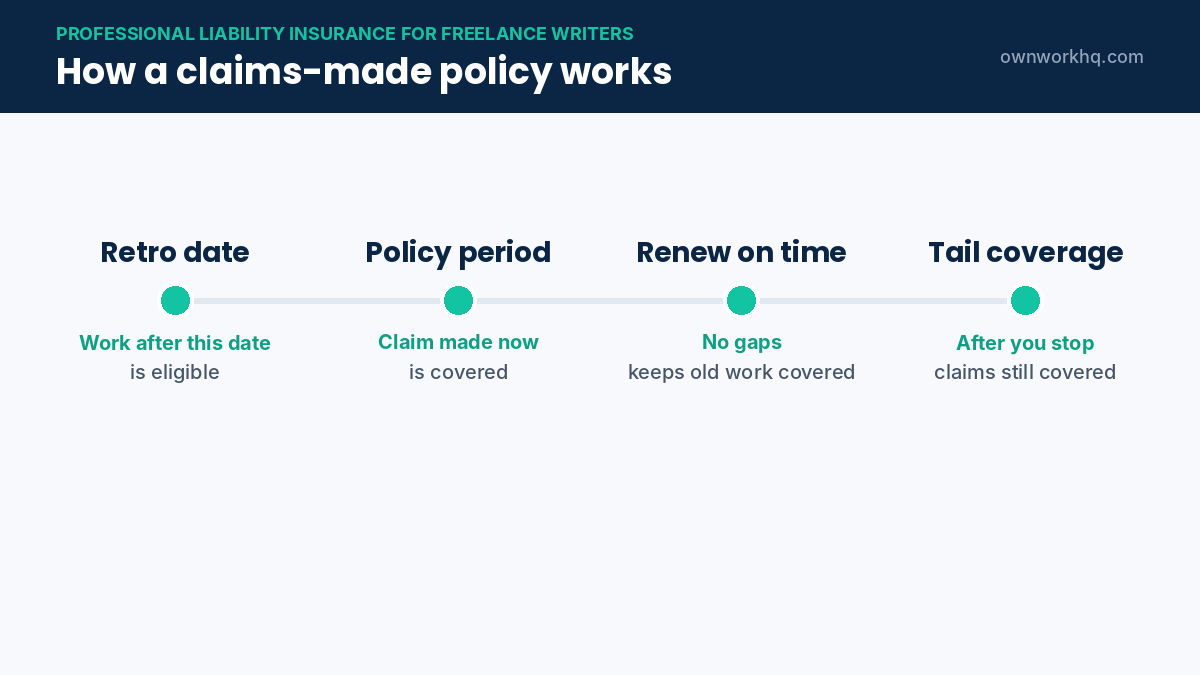
This is one of the most important details of professional liability insurance for freelance writers, and one of the easiest to overlook when comparing quotes.
How to read your policy before you buy
| Section | What to check |
|---|---|
| Declarations page | Limits per claim and aggregate, deductible, retroactive date, policy period |
| Insuring agreement | Which activities are covered: writing, editing, content strategy, social media |
| Exclusions | Intentional acts, contract disputes, prior known claims, specific content types |
| Defense costs | Whether legal fees reduce your limit (“defense within limits”) or are paid on top |
| Territory | Whether claims from outside the US are covered |
If anything is unclear, ask the insurer or broker in writing. The answers become part of your records if you ever need to make a claim.
Higher-risk niches for writers
- Finance and investing: readers act on numbers and recommendations.
- Health and medical: inaccurate information can cause harm.
- Legal and insurance topics: errors can lead to costly decisions.
- Reviews and comparisons: negative statements about real companies invite defamation claims.
- Ghostwriting for public figures: statements about others can be contested.
If you work in these niches, choose higher limits, use expert review where possible and keep especially careful records. For the money side of freelancing, see how to set freelance rates so your prices cover insurance costs.
Professional liability insurance for writers: buying checklist
- List the types of content you write and any high-risk niches.
- Check client contracts for required coverage, limits and indemnification clauses.
- Request quotes for media / professional liability with $1 million limits as a baseline.
- Compare the retroactive date, defense-cost terms and exclusions, not just the price.
- Add general liability if you meet clients or a contract requires it.
- Buy the policy, save your certificate and set a renewal reminder.
Writers who follow these steps usually find coverage that fits their budget. Remember that the cheapest policy isn’t a bargain if it excludes the kind of claim you’re most likely to face.
Real claim scenarios for freelance writers
| Scenario | Likely coverage |
|---|---|
| A company says your product comparison falsely called its software insecure | Media liability (defamation) |
| A photographer finds their image in a blog post you delivered | Media liability (copyright), if covered |
| A client says a wrong statistic in your white paper led to a costly decision | Professional liability (errors) |
| A case study reveals a customer’s private details without consent | Media liability (privacy) |
Even when a claim turns out to be groundless, legal defense can cost thousands of dollars. That’s the core value of professional liability insurance for freelance writers: it pays for defense so a single dispute doesn’t sink your business.
How much does it cost compared with your income?
At the median of about $78 a month, media liability costs roughly $930 a year. For a writer earning $60,000, that’s about 1.5% of revenue. Many solo writers with low-risk niches pay less. Build the premium into your rates the same way you include software and other business costs.
Frequently asked questions
How much is professional liability insurance for a freelance writer?
Insureon reports a median of about $78 per month (roughly $930 per year) for media and professional liability among media businesses, with $1 million limits. Solo writers in low-risk niches often pay less, and 28% of media customers pay under $50 per month.
Does general liability cover defamation in my articles?
Generally no. General liability may cover advertising injury in your own marketing, but claims arising from content you produce for clients are usually covered by media or professional liability insurance.
Does professional liability cover AI-generated content?
It depends on the policy wording. Some insurers are adding specific language about AI-assisted work. If you use AI tools, tell your insurer and ask how infringement or accuracy claims involving AI-assisted content are handled.
Is media liability insurance tax deductible?
For self-employed writers, business insurance premiums are generally deductible as a business expense. Keep records and confirm with a tax professional.
What happens if my insurance lapses?
Most writer policies are claims-made, meaning they cover claims made while the policy is active, for work done after the retroactive date. If coverage lapses, a later claim about an old article may not be covered. Ask about tail coverage if you stop freelancing.
Is professional liability insurance for freelance writers tax deductible?
Generally yes. Premiums for business insurance are deductible business expenses for self-employed writers and are reported on Schedule C.
Does my client’s insurance cover my work?
Not necessarily. A publisher’s or agency’s media policy may or may not extend to freelancers, and contracts often require you to indemnify the client. Check your contract and carry your own coverage if you take on risky work.
How much coverage does a freelance writer need?
Many clients ask for $1 million per claim. Writers in high-risk niches or working with large publishers may need more. Match your limit to your contracts and the kind of content you produce.
Does media liability cover social media posts I write for clients?
Often yes, if social media content is listed as a covered service. Confirm with the insurer, because some policies limit coverage to specific media or exclude advertising for certain industries.
Can I get professional liability insurance for freelance writers with no clients yet?
Yes. Insurers quote based on expected revenue and services. Starting coverage early also sets an earlier retroactive date for future claims-made policies.
Does professional liability insurance cover plagiarism claims?
It can cover defense against accusations of copyright infringement, but intentional plagiarism is typically excluded. Keeping drafts, sources and licenses helps show your work was original.
Will a policy cover articles I wrote before I bought it?
Only if they fall after the policy’s retroactive date. New policies often start the retroactive date on the purchase date, so earlier work may not be covered unless you negotiate prior-acts coverage.
Sources
- Insureon: Media and advertising business insurance costs (data updated April 2025)
- Insureon: Professional liability insurance cost (updated March 2026)
Disclaimer: This article is for informational purposes only and is not insurance, legal or financial advice. OwnWork HQ is not a licensed insurance agent. Coverage, prices and eligibility vary by insurer and state and can change at any time, so always confirm details with the insurer or a licensed broker before you buy.
About OwnWork HQ Editorial
We write plain-English guides for US freelancers and check every rate, limit and deadline against IRS and state agency publications. We are not CPAs or financial advisors; for advice on your situation, talk to a qualified professional.