Business Insurance for Freelance Graphic Designers: Coverage & Cost (2026)
In short: The business insurance freelance graphic designers need in 2026: media/professional liability, general liability and BOP, with median costs and tips to avoid trademark and copyright claims.

On this page
- What business insurance costs for graphic designers
- Business insurance for freelance graphic designers: the policies you need
- The biggest risk: trademarks, fonts and stock assets
- Contract clauses that protect graphic designers
- Do freelance graphic designers need insurance?
- How to buy business insurance as a graphic designer
- Common claims against graphic designers
- A print proof workflow that prevents expensive errors
- Trademark checks for logo projects
- Protecting your equipment
- Business insurance for freelance graphic designers: buying checklist
- Contract tips that cut graphic design claims
- Annual insurance budget examples
- Stock assets and licensing: a practical system
- When to add cyber insurance as a designer
- Frequently asked questions
- Sources
Graphic design looks low-risk from the outside: no heavy equipment, no job sites, no customers walking into a store. But freelance designers face very real claims: a logo that resembles an existing trademark, a font used without the right license, a print run with a typo that costs a client thousands. Business insurance for freelance graphic designers is mainly about protecting you from those creative and professional risks.
Key takeaways
- Media / professional liability (median ~$70/month for graphic designers) covers IP infringement, errors and client financial losses.
- General liability (~$33–$36/month) covers injuries and property damage, and is often required by contracts and leases.
- BOP (~$54–$56/month) bundles general liability with coverage for your computers, monitors and office.
- Trademark and copyright claims are the signature risk for designers. Check exactly how your policy covers them.
- Good contracts and licensing records reduce both your risk and your premium.
What business insurance costs for graphic designers
Two insurance marketplaces publish median premiums for design and media businesses:
| Policy | Median / average monthly | Annual | Typical limits | Source |
|---|---|---|---|---|
| Media liability (graphic designers) | $70 | about $840 | $1M / $1M | Insureon |
| Media / professional liability (all media businesses) | $78 | $930 | $1M / $1M, $1,000 deductible | Insureon |
| General liability (media businesses) | $33 | $394 | $1M / $2M, $500 deductible | Insureon |
| General liability (design businesses) | $36 | $435 | $1M / $2M, $500 deductible | TechInsurance |
| Business Owner’s Policy | $54–$56 | $648–$670 | $1M / $2M | TechInsurance / Insureon |
| Cyber insurance | $84–$108 | $1,002–$1,295 | Varies | TechInsurance / Insureon |
Insureon media business data updated April 2025. TechInsurance’s “designer” category includes a broad range of design businesses, so its professional liability average ($142/month) runs higher than what most solo graphic designers pay.
Business insurance for freelance graphic designers: the policies you need
1. Media or professional liability (most important)
This policy responds when a client or third party claims your work caused harm or financial loss. For graphic designers that typically includes:
- Trademark infringement: a logo or brand identity you created is too similar to an existing registered mark.
- Copyright infringement: an illustration, photo, icon set or font was used without the proper license.
- Errors and omissions: a typo or wrong price on 10,000 printed brochures, or a packaging file sent with the wrong dimensions.
- Missed deadlines that cause a client measurable losses (coverage varies; some policies exclude pure contract disputes).
2. General liability
General liability covers third-party bodily injury, property damage and certain advertising injury. Freelance designers usually buy it because a client contract, agency or coworking space requires it, or because they meet clients in person. It’s inexpensive, but remember: it doesn’t cover the quality or originality of your designs. Our guide to general liability insurance for consultants explains that difference in more detail.
3. Business Owner’s Policy or equipment coverage
A BOP bundles general liability with commercial property insurance. For designers, that can mean coverage for your computer, monitors, drawing tablet, cameras and printers if they’re damaged or stolen. Homeowners and renters policies often limit or exclude business equipment, so check yours.
4. Cyber insurance (situational)
If you manage client websites, social media accounts or customer data, cyber insurance can help with breach response and liability. Many print and brand designers who only exchange files can treat it as optional.
The biggest risk: trademarks, fonts and stock assets
Most claims against designers come down to rights. A few habits dramatically cut your exposure:
- Run a trademark search before delivering a logo. The USPTO trademark search is free, and you can include it as a step in your process.
- License fonts for commercial use and confirm whether the client needs its own license (web, app or broadcast use often requires additional licenses).
- Keep receipts and license terms for every stock photo, illustration and icon set.
- Put client-supplied assets in writing: the client confirms it has the rights to anything it gives you.
- Avoid “make it look like…” briefs that copy a competitor’s identity too closely.
Three scenarios where insurance pays off
Illustrative examples, not real claims.
- The rebrand. You design a new logo for a regional coffee chain. Six months later, a company with a registered trademark in the same industry sends a cease-and-desist and demands damages. The client asks you to cover the rebranding costs under your contract’s indemnity clause. Media liability with trademark coverage can pay for legal defense and a settlement.
- The menu misprint. A restaurant approves a digital proof, but the file you send to the printer has an older price list. They reprint 5,000 menus and bill you. If you can show the approved proof, your contract protects you. If the error was yours, professional liability (errors and omissions) is the policy that responds.
- The font license. You use a desktop-licensed font in an app interface. The foundry contacts the client for an unpaid app license and back fees. Depending on the policy, copyright coverage may help, but the cheapest fix is to license fonts correctly from the start.
How to lower your premium
- Choose a higher deductible if you can comfortably cover it.
- Bundle general liability with professional liability, or buy a BOP.
- Pay annually if a discount is offered.
- Keep documented processes for proofs, approvals and licenses, and mention them when you apply.
Contract clauses that protect graphic designers
| Clause | Why it matters |
|---|---|
| Final approval / proofing | The client signs off on final files and print proofs, which shifts responsibility for typos they approved. |
| Client-supplied materials | The client warrants it owns or licensed the content it provides. |
| Trademark clearance | Clarifies that formal legal clearance is the client’s responsibility unless you’re paid to manage it. |
| Limitation of liability | Caps your liability, often at the project fee. |
| Indemnification | Make it mutual and limited to your own negligence. |
| Usage rights | Defines what the client can use and where, reducing future disputes. |
Do freelance graphic designers need insurance?
It isn’t legally required for a solo designer with no employees. It’s strongly recommended if you create logos and brand identities, work on print production, design packaging, or sign contracts with indemnification clauses. Agencies and corporate clients increasingly require proof of coverage before they onboard freelancers.
If your work extends into websites, see business insurance for web designers, since building or maintaining sites adds tech E&O and cyber considerations.
How to buy business insurance as a graphic designer
- List your services: branding, print, packaging, illustration, web or social media design.
- Check client and lease requirements for limits and additional-insured wording.
- Get at least three quotes for media/professional liability, and ask about bundling general liability or a BOP.
- Read the IP section: which trademark and copyright claims are covered, and which are excluded.
- Keep coverage continuous to protect past projects under claims-made policies.
- Save your certificate of insurance for onboarding with new clients.
Common claims against graphic designers
| Scenario | Policy that usually responds |
|---|---|
| A logo you designed is challenged by a company with a similar trademark | Media / professional liability (if IP is covered) |
| A brochure goes to print with the wrong phone number | Professional liability (errors) |
| You used a font in a way its license doesn’t allow | Media liability, depending on IP coverage |
| A client trips over your laptop bag at their office | General liability |
| Your laptop and tablet are stolen from your studio | BOP or equipment coverage |
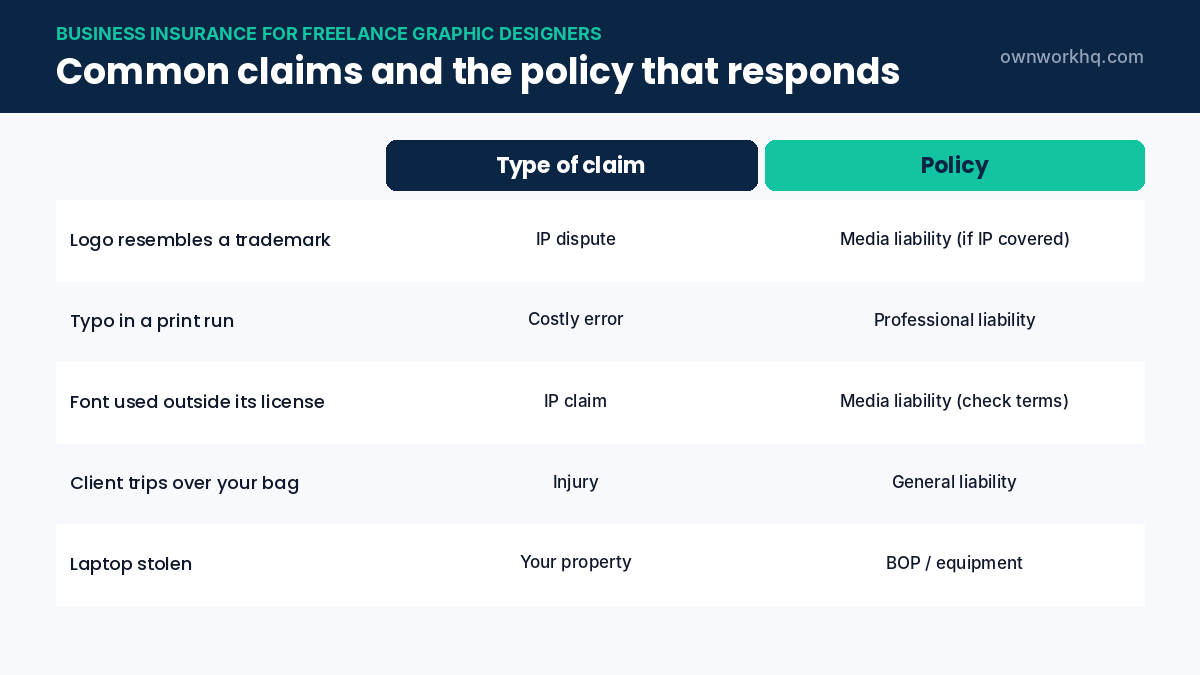
The table shows why business insurance for freelance graphic designers is mostly about media and professional liability: the costly claims come from the work itself, not physical accidents.
A print proof workflow that prevents expensive errors
- Send a PDF proof with a clear version number and date.
- Include a checklist for the client: names, phone numbers, addresses, prices, dates, URLs.
- Get written approval (“Approved for print”) from the person authorized to sign off.
- Review the printer’s proof before the full run, especially for color-critical work.
- Archive approvals with the project files.
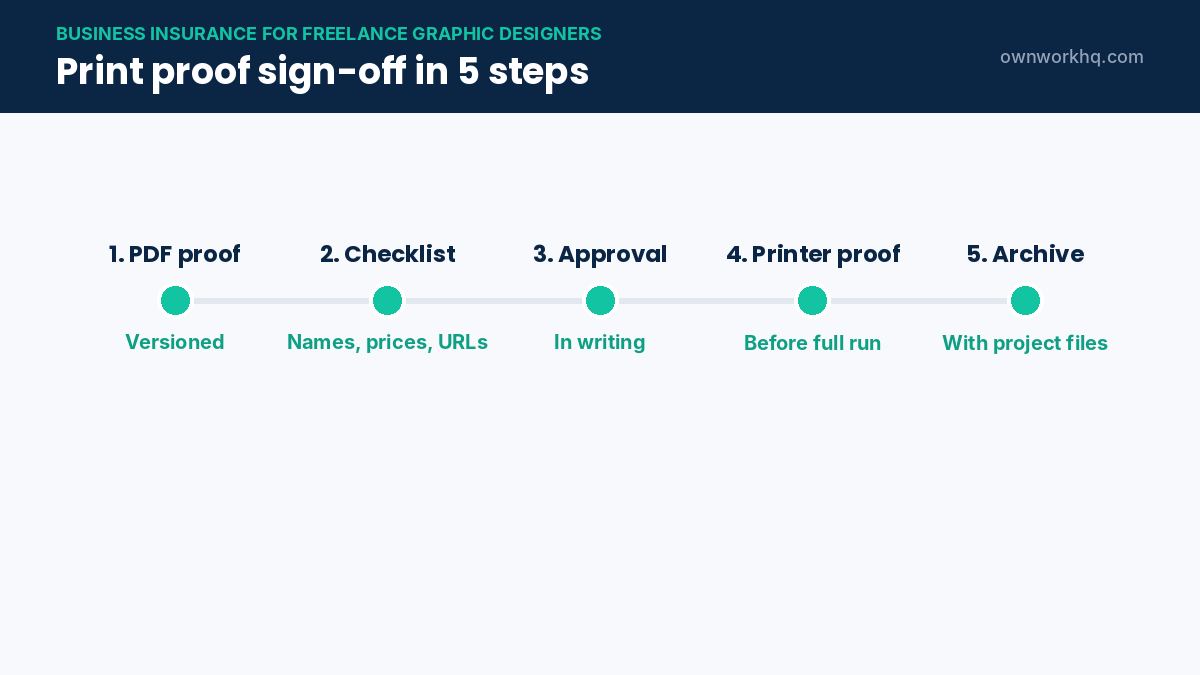
Written approvals shift responsibility for content errors back to the client and give your insurer strong evidence if a claim arises.
Trademark checks for logo projects
You can’t guarantee a logo is legally clear without a trademark attorney, but basic checks reduce risk:
- Search the USPTO’s trademark database for similar marks in the client’s industry.
- Run a reverse image search on final concepts.
- Avoid stock icons or templates as the core of a logo; most licenses don’t allow it.
- Write in your contract that the client is responsible for legal clearance and registration.
These steps also help when you apply for insurance, because insurers ask how you manage IP risk.
Protecting your equipment
Computers, tablets, monitors and cameras are a graphic designer’s main assets. General liability doesn’t cover them. Options include a BOP with business personal property coverage, a separate equipment policy, or an endorsement on your homeowners or renters policy if you work from home. Check whether coverage applies when you work from cafes or travel, and keep a list of serial numbers and receipts.
Business insurance for freelance graphic designers: buying checklist
- List your services: branding, print, packaging, digital, illustration.
- Check client contracts and coworking leases for insurance requirements.
- Start with media / professional liability and confirm how IP claims are covered.
- Add general liability if required, or a BOP if you also need equipment coverage.
- Compare limits, deductibles, retroactive dates and exclusions.
- Buy, download certificates and set a renewal reminder.
Contract tips that cut graphic design claims
- Limit revisions and define what counts as a revision versus a new concept.
- Assign rights only after full payment, and list what you keep (sketches, rejected concepts, portfolio use).
- Make the client responsible for final proofreading and legal clearance of logos and claims.
- Cap your liability at the fees paid for the project.
- State file deliverables: formats, source files and who owns fonts and stock licenses.
Adapt our freelance contract template with these points. Insurers look favorably on designers who use written contracts for every project.
Annual insurance budget examples
| Setup | Policies | Approximate yearly cost |
|---|---|---|
| Remote designer, small clients | Media / professional liability | About $840 |
| Designer with agency or corporate clients | Media liability + general liability | About $1,260 |
| Designer with a studio or expensive gear | Media liability + BOP | About $1,500 |
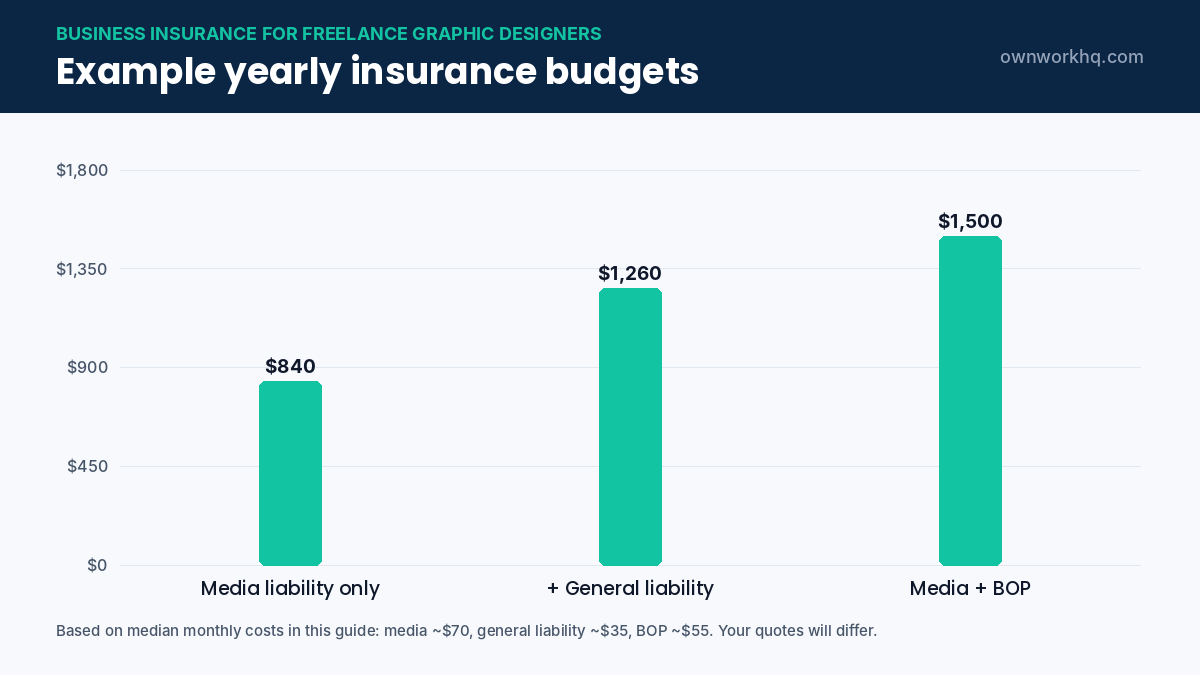
Based on the median monthly costs earlier in this guide. Divide by your billable hours to see how much insurance adds to your hourly rate; for most designers it’s a dollar or two.
Stock assets and licensing: a practical system
- Buy licenses that match the use: web, print run size, merchandise or advertising each may need a different license.
- License in the client’s name when they’ll keep using the asset after the project.
- Keep a license log with the asset ID, source, license type, date and project.
- Avoid free sites with unclear terms for commercial work.
- Check fonts separately: desktop, web and app embedding licenses are often sold separately.
A license log takes seconds per project and is often the fastest way to make an infringement claim go away. It also helps when renewing business insurance for freelance graphic designers, since insurers ask how you manage third-party content.
When to add cyber insurance as a designer
Pure print and branding work rarely needs cyber coverage. It becomes relevant if you manage client websites, run email campaigns with customer lists, store client logins or handle e-commerce assets. In those cases, a data incident could lead to notification costs and claims that media liability doesn’t cover.
Frequently asked questions
How much does insurance cost for a freelance graphic designer?
Insureon reports a median of about $70 per month for media liability among graphic designers, and roughly $33 per month for general liability among media businesses. A BOP that adds equipment coverage runs about $54–$56 per month in published data.
Does insurance cover me if my logo infringes a trademark?
It can, if your media or professional liability policy includes trademark infringement. Coverage varies by insurer, and intentional infringement is excluded. Ask the insurer specifically about trademark claims before buying.
Does homeowners insurance cover my design equipment?
Often only partially. Many homeowners and renters policies limit or exclude business property. A BOP or a business equipment endorsement is the safer choice if your gear is essential to your income.
Do I need insurance if I work through an agency?
Many agencies require freelancers to carry their own general and professional liability. Their policy protects the agency, not you.
Can I deduct insurance as a self-employed designer?
Business insurance premiums are generally deductible business expenses. Keep records and confirm with a tax professional.
Is business insurance for freelance graphic designers tax deductible?
Generally yes. Premiums for business insurance are deductible business expenses for self-employed designers and go on Schedule C.
Does insurance cover a client who refuses to pay?
No. Unpaid invoices are a business risk, not an insured event. Use deposits, milestone payments and a clear contract to protect your cash flow.
Do I need insurance if I only design for small local businesses?
It isn’t legally required, but a single IP or error claim can cost more than years of premiums. Many designers start with media liability even when clients don’t ask for it.
Does media liability cover AI-generated images in my designs?
Coverage depends on the policy wording. Some insurers are adding exclusions or questions about AI-generated content. Ask how claims involving AI tools are handled, and check the license terms of any tool you use.
Can a coworking space require me to have insurance?
Yes. Many coworking agreements require members to carry general liability and sometimes to name the space as an additional insured.
How quickly can I get insured as a graphic designer?
With most online insurers, you can compare quotes, buy coverage and download a certificate of insurance on the same day.
What limits do clients usually require from graphic designers?
Most ask for $1 million in professional or media liability and, when general liability is required, $1 million per occurrence and $2 million aggregate. Large brands and agencies sometimes ask for more.
Does a BOP cover my work mistakes?
No. A BOP combines general liability and property coverage. Errors in your designs and IP claims need professional or media liability.
Is insurance more expensive for packaging and print designers?
Often slightly, because print and packaging errors can be costly to fix once produced. Your revenue, limits and claims history matter more than the specialty itself.
Sources
- Insureon: Media and advertising business insurance costs (updated April 2025)
- TechInsurance: Designer insurance cost
- USPTO: Trademark search
Disclaimer: This article is for informational purposes only and is not insurance, legal or financial advice. OwnWork HQ is not a licensed insurance agent. Coverage, prices and eligibility vary by insurer and state and can change at any time, so always confirm details with the insurer or a licensed broker before you buy.
About OwnWork HQ Editorial
We write plain-English guides for US freelancers and check every rate, limit and deadline against IRS and state agency publications. We are not CPAs or financial advisors; for advice on your situation, talk to a qualified professional.