Professional Liability Insurance for Developers: Tech E&O Cost & Coverage (2026)
In short: What tech E&O (professional liability) insurance costs for freelance software developers in 2026, what it covers, how claims-made policies work, and what clients require.


On this page
- Professional liability insurance for software developers: how much does it cost?
- What tech E&O covers for developers
- What it usually doesn’t cover
- Do freelance developers really need it?
- Understanding claims-made policies and the retroactive date
- How much coverage should you buy?
- Open source, AI-generated code and IP risk
- How to buy tech E&O as a software developer
- Reading an MSA insurance clause, line by line
- Working through platforms and staffing agencies
- Services vs software products: a coverage gap to watch
- Security habits that reduce risk (and help with underwriting)
- Professional liability insurance for software developers: buying checklist
- Professional liability insurance for developers: real claim examples
- How much tech E&O do freelance developers usually carry?
- Frequently asked questions
- Sources
Freelance and contract software developers sign a lot of master service agreements (MSAs), and almost every one has an insurance section. The line that trips people up is usually: “Contractor shall maintain Technology Errors & Omissions insurance with limits of not less than $1,000,000.” That’s professional liability insurance for developers, and it’s the policy that responds when a client claims your code cost them money.
Key takeaways
- Tech E&O is the professional liability policy for developers. It covers bugs, failed deliverables, missed deadlines and negligence claims.
- Typical cost: $59–$111/month for $1M/$1M limits (TechInsurance and Insureon data).
- Cyber insurance (median $124/month for software developers) covers data breaches and is often bundled with tech E&O.
- General liability (median $32/month) is cheap and often required, but it doesn’t cover your code.
- Watch the retroactive date: tech E&O is usually claims-made, so gaps in coverage can leave past projects exposed.
Professional liability insurance for software developers: how much does it cost?
| Policy | Median / average monthly | Annual | Typical limits / deductible | Source |
|---|---|---|---|---|
| Tech E&O (independent contractors) | $59 | $713 | $1M / $1M, $2,500 deductible | TechInsurance |
| Tech E&O (software development businesses) | $111 | $1,330 | $1M / $1M, $2,500 deductible | Insureon |
| Cyber insurance | $124 | $1,492 | Varies | Insureon |
| General liability | $32 | $385 | $1M / $2M, $500 deductible | Insureon |
| Business Owner’s Policy (BOP) | $67 | $806 | Varies | Insureon |
Insureon’s software developer figures were last updated in August 2024 and are based on businesses with fewer than five employees and roughly $50,000 to $200,000+ in annual revenue. TechInsurance reports that 89% of independent contractors pay less than $100/month for tech E&O.
The range is wide because tech E&O is priced on risk. A solo developer building internal tools for small businesses pays far less than a team building payment systems, healthcare software or anything that processes sensitive data.
What tech E&O covers for developers
Technology errors and omissions insurance typically pays for legal defense and settlements when a client claims your services caused a financial loss. Common claims for developers include:
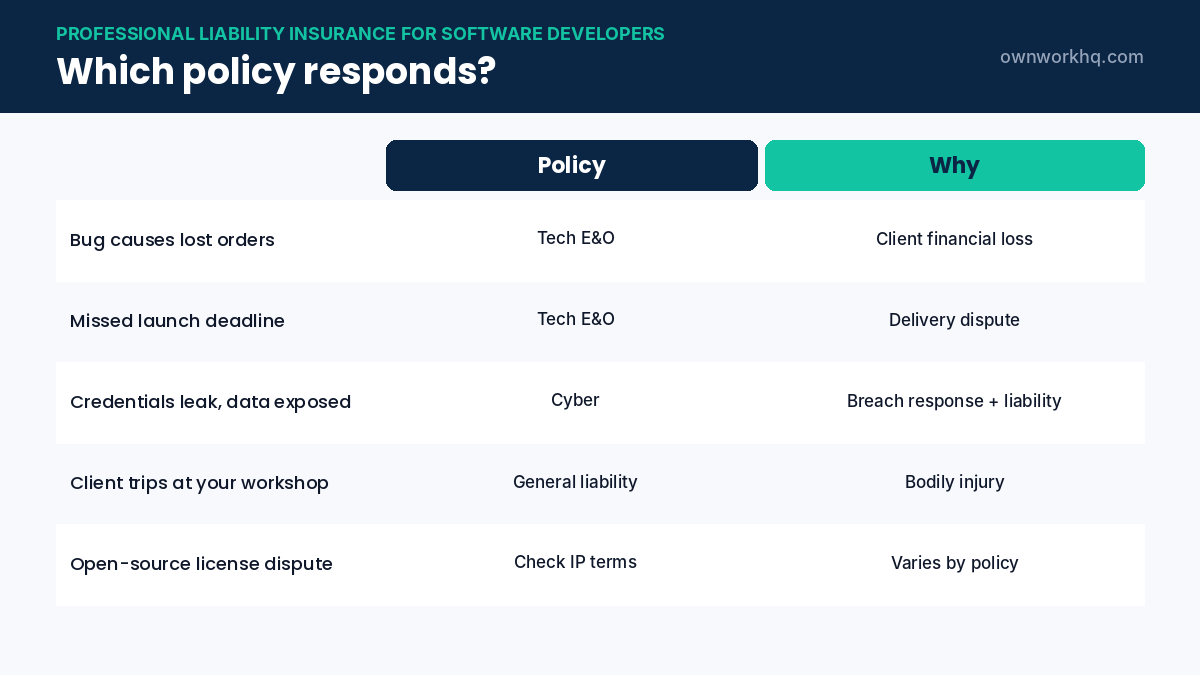
- Software bugs and defects that cause downtime, lost sales or corrupted data.
- Failure to deliver features or functionality promised in the statement of work.
- Missed deadlines that cost the client a launch window or contract.
- Negligence, such as a deployment that wipes a production database.
- Integration failures that break a client’s existing systems.
Many tech E&O policies also include, or can add, coverage for some intellectual property claims and cyber incidents. Read the policy to see exactly what’s included.
What it usually doesn’t cover
| Risk | Covered by tech E&O? | What covers it |
|---|---|---|
| Client’s customer data is breached through your system | Often partially or not at all | Cyber insurance (first- and third-party) |
| A visitor trips over your equipment at a client office | No | General liability |
| Your laptop is stolen | No | BOP / commercial property or equipment coverage |
| Intentional violations or fraud | No | Not insurable |
| Fee disputes (client just refuses to pay) | No | Your contract and collections process |
| Patent infringement | Usually excluded | Specialized IP insurance |
Do freelance developers really need it?
No law requires it, but in practice you need tech E&O when:
- Your contracts require it. Enterprise MSAs and staffing agencies often require $1M–$2M in tech E&O, plus cyber and general liability.
- Your code touches money, data or uptime: e-commerce, fintech, healthcare, SaaS integrations, data pipelines.
- You operate as a sole proprietor, where a judgment could reach personal assets.
- You indemnify clients in your contracts.
If you also design websites for clients, see our guide to business insurance for web designers, which covers overlapping risks.
Understanding claims-made policies and the retroactive date
Tech E&O is almost always written on a claims-made basis. That means the policy responds to claims made while it’s active, for work performed after the retroactive date. Three practical rules:
- Avoid gaps. If your policy lapses and you buy a new one later, the new retroactive date may start fresh, leaving earlier projects uncovered.
- Keep your retro date when switching insurers. Ask the new insurer to honor your original retroactive date (“prior acts coverage”).
- Buy tail coverage if you stop freelancing. An extended reporting period protects you from claims that arrive after you close your business.
How much coverage should you buy?
Tech E&O limits are shown as two numbers: a per-claim limit (the most the policy pays for one claim) and an aggregate limit (the most it pays during the policy period). Most solo developers buy $1M / $1M. Consider higher limits when:
- A client contract requires $2M or more, which is common with large enterprises, banks, hospitals and government agencies.
- Your projects affect revenue-critical systems, like payments, checkout or core SaaS infrastructure.
- You work on several large contracts at once, so one aggregate limit could be shared across multiple claims.
- Defense costs reduce your limit under your policy (“defense within limits”). Ask whether that applies.
Increasing limits from $1M to $2M usually costs noticeably less than double the premium, so get quotes for both.
Three illustrative claim scenarios
Hypothetical examples to show how coverage works.
- The checkout bug. A rounding error in a discount module you built undercharges customers for two weeks. The retailer claims $40,000 in lost revenue. Tech E&O would typically respond to the claim and pay defense costs.
- The migration. During a database migration, records are lost and the client spends weeks restoring them. They allege negligence. Tech E&O covers negligence claims; data restoration costs may fall under cyber, depending on the policy.
- The leaked credentials. API keys committed to a public repository are used to access a client’s customer data. Breach notification and third-party claims usually fall under cyber insurance, which is why many developers buy both policies together.
Open source, AI-generated code and IP risk
Developers increasingly use open-source libraries and AI coding assistants. Both create potential IP questions, from license obligations (for example, copyleft licenses) to claims that generated code reproduces someone else’s work. Coverage for these claims varies by insurer. Disclose your practices honestly when applying, ask how IP claims are handled, and keep a record of the licenses of the dependencies you ship.
How to buy tech E&O as a software developer
- Gather client requirements: limits, cyber requirements, additional insured, waiver of subrogation, primary and non-contributory wording.
- Describe your work precisely: stack, industries, whether you handle personal or payment data, and your revenue.
- Get at least three quotes from tech-focused online insurers or a broker. Bundled tech E&O + cyber is common.
- Compare: limits, deductible, retroactive date, cyber sublimits and exclusions (IP, contractual liability).
- Send the certificate of insurance and any endorsements the client requested.
Contract tips that reduce your exposure
- Cap your liability at the fees paid under the contract.
- Exclude consequential damages (lost profits, lost data) where possible.
- Define acceptance testing, so delivered work is signed off.
- Make the client responsible for backups and production access controls.
- Make sure your indemnity obligations match what your policy actually covers.
Reading an MSA insurance clause, line by line
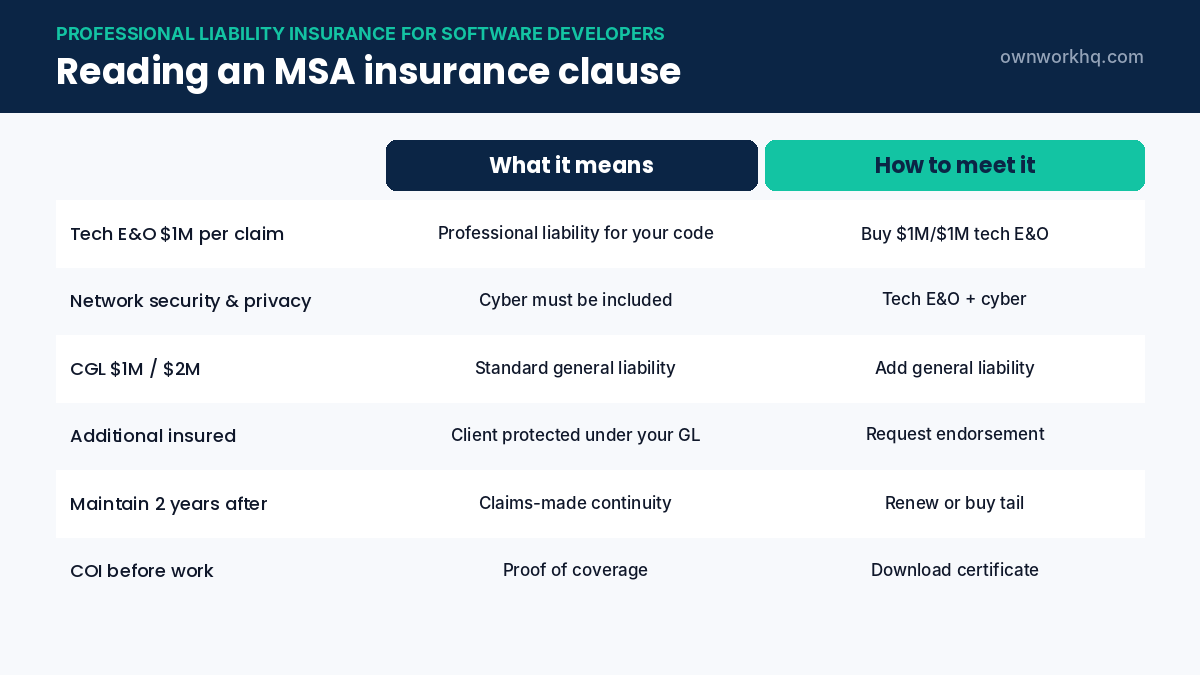
Most client contracts for developers use similar wording. Here’s what a typical clause asks for and how to respond:
| Clause wording | What it means | How to meet it |
|---|---|---|
| “Technology Errors & Omissions with limits of not less than $1,000,000 per claim” | Tech E&O with at least $1M per claim | Buy a policy with $1M/$1M limits or higher |
| “Including network security and privacy liability” | Cyber liability must be part of the coverage | Choose tech E&O with cyber included, or add a cyber policy |
| “Commercial General Liability of $1,000,000 per occurrence / $2,000,000 aggregate” | Standard general liability | Add a general liability policy |
| “Client shall be named as additional insured” | Client gets protection under your general liability | Request an additional insured endorsement |
| “Coverage shall be maintained for 2 years after termination” | Claims-made coverage must continue after the project ends | Renew continuously or buy tail coverage |
| “Certificate of insurance prior to commencement of work” | Proof before you start | Download a certificate from your insurer |
If a requirement is disproportionate to the project, such as $5 million for a short contract, ask for it to be reduced. Procurement teams often accept a lower limit for smaller engagements.
Working through platforms and staffing agencies
- Freelance marketplaces generally don’t extend their own insurance to you. If a client sues over your code, your own professional liability insurance for software developers is what responds.
- Staffing agencies and staff augmentation firms often require you to carry tech E&O and general liability before placing you with a client.
- Subcontracting for an agency usually means the agency’s contract flows its insurance requirements down to you.
- Corp-to-corp contracts through your LLC typically require the LLC to be the named insured.
Read the agency agreement carefully; the insurance section is often longer than the scope of work.
Services vs software products: a coverage gap to watch
Tech E&O is designed for professional services: building, customizing and maintaining software for clients. If you also sell your own app, plugin or SaaS product, claims from its users may need different or additional coverage. Tell your insurer about every product you sell, and check that your policy’s definition of “technology services” or “technology products” includes them.
Security habits that reduce risk (and help with underwriting)
- Never commit secrets: use environment variables or a secrets manager.
- Use separate, least-privilege credentials for each client, and remove access when projects end.
- Turn on two-factor authentication for code hosting, cloud and client systems.
- Require code review or automated tests before deploying to production.
- Keep backups and a rollback plan for every release.
- Encrypt your laptop and keep your OS and dependencies updated.
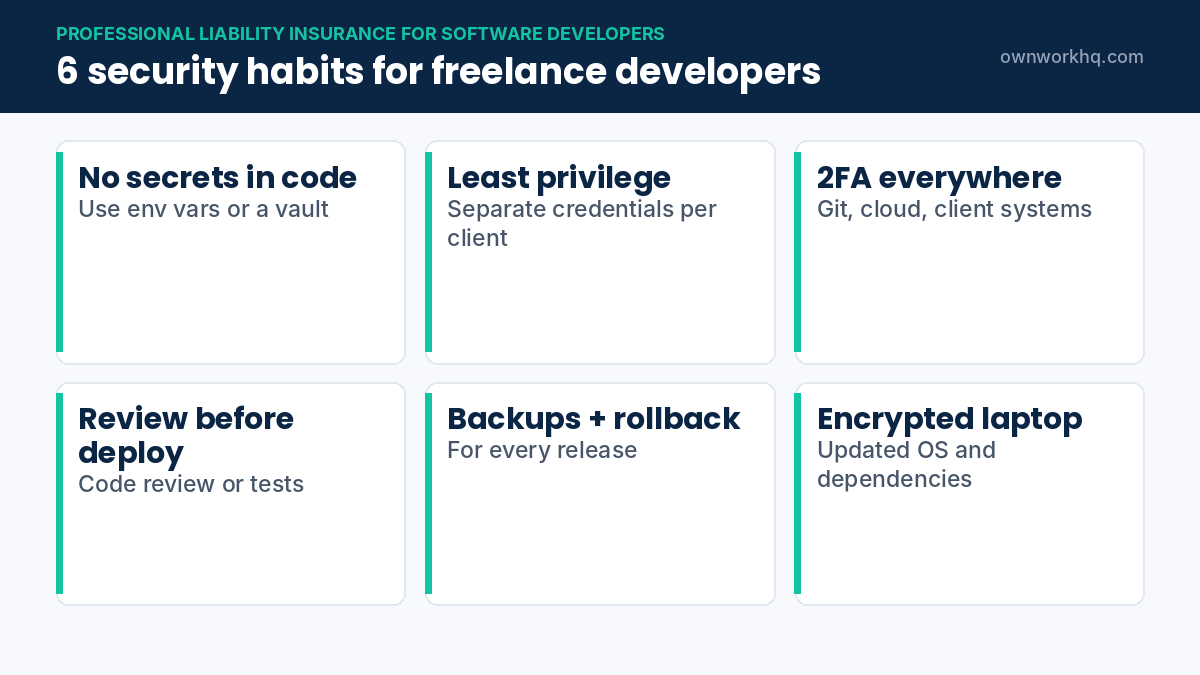
Insurers increasingly ask about these controls on applications, especially for cyber coverage. Good answers can improve your options and price.
Professional liability insurance for software developers: buying checklist
- Collect the insurance clauses from your current contracts and agency agreements.
- Decide on limits: $1M/$1M is the common baseline; raise it if contracts require.
- Choose tech E&O with cyber included, or price a separate cyber policy.
- Add general liability if contracts or coworking leases ask for it.
- Compare retroactive dates, exclusions and how defense costs are handled.
- Buy the policy, issue certificates and calendar the renewal date.
Pair the policy with clear contracts. A limitation of liability tied to fees paid and precise acceptance criteria make claims less likely. Our freelance contract template covers the basics.
Professional liability insurance for developers: real claim examples
| What happened | Why it became a claim |
|---|---|
| A payment integration double-charged customers for a weekend | The client paid refunds and lost customers, then sought damages |
| A migration script deleted historical records | The client paid to restore data and blamed the developer |
| An app launch slipped by six weeks | The client missed a seasonal sales window covered in the contract |
| An API key was exposed in a public repository | Attackers used the client’s cloud account, creating a large bill |
Each of these is the kind of financial-loss claim that professional liability insurance for developers is built for, with cyber coverage handling the breach-related costs in the last example.
How much tech E&O do freelance developers usually carry?
| Situation | Common limits |
|---|---|
| Small business clients, low-risk projects | $1M per claim / $1M aggregate |
| Enterprise clients or staffing agencies | $1M–$2M per claim, sometimes higher |
| Fintech, healthcare or e-commerce systems | $2M–$5M, plus cyber |
Higher limits cost more, but the increase is usually smaller than the jump from no coverage to $1 million. If one large client requires a higher limit, ask whether a project-specific increase is possible.
Frequently asked questions
How much is tech E&O insurance for a freelance developer?
Published data puts it at roughly $59 to $111 per month for $1 million in coverage. TechInsurance reports an average of $59/month for independent contractors, and Insureon reports a median of $111/month for software development businesses. Your price depends on your work, revenue and data exposure.
Is tech E&O the same as professional liability?
Yes, tech E&O is a form of professional liability tailored to technology services. It often includes or can add cyber coverage, which a standard professional liability policy may not.
Do I need cyber insurance too?
If you store, process or have access to client or customer data, cyber insurance is strongly recommended and many enterprise contracts require it. Some insurers bundle it with tech E&O.
Will my client’s insurance cover me as a contractor?
Usually not. Client policies protect the client. That’s why contracts require contractors to carry their own coverage and often to name the client as an additional insured.
Are insurance premiums tax deductible for freelance developers?
Business insurance premiums are generally deductible business expenses for self-employed people. Confirm the treatment with a tax professional.
Is professional liability insurance for software developers tax deductible?
Generally yes. Premiums for tech E&O, cyber and general liability are deductible business expenses for self-employed developers.
Does tech E&O cover open-source license violations?
Some policies cover intellectual property claims, including certain copyright allegations, while others exclude them or offer limited sublimits. Ask how open-source license claims are treated before you buy.
Do I need tech E&O if I only work on internal tools for one client?
If the client’s contract requires it, yes. Even without a requirement, a bug in an internal tool can still cause financial loss, so many developers keep coverage for all client work.
Does tech E&O cover work I subcontract to other developers?
Some policies cover work done on your behalf by subcontractors; others exclude it or require the subcontractor to carry their own policy. Ask your insurer, and require subcontractors to have tech E&O.
Will my policy cover claims from work done before I bought it?
Only if the work falls after the policy’s retroactive date. Many new policies start the retroactive date on the purchase date, so earlier projects may not be covered.
Is professional liability insurance for developers the same as cyber insurance?
No. Tech E&O covers claims that your services caused a client financial loss. Cyber insurance covers data breaches and network security incidents. Many insurers sell them together, and many contracts require both.
Can I get professional liability insurance for developers if I work part-time?
Yes. Insurers quote based on your expected revenue and services, so part-time and side-project developers can usually buy the same coverage at a lower premium.
Sources
- Insureon: Software developer insurance costs (updated August 2024)
- TechInsurance: Independent contractor insurance cost
Disclaimer: This article is for informational purposes only and is not insurance, legal or financial advice. OwnWork HQ is not a licensed insurance agent. Coverage, prices and eligibility vary by insurer and state and can change at any time, so always confirm details with the insurer or a licensed broker before you buy.
About OwnWork HQ Editorial
We write plain-English guides for US freelancers and check every rate, limit and deadline against IRS and state agency publications. We are not CPAs or financial advisors; for advice on your situation, talk to a qualified professional.