Workers’ Compensation for Freelancers (2026): Do You Need It?
In short: Do freelancers need workers' compensation? When solo workers are exempt, why clients ask for it, what a ghost policy is, how much it costs, and what changes once you hire employees.


On this page
- Workers compensation for freelancers: do you need it?
- Why clients ask freelancers for workers’ comp
- Your options when a client requires coverage
- How much workers’ comp costs
- When you hire your first employee
- Subcontractors and misclassification
- Protecting yourself without workers’ comp
- Employer requirements in selected states
- How to buy workers’ comp as a freelancer
- Common mistakes with workers’ comp
- If you’re injured while freelancing
- Real-world scenarios
- Questions to ask before you buy
- Occupational accident insurance in more detail
- What the coverage pays when an employee is hurt
- LLC members and S corp owners
- Workers’ comp vs other business insurance
- The bottom line
- Frequently asked questions
- Sources
Workers’ compensation pays medical bills and lost wages when an employee is hurt on the job. Most freelancers have no employees, so the question is whether they need it at all. The answer to workers compensation for freelancers is usually no, until a client contract requires it or you hire your first employee.
Key takeaways
- Solo freelancers with no employees are usually exempt from carrying workers’ comp for themselves.
- Clients, especially in construction and events, may require a certificate of coverage or proof of exemption.
- A ghost policy is a low-cost policy that covers no one but can satisfy some contract requirements.
- Once you hire employees, nearly every state requires coverage, with thresholds that vary by state and industry.
- To protect your own income, disability insurance and health insurance often matter more than workers’ comp.
Workers compensation for freelancers: do you need it?
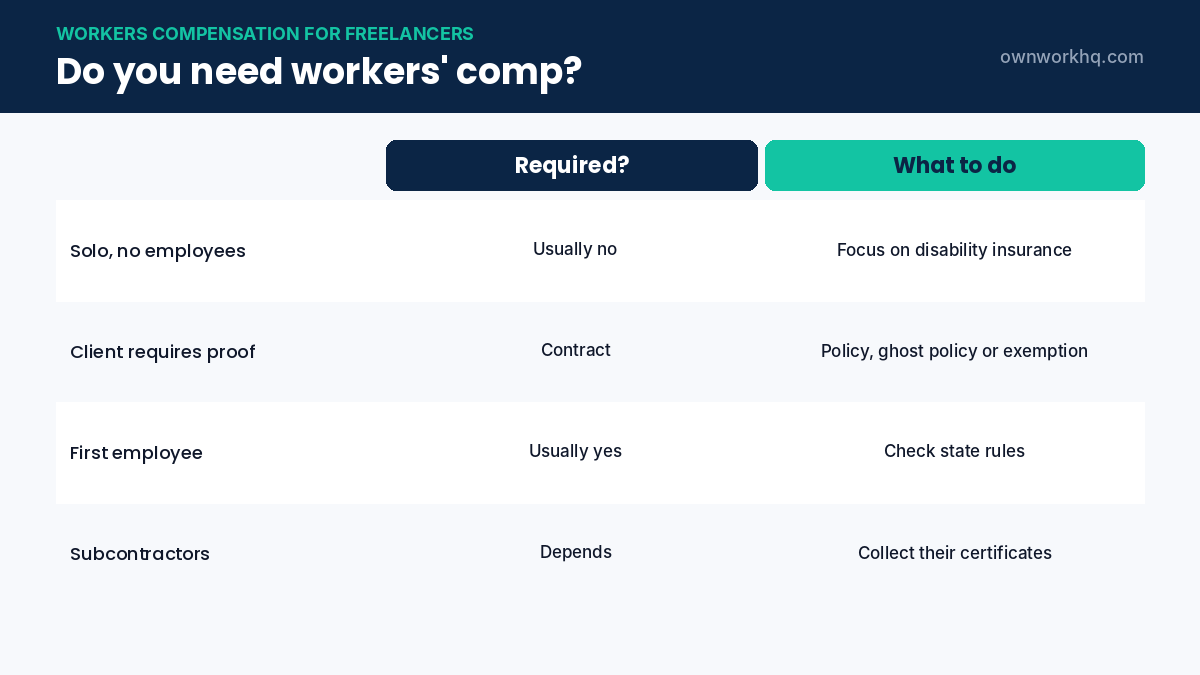
| Your situation | Do you need workers’ comp? |
|---|---|
| Solo freelancer, no employees, no client requirement | Usually not required |
| A client contract requires proof of coverage | Policy, ghost policy or exemption certificate, depending on the client and state |
| You hire your first employee | Generally required, depending on your state and industry |
| You work with subcontractors | Collect their certificates; uninsured subcontractors can count as your employees in some states |
| You work in construction | Rules are stricter; even owners may need coverage in some states |
State laws decide who must carry coverage. In most states, sole proprietors, partners and LLC members can choose to cover themselves but aren’t required to. Corporate officers may be treated differently, and construction trades often have tighter rules. Check your state’s workers’ compensation agency before you rely on an exemption.
Why clients ask freelancers for workers’ comp
Larger clients and general contractors often require every vendor to show workers’ comp coverage. Their reason is simple: if an uninsured contractor is injured on their site, the client’s own policy may end up paying, and their auditor may charge them extra premium for uninsured contractors. A certificate of insurance or proof of exemption protects them from that cost.
This is most common for freelancers who work on site: event and wedding photographers, videographers, installers, consultants working at client facilities and anyone in construction-related work. Remote freelancers such as writers and developers are asked less often.
Your options when a client requires coverage
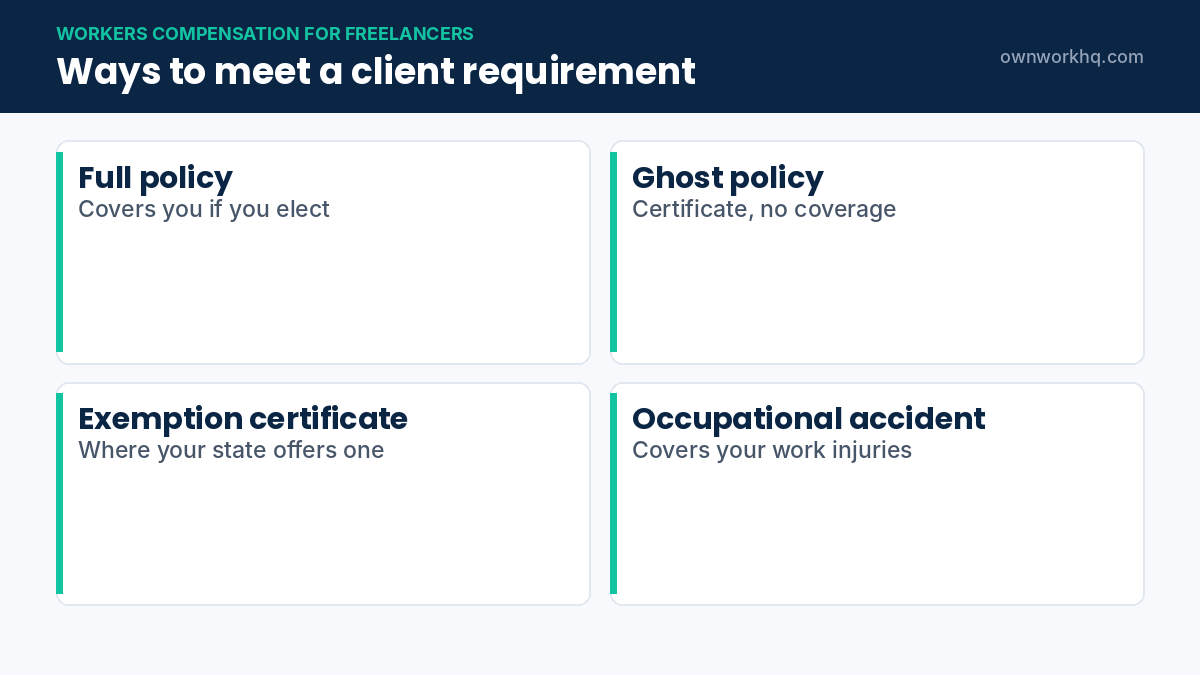
- Buy a full policy that covers you: you pay premium based on your own payroll or a set amount for owners, and you’re covered for work injuries.
- Buy a ghost policy: a minimum-premium policy with no employees listed. It covers no one, but it produces a certificate of insurance some clients accept.
- Provide an exemption certificate: some states issue certificates showing you’re exempt as a sole proprietor or officer.
- Negotiate: ask whether general liability and professional liability certificates, plus a signed waiver, will satisfy the requirement.
A ghost policy is often the cheapest way to satisfy a contract, but it doesn’t protect you. If you get hurt, it pays nothing. Make sure you understand that before buying one.
How much workers’ comp costs
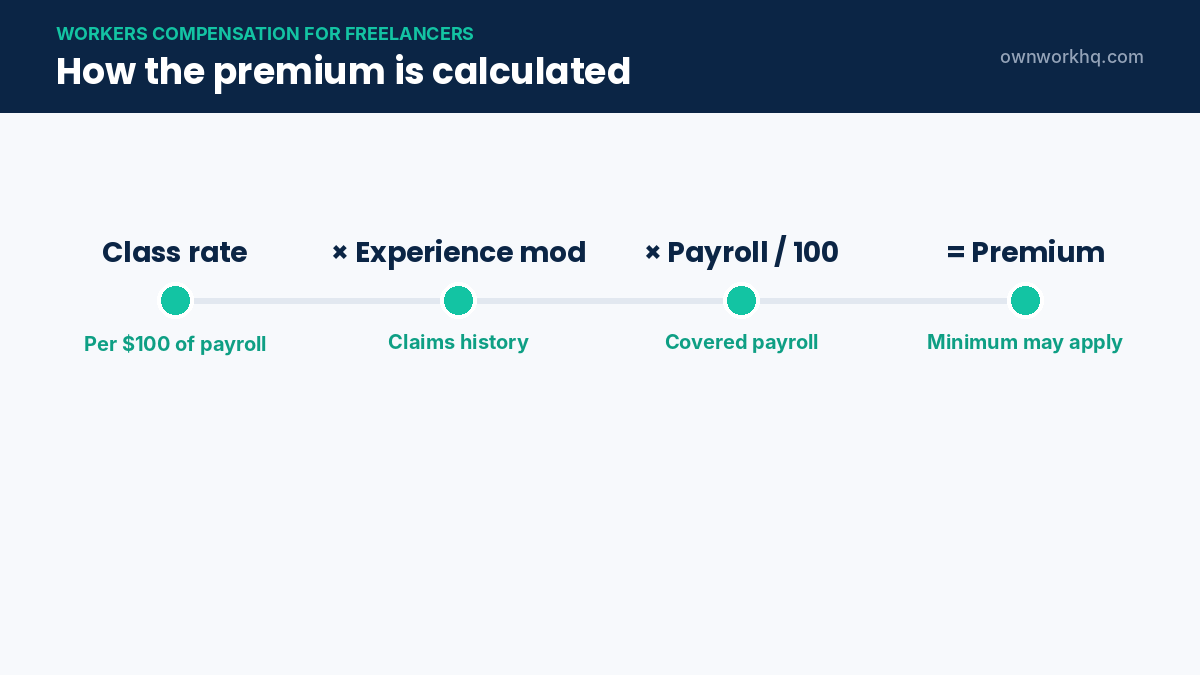
Workers’ comp premiums are based on payroll, the risk of the work and your claims history. Insurers use this formula:
| Part of the formula | What it means |
|---|---|
| Classification rate | A rate per $100 of payroll, based on the type of work; office work is far cheaper than construction |
| Experience modification | Adjusts the rate up or down based on your claims history; new businesses usually start at 1.0 |
| Payroll ÷ $100 | Your covered payroll, in hundreds of dollars |
According to Insureon, small businesses pay a median of about $54 a month, or $643 a year. Solo freelancers who only need a ghost policy or a minimum premium policy may pay a few hundred dollars a year, while businesses with employees in physical trades pay far more.
When you hire your first employee
Hiring changes everything. Nearly every state requires employers to carry workers’ comp, though thresholds vary. Texas is the notable exception: private employers can generally choose not to carry it, but they give up important legal protections. Some states only require coverage after a set number of employees, and construction businesses are often covered from the first worker. Part-time employees and family members may count, depending on the state.
- Check your state’s rules before your new hire’s first day.
- Get quotes from insurers or your state fund, if your state has one.
- Report payroll accurately; policies are audited at the end of the term.
- Post any required workers’ comp notices at your workplace.
Penalties for operating without required coverage can be severe, including fines, stop-work orders and personal liability for an injured employee’s costs.
Subcontractors and misclassification
If you hire other freelancers to help with projects, collect their certificates of insurance before they start. In many states, if an uninsured subcontractor is injured, your policy, or you, may be responsible as though they were your employee. Workers’ comp auditors may also add payments to uninsured subcontractors to your payroll and charge premium on them.
Classification matters too. If someone works like an employee, with set hours and your direction, calling them a contractor doesn’t change their status. Our guide to 1099 vs W-2 explains the difference.
Protecting yourself without workers’ comp
Workers’ comp is designed for employees. As a solo freelancer, these usually do more to protect you:
- Health insurance: pays for medical care after an injury, wherever it happens; check your plan’s exclusions. See health insurance for self-employed freelancers.
- Disability insurance: replaces part of your income if you can’t work, whether the cause is an injury or illness; read disability insurance for self-employed workers.
- Occupational accident insurance: a lower-cost policy common among independent drivers and contractors that pays medical and income benefits for work injuries.
- General liability insurance: covers injuries to other people and damage to their property, not your own injuries.
Employer requirements in selected states
| State | When employers generally must carry coverage |
|---|---|
| California | From the first employee |
| New York | From the first employee, in most cases |
| Florida | 4 or more employees (non-construction); 1 or more in construction |
| Georgia | 3 or more employees |
| North Carolina | 3 or more employees |
| Alabama | 5 or more employees |
| Texas | Optional for most private employers |
These are general rules for private employers; part-time workers, family members and certain occupations may be treated differently. Your state’s workers’ compensation board or industrial commission publishes the exact rules, and an insurance agent can confirm what applies to your business.
How to buy workers’ comp as a freelancer
- Decide what you need: real coverage for yourself or employees, or a certificate to satisfy a client.
- Find your class code: the classification that matches your work determines your rate.
- Get quotes: from online small-business insurers, a local agent, or your state fund where one exists.
- Estimate payroll honestly: premium is adjusted after an audit at the end of the policy term.
- Request certificates: add clients as certificate holders when they ask, usually at no charge.
Some insurers bundle workers’ comp with general liability and other coverage, which can simplify billing for small businesses with employees.
Common mistakes with workers’ comp
- Assuming a ghost policy protects you; it doesn’t cover your injuries.
- Hiring without checking state rules, even for a part-time helper.
- Paying uninsured subcontractors without collecting certificates.
- Underestimating payroll and getting a large bill after the audit.
- Skipping disability insurance because you think workers’ comp would cover you as a solo owner.
If you’re injured while freelancing
Without a workers’ comp policy that includes you, a work injury is handled like any other injury: your health insurance pays medical bills under its normal terms, and disability insurance, if you have it, replaces part of your income after the waiting period. If someone else caused the injury, such as a client’s negligence on their property, their liability insurance may be responsible. Keep records of how and where the injury happened, and tell your health insurer if it occurred during work, since some plans coordinate benefits with other coverage.
Real-world scenarios
| Scenario | What usually applies |
|---|---|
| A wedding photographer trips while carrying gear at a venue | Your health insurance pays medical bills; disability insurance replaces income if you can’t work. The venue’s liability insurance may apply only if the venue was negligent. |
| A consultant’s client requires a certificate before an on-site project | A ghost policy, an exemption certificate or a policy that covers you, depending on the client and state |
| A designer hires a part-time assistant | Check state rules; in many states coverage is required from the first employee |
| A videographer pays a second shooter as a subcontractor | Collect the second shooter’s certificate; otherwise your policy or you may be responsible if they’re hurt |
| A remote developer with no employees | Usually no requirement; focus on disability and professional liability coverage |
The pattern is consistent: for a solo freelancer, the main reasons to buy a policy are contracts and future hiring, not protection for yourself. For your own protection, income replacement and health coverage do most of the work.
Questions to ask before you buy
- Does my state allow ghost policies, or will the insurer require me to include myself?
- Which class code fits my work, and what is the rate per $100 of payroll?
- What is the minimum premium for a business like mine?
- Will the client accept a certificate from this insurer and policy type?
- How will the year-end audit work if my business changes during the year?
Getting these answers in writing avoids surprises at audit time and makes it easier to compare quotes from different insurers or a state fund.
Occupational accident insurance in more detail
Occupational accident insurance is a common alternative for independent contractors who can’t or don’t want to buy a full policy. It typically pays medical expenses, a weekly disability benefit and a death benefit for injuries that happen while working. Benefits and limits are usually lower than a traditional policy, and it doesn’t cover illnesses. It’s popular with delivery and rideshare drivers and some trades. Compare it with disability insurance, which covers both injuries and illnesses and isn’t limited to accidents at work.
What the coverage pays when an employee is hurt
- Medical care: treatment related to the work injury or illness, usually with no deductible for the employee.
- Wage replacement: a portion of lost wages while the employee can’t work, often around two-thirds of average weekly wages up to a state maximum.
- Rehabilitation: physical therapy and, in some cases, retraining for a new role.
- Death benefits: payments to dependents if a work injury is fatal.
- Employer’s liability: most policies also defend you if an employee sues over a work injury in situations the system allows.
In exchange, employees generally can’t sue the employer for work injuries covered by the system. That trade-off is the main reason the coverage exists, and it’s why going without it when required can expose a small business to lawsuits as well as fines.
LLC members and S corp owners
If you’ve formed an LLC or elected S corporation status, check how your state treats you. Members of an LLC are often treated like sole proprietors and can opt out. Corporate officers, including S corp owner-employees on payroll, may be counted as employees by default in some states, although most allow officers to file for an exemption. If you’re on payroll through your own S corp, ask your insurer or state agency whether you need to include your salary or file an exemption form.
Workers’ comp vs other business insurance
| Policy | Covers | Who it protects |
|---|---|---|
| Workers’ compensation | Work injuries and illnesses of employees (and you, if you elect coverage) | Employees; owner if included |
| General liability | Injuries to clients and third parties, property damage | Your business against third-party claims |
| Professional liability | Mistakes in your work that cost clients money | Your business against client claims |
| Disability insurance | Lost income when you can’t work | You |
For a full picture of business policies and their costs, read how much business insurance costs for freelancers.
The bottom line
For most solo freelancers, workers compensation is a contract question rather than a personal-protection question. Keep a simple plan: know your state’s exemption rules, have a fast way to produce a certificate or exemption when a client asks, collect certificates from anyone you hire as a subcontractor, and revisit the decision the moment you add an employee. Spend the rest of your insurance budget on the policies that protect your own income and health.
Frequently asked questions
Do 1099 contractors need workers’ comp?
Usually not for themselves, if they have no employees. Some clients still require proof of coverage, and some states have stricter rules for construction work.
What is a ghost policy?
A minimum-premium workers’ comp policy that lists no employees. It covers no one, but it provides a certificate of insurance that some clients accept. It isn’t available in every state.
How much does workers’ comp cost for a freelancer?
Small businesses pay a median of about $54 a month according to Insureon. Solo freelancers buying a minimum or ghost policy often pay a few hundred dollars a year, depending on the state and type of work.
Can I cover myself under workers’ comp as a sole proprietor?
In most states, yes. Sole proprietors can usually elect to include themselves on a policy, but they aren’t required to.
Do I need coverage if I hire freelancers instead of employees?
Usually not for true independent contractors, but collect their certificates of insurance. If a worker is really an employee under your state’s rules, you’ll need coverage for them regardless of what the contract says.
Does homeowners or renters insurance cover a work injury at home?
Generally not for business activities. Homeowners and renters policies often exclude business-related injuries, which is another reason to have health and disability coverage in place.
Can a client refuse to work with me without coverage?
Yes. Clients can set their own vendor requirements. If they won’t accept an exemption or a ghost policy certificate, you’ll need a policy that meets their contract terms.
Does general liability cover my own injuries?
No. General liability covers injuries to other people and damage to their property. Your own injuries are covered by health insurance, disability insurance or a workers’ comp policy that includes you.
Sources
- Insureon: Workers’ compensation cost (updated April 2026)
- U.S. Department of Labor: Workers’ compensation
- SBA: Get business insurance
Disclaimer: This article is for informational purposes only and is not insurance, legal or financial advice. OwnWork HQ is not a licensed insurance agent. Coverage, prices and eligibility vary by insurer and state and can change at any time, so always confirm details with the insurer or a licensed broker before you buy.
About OwnWork HQ Editorial
We write plain-English guides for US freelancers and check every rate, limit and deadline against IRS and state agency publications. We are not CPAs or financial advisors; for advice on your situation, talk to a qualified professional.