LLC vs Sole Proprietorship Texas: Which Is Best for Freelancers? (2026 Guide)
In short: LLC or sole proprietorship in Texas? A 2026 guide for freelancers comparing the $300 filing fee, franchise tax rules, liability protection and federal taxes.


On this page
- LLC vs sole proprietorship Texas: side-by-side comparison
- Running as a sole proprietor in Texas
- Forming an LLC in Texas
- Texas franchise tax: what freelancers really owe
- Federal taxes: LLC vs. sole proprietor
- Liability protection: what an LLC does (and doesn’t) do
- Which should you choose?
- Step-by-step: switching from sole proprietor to LLC in Texas
- LLC vs sole proprietorship Texas: first-year cost example
- Sales tax: services that are taxable in Texas
- Protecting your LLC status in Texas
- Taxes stay the same, until you elect S corp
- Switching back or closing a Texas LLC
- Liability protection: what a Texas LLC does and doesn’t do
- Texas franchise tax: the details that matter
- Banking, contracts and getting paid as a Texas LLC
- When a sole proprietorship is the better choice
- A quick checklist before you decide
- Frequently asked questions
- Sources
If you freelance in Texas, you have two common ways to run your business: as a sole proprietor (the default, with no paperwork required) or as a limited liability company (LLC). Texas makes the choice simpler than most states because there’s no state personal income tax, and most small LLCs owe no franchise tax. But there are still real differences in cost, paperwork and protection. Here’s how LLC vs sole proprietorship Texas rules compare for freelancers in 2026.
Key takeaways
- Sole proprietorship: no state filing required. If you use a business name, file an assumed name (DBA) certificate with your county clerk.
- Texas LLC: file a Certificate of Formation (Form 205) with the Secretary of State. The filing fee is $300.
- Franchise tax: LLCs are subject to it, but the no-tax-due threshold is $2.65 million in revenue for 2026 and 2027 reports. Most freelancers owe $0 but must still file an information report by May 15.
- Federal taxes: a single-member LLC is taxed like a sole proprietorship by default (Schedule C plus self-employment tax).
- An LLC helps protect personal assets, but it doesn’t replace business insurance.
LLC vs sole proprietorship Texas: side-by-side comparison
| Sole proprietorship | Texas LLC | |
|---|---|---|
| Setup | Automatic when you start working | Certificate of Formation (Form 205) with the Secretary of State |
| State filing fee | $0 (county DBA fee if you use a business name) | $300 |
| Personal liability protection | None. Business debts and claims can reach personal assets. | Generally limited to business assets, if you keep finances separate |
| Texas franchise tax | Not subject | Subject, but $0 due below $2.65M revenue (2026–2027 reports) |
| Annual state filing | None | Public Information Report or Ownership Information Report to the Comptroller, due May 15 |
| Federal income tax | Schedule C + self-employment tax | Same by default (disregarded entity); can elect S corp |
| Registered agent | Not required | Required (can be you, with a Texas address) |
| Business bank account | Recommended | Strongly recommended to preserve liability protection |
| Credibility with clients | Lower | Higher; some clients and platforms prefer an entity |
Running as a sole proprietor in Texas
You become a sole proprietor automatically when you start freelancing under your own name. You report income on Schedule C with your federal return and pay self-employment tax (15.3% on most net earnings). Texas has no state income tax, so there’s no state return for your freelance income.
If you want to work under a name other than your legal name (for example, “Lone Star Design”), Texas law requires an assumed name certificate (DBA). Sole proprietors file it with the county clerk in each county where they do business. Fees vary by county.
- Pros: free, no annual filings, simple taxes, easy to close.
- Cons: no separation between you and your business. A lawsuit or business debt can reach your savings, car or home equity (subject to Texas’s homestead protections).
Forming an LLC in Texas
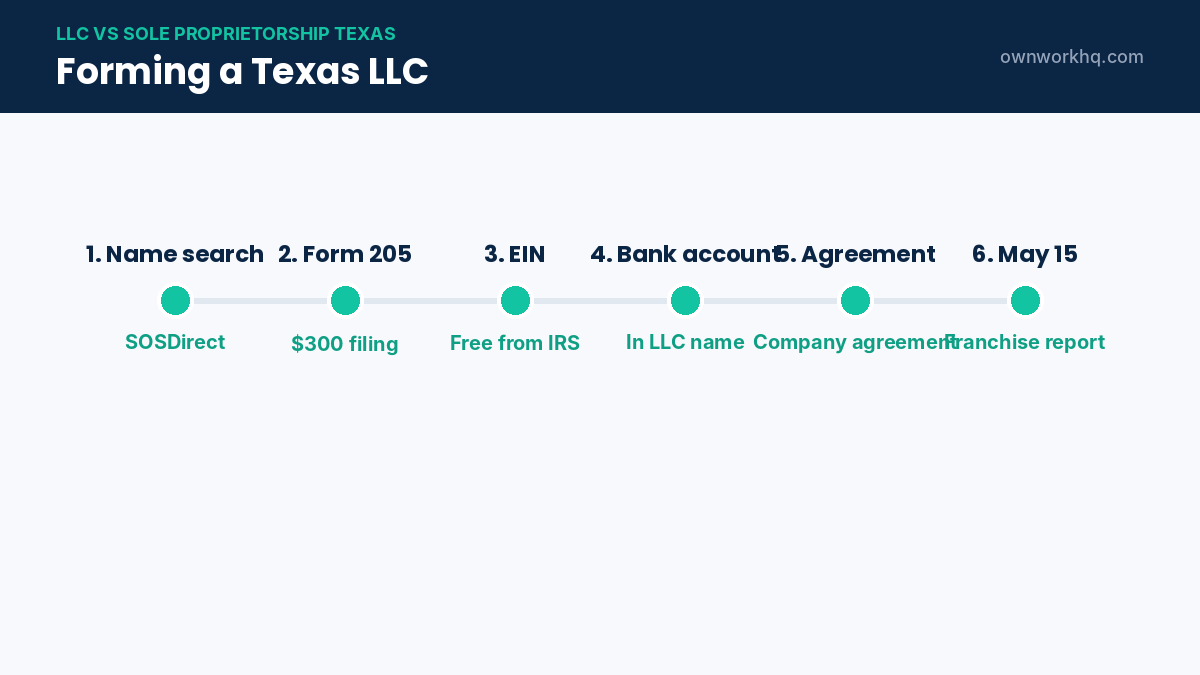
To form an LLC you file a Certificate of Formation (Form 205) with the Texas Secretary of State, online through SOSDirect or by mail. The filing fee is $300. You’ll need:
- A unique business name that includes “LLC” or “Limited Liability Company.”
- A registered agent with a physical Texas address (you can be your own).
- The names of the managers or members.
- An organizer (the person filing).
After approval, get a free EIN from the IRS, open a business bank account, and write a simple company agreement. Texas doesn’t require it to be filed, but it documents how your LLC operates.
Texas franchise tax: what freelancers really owe
LLCs are taxable entities for Texas franchise tax; sole proprietorships are not. According to the Texas Comptroller, the no-tax-due threshold is $2,650,000 in annualized total revenue for 2026 and 2027 reports. Almost every freelancer is far below that, so you’ll owe $0.
You still have a filing obligation: entities at or below the threshold must file a Public Information Report (or an Ownership Information Report, depending on entity type) by May 15 each year. Missing it can lead to penalties and eventually the loss of your LLC’s right to transact business in Texas, so put it in your calendar.
Federal taxes: LLC vs. sole proprietor
By default, the IRS treats a single-member LLC as a disregarded entity, so you file exactly the same way as a sole proprietor: Schedule C, self-employment tax, and the same deductions. Forming an LLC doesn’t lower your taxes on its own.
The tax difference comes if you elect for your LLC to be taxed as an S corporation, which can reduce self-employment tax once your profit is high enough to justify a reasonable salary and payroll costs. Many accountants suggest looking at it once net profit is consistently around $80,000–$100,000 or more, but it depends on your numbers.
Liability protection: what an LLC does (and doesn’t) do
An LLC can protect your personal assets from business debts and lawsuits against the business. But it has limits:
- You’re still personally liable for your own professional mistakes in many situations, for example your own negligence.
- Courts can “pierce the veil” if you mix personal and business money or don’t treat the LLC as separate.
- Personal guarantees on loans or leases bypass the LLC.
That’s why most freelancers pair an LLC with business insurance. If you’re not sure what that costs, see how much business insurance costs for freelancers.
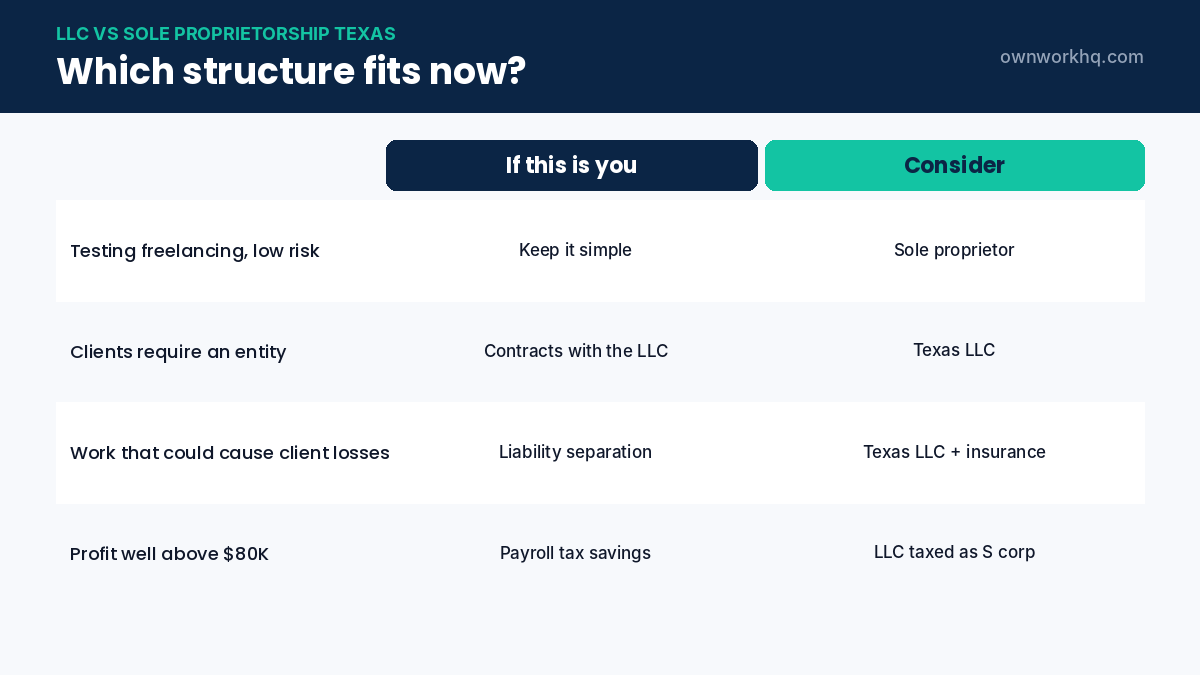
Which should you choose?
| Choose a sole proprietorship if… | Choose an LLC if… |
|---|---|
| You’re testing freelancing or earn little so far | You earn steady income and have savings or assets to protect |
| Your work has low liability risk | You sign contracts with indemnification clauses or work with large clients |
| You want zero paperwork | You want a more professional image and a separate business identity |
| You plan to switch to an LLC later | You may want an S corp election in the future |
Step-by-step: switching from sole proprietor to LLC in Texas
- Search your desired name in the Secretary of State’s records.
- File Form 205 and pay the $300 fee.
- Get a new EIN for the LLC from the IRS (free).
- Open a business bank account in the LLC’s name.
- Update contracts, invoices, W-9s and payment platforms with the LLC name and EIN.
- Update your business insurance to name the LLC.
- Set calendar reminders for the May 15 franchise tax information report.
Once you’re set up, the right tools make the admin easier. See our comparison of the best invoicing software for consultants.
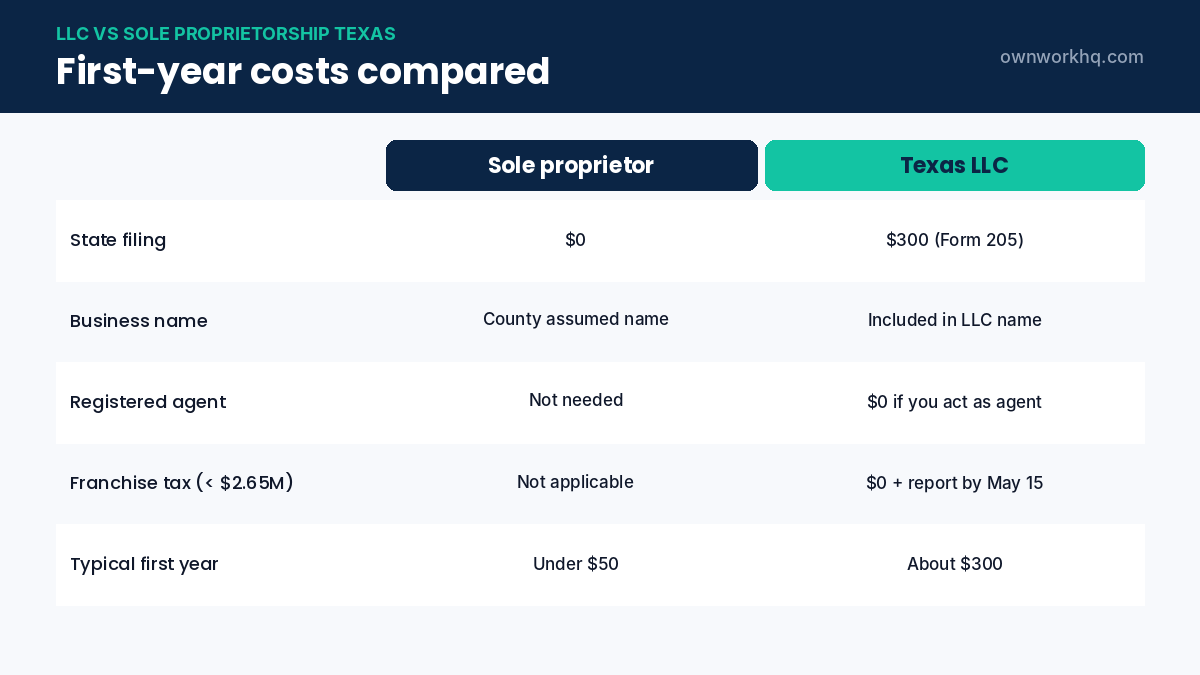
LLC vs sole proprietorship Texas: first-year cost example
| Cost item | Sole proprietor | Texas LLC |
|---|---|---|
| State formation filing | $0 | $300 (Form 205) |
| Business name | County assumed name certificate (fee varies) | Included in LLC name; separate DBA only if needed |
| Registered agent | Not needed | $0 if you act as your own agent |
| Franchise tax (below $2.65M revenue) | Not applicable | $0 tax; information report due May 15 |
| EIN | Optional, free | Recommended, free |
| Typical first-year total | Under $50 | About $300 plus optional services |
Unlike states with high annual LLC fees, Texas keeps the yearly cost of an LLC low for most freelancers. That makes the LLC vs sole proprietorship Texas decision mostly about liability, credibility and paperwork, not cost.
Sales tax: services that are taxable in Texas
Most professional services aren’t subject to Texas sales tax, but some freelance work is. Texas taxes certain data processing services and some information services, and sales of tangible items such as prints or merchandise are generally taxable. If any of your services might fall into these categories, check the Texas Comptroller sales tax pages before you invoice, because the rules apply whether you’re an LLC or a sole proprietor.
Protecting your LLC status in Texas
- Keep a separate business bank account in the LLC’s name.
- Sign contracts as the LLC, for example “Jane Doe, Manager, Lone Star Design LLC”.
- Update the registered agent with the Secretary of State if your address changes.
- File the information report with the Comptroller by May 15 every year.
- Keep a simple company agreement and records of major decisions.
Missing the May 15 report is the most common mistake. Penalties and, eventually, forfeiture of the LLC’s right to do business can follow, which defeats the purpose of forming it.
Taxes stay the same, until you elect S corp
As a single-member LLC in Texas, you still file Schedule C and pay self-employment tax, exactly like a sole proprietor. Texas has no personal income tax, so there’s no state return on your freelance profit either way. The tax picture only changes if you elect S corporation taxation, which can reduce self-employment tax at higher profits; see S corp vs LLC for freelancers for the numbers.
Switching back or closing a Texas LLC
If you no longer need the LLC, you’ll generally need tax clearance from the Comptroller and then file a certificate of termination with the Secretary of State. Simply stopping work doesn’t end the obligation to file the yearly report, so close the LLC properly if you decide to go back to operating as a sole proprietor.
Liability protection: what a Texas LLC does and doesn’t do
The main reason freelancers form a Texas LLC is to separate business debts and claims from personal assets. That protection is real but limited:
- It generally protects you from the LLC’s contract debts and claims against the business.
- It doesn’t protect you from your own professional negligence; you can still be personally liable for your own mistakes.
- It can be lost if you mix personal and business money or fail to keep the LLC in good standing.
Because of that second point, insurance still matters even with an LLC. Freelancers who give advice, write code or design for clients should look at professional liability coverage; see professional liability insurance for developers for how it works.
Texas franchise tax: the details that matter
Texas LLCs are subject to the franchise tax, but most freelancers owe nothing because their revenue is below the no-tax-due threshold, which is $2.65 million for reports due in 2026 and 2027. Since 2024, entities under the threshold no longer file a separate No Tax Due Report; they still file the information report (a Public Information Report for an LLC) by May 15 each year. Check the Texas Comptroller franchise tax page for the current forms, because filing rules can change.
Banking, contracts and getting paid as a Texas LLC
- Get a free EIN from the IRS so you don’t have to give clients your Social Security number.
- Open a business bank account in the LLC’s exact legal name.
- Send clients a new W-9 with the LLC’s name and EIN.
- Update contracts, invoices and payment platforms to the LLC.
- Keep receipts and records in the LLC’s name.
These steps also make bookkeeping simpler. Our guide to getting an EIN walks through the IRS application.
When a sole proprietorship is the better choice
Staying a sole proprietor makes sense if you’re testing freelancing, your work carries little liability risk, and none of your clients require an entity. You can start immediately, file a single Schedule C, and form a Texas LLC later without losing anything. If you use a business name, file an assumed name certificate with your county so clients can pay you under that name.
A quick checklist before you decide
- Do any of your clients require you to work through an entity?
- Could a mistake in your work cause a client a significant financial loss?
- Do you have personal assets, such as a home or savings, you want to keep separate?
- Are you comfortable filing a yearly report and keeping business records separate?
- Is your profit high enough that an S corp election might make sense soon?
If you answered yes to two or more, forming an LLC is worth a closer look. If not, a sole proprietorship with good contracts and insurance is a reasonable place to start.
Whatever you choose, revisit the decision each year as your income, clients and risk change.
Texas has no state income tax, but you still owe federal income tax and self-employment tax. Estimate both with our income tax calculator.
Frequently asked questions
How much does it cost to form an LLC in Texas?
The Texas Secretary of State charges $300 to file a Certificate of Formation (Form 205). Optional costs include a registered agent service and a company agreement template.
Do Texas LLCs pay franchise tax?
LLCs are subject to Texas franchise tax, but those with total revenue at or below the no-tax-due threshold ($2.65 million for 2026 and 2027 reports) owe nothing. They must still file an information report by May 15.
Does a sole proprietor in Texas need to register?
No state registration is needed to operate under your own name. If you use a different business name, you must file an assumed name certificate with the county clerk.
Will an LLC lower my taxes in Texas?
Not by default. A single-member LLC is taxed like a sole proprietorship. Savings may come from electing S corporation status once your profits are high enough.
Do I need an LLC to get business insurance?
No. Sole proprietors can buy business insurance in their own name. If you form an LLC, update your policy so the LLC is the named insured.
Is a Texas LLC worth it for a freelancer with low income?
It can be, because the annual cost is low compared with many states. The main question is whether you need liability protection or an entity for clients. If not, a sole proprietorship is simpler.
Do I need a business license in Texas as a freelancer?
Texas doesn’t have a general statewide business license. Some cities and professions require permits or licenses, so check with your city and any licensing board for your field.
Can I be my own registered agent in Texas?
Yes, if you have a physical Texas address where you can receive legal documents during business hours. Many freelancers use a registered agent service for privacy.
Does a Texas LLC owe franchise tax if I earn under $100,000?
Generally no tax is due, because the no-tax-due threshold is far higher. You still need to file the annual information report by May 15.
Can I convert my sole proprietorship to a Texas LLC later?
Yes. You form a new LLC, move your bank account, contracts and invoicing to it, and give clients a new W-9. Your past income stays on your personal return.
Sources
- Texas Comptroller: Franchise tax
- Texas Secretary of State: Business forms
- IRS: Single-member limited liability companies
Disclaimer: This article is for informational purposes only and is not legal, tax or financial advice. OwnWork HQ is not a law firm. Rules vary by state and change over time, so confirm details with the relevant state agency or a qualified professional.
About OwnWork HQ Editorial
We write plain-English guides for US freelancers and check every rate, limit and deadline against IRS and state agency publications. We are not CPAs or financial advisors; for advice on your situation, talk to a qualified professional.