LLC vs Sole Proprietorship California: Is the $800 Tax Worth It for Freelancers? (2026)
In short: Should a California freelancer form an LLC or stay a sole proprietor? 2026 guide to the $800 annual tax, filing fees, liability protection and taxes.


On this page
- LLC vs sole proprietorship California: side-by-side comparison
- The $800 California LLC tax, explained
- Running as a sole proprietor in California
- Forming an LLC in California
- Liability protection vs. cost
- AB5 and independent contractor status
- Which should you choose?
- LLC vs sole proprietorship California: 3-year cost example
- California LLC fee at higher gross receipts
- Key deadlines for a new California LLC
- Sole proprietor obligations in California
- Closing a California LLC properly
- Liability protection: does a California LLC actually protect you?
- Break-even: when the $800 makes sense
- S corp election for a California LLC
- Taxes for a California sole proprietor
- A first-year timeline for a new California LLC
- Common mistakes California freelancers make
- Records to keep either way
- Frequently asked questions
- Sources
California is one of the most expensive states to run an LLC. Every LLC owes an $800 annual tax to the Franchise Tax Board, whether it earns $0 or $200,000. For freelancers, that changes the math on LLC vs. sole proprietorship in California compared with states like Texas or Florida. Here’s how LLC vs sole proprietorship California rules compare for freelancers in 2026.
Key takeaways
- Sole proprietorship: no state formation fee. Using a business name requires a Fictitious Business Name filing with your county.
- California LLC: $70 to file Articles of Organization, a $20 Statement of Information every two years, and an $800 annual tax every year.
- The temporary first-year exemption from the $800 tax only applied to LLCs organized between January 1, 2021 and January 1, 2024. It no longer applies.
- An extra LLC fee applies once California gross receipts exceed $250,000.
- Federal taxes are the same for a single-member LLC and a sole proprietor unless you elect S corp status.
LLC vs sole proprietorship California: side-by-side comparison
| Sole proprietorship | California LLC | |
|---|---|---|
| Setup | Automatic when you start working | Articles of Organization (Form LLC-1) with the Secretary of State |
| Formation fee | $0 (county Fictitious Business Name fee if you use a business name) | $70 |
| Annual state tax | None beyond personal income tax | $800 minimum annual tax, every year |
| Extra LLC fee | None | $900–$11,790 if CA gross receipts exceed $250,000 |
| Ongoing filings | Personal return (Form 540) with Schedule C income | Form 568 LLC return + Statement of Information every 2 years ($20) |
| Personal liability protection | None | Generally limited to business assets if you keep finances separate |
| Federal tax | Schedule C + self-employment tax | Same by default; S corp election possible |
| Local business license | Often required by your city | Often required by your city |
The $800 California LLC tax, explained
According to the California Franchise Tax Board, every LLC that is organized in or doing business in California must pay an $800 annual tax. It’s due even if the LLC doesn’t do any business, until you formally cancel it.
- First payment: due by the 15th day of the 4th month after you register with the Secretary of State. For example, an LLC registered on June 18 owes its first $800 by September 15.
- Every year after: due by the 15th day of the 4th month of the tax year (April 15 for calendar-year LLCs), paid with Form FTB 3522.
- First-year exemption: only LLCs organized between January 1, 2021 and January 1, 2024 were exempt for their first year. LLCs formed now pay from year one.
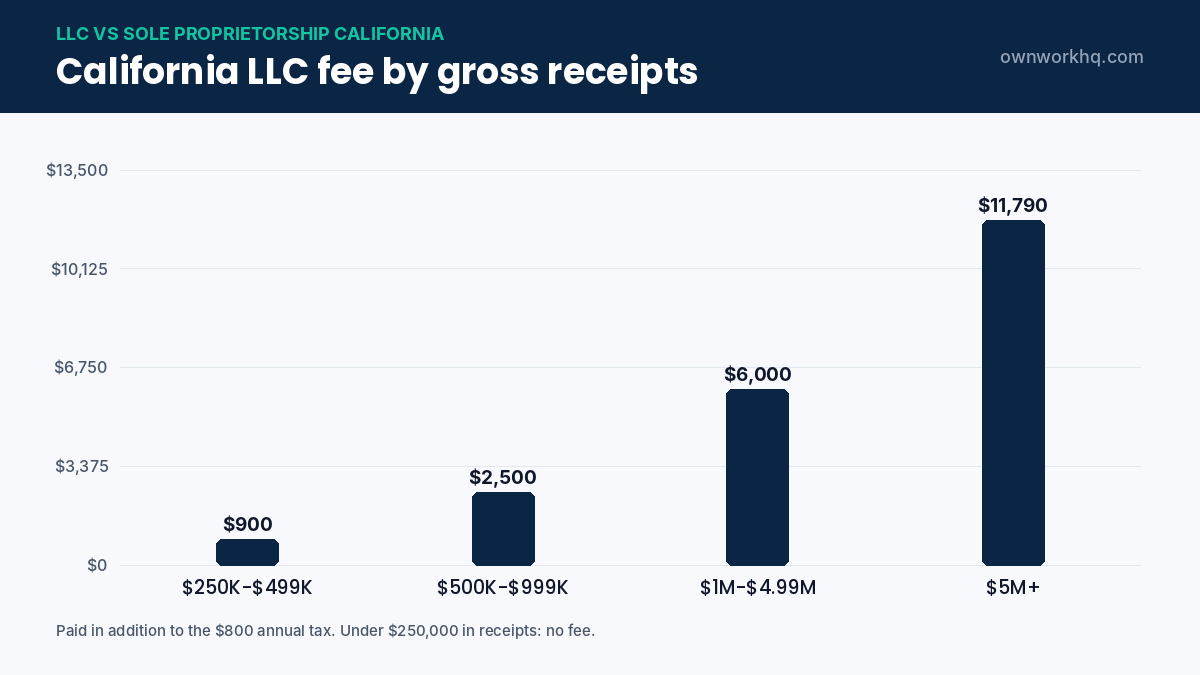
If your LLC’s California gross receipts top $250,000, you also owe an LLC fee on top of the $800 tax:
| California gross receipts | Annual LLC fee |
|---|---|
| $250,000–$499,999 | $900 |
| $500,000–$999,999 | $2,500 |
| $1,000,000–$4,999,999 | $6,000 |
| $5,000,000 or more | $11,790 |
Running as a sole proprietor in California
As a sole proprietor you report freelance income on Schedule C with your federal return and include it in your California personal income tax return. You pay federal self-employment tax (15.3% on most net earnings) plus regular income tax. California doesn’t charge sole proprietors an $800 minimum tax.
If you work under a business name rather than your own (for example, “Bay Pixel Studio”), you must file a Fictitious Business Name (FBN) statement with your county clerk. Most counties also require you to publish the FBN in a local newspaper for four weeks, and FBNs typically expire after five years. Many cities also require a business license or tax registration, even for home-based freelancers.
Forming an LLC in California
- Check name availability and file Articles of Organization (LLC-1) with the California Secretary of State through bizfile Online. The fee is $70.
- File the initial Statement of Information (LLC-12) within 90 days of formation ($20), then every two years.
- Pay the $800 annual tax on time with Form FTB 3522.
- Get an EIN from the IRS (free) and open a business bank account.
- Write an operating agreement. It isn’t filed with the state, but it documents ownership and rules.
- Register with your city for a business license if required.
Budget at least $870 in the first year ($70 + $800), plus the $20 Statement of Information, and $800+ every year after.
Liability protection vs. cost
The main reason to form an LLC is liability protection: business debts and lawsuits against the business generally stay with the business. But an LLC doesn’t protect you from your own professional negligence in many cases, and courts can disregard it if you mix personal and business funds.
For many California freelancers, a good contract plus business insurance provides more practical protection per dollar than an LLC alone. Compare costs in our guide to how much business insurance costs for freelancers.
AB5 and independent contractor status
California’s worker classification rules (the “ABC test” from AB5, with exemptions for certain professions) affect whether clients can treat you as an independent contractor. Forming an LLC does not by itself make you an independent contractor under California law. Some exemptions do depend on factors like having a business location, a business license and multiple clients. If classification matters for your clients, consider getting advice specific to your profession.
Which should you choose?
| Stay a sole proprietor if… | Form an LLC if… |
|---|---|
| You earn less than a few thousand dollars a month | You have steady income and the $800 tax is a small share of profit |
| Your work has low liability risk and you carry insurance | You have significant personal assets to protect |
| You’re still testing freelancing | Clients or platforms prefer contracting with an entity |
| You want minimal paperwork | You plan to elect S corp status as profits grow |
Freelancing in Texas instead? The rules are very different. Read LLC vs. sole proprietorship in Texas.
LLC vs sole proprietorship California: 3-year cost example
| Cost | Sole proprietor | California LLC |
|---|---|---|
| Formation | $0 (plus county fictitious business name if used) | $70 Articles of Organization |
| Statement of Information | Not required | $20 every two years |
| Annual LLC tax | None | $800 every year |
| Three-year total (approximate) | Under $100 | About $2,510 ($70 + $40 + $2,400) |
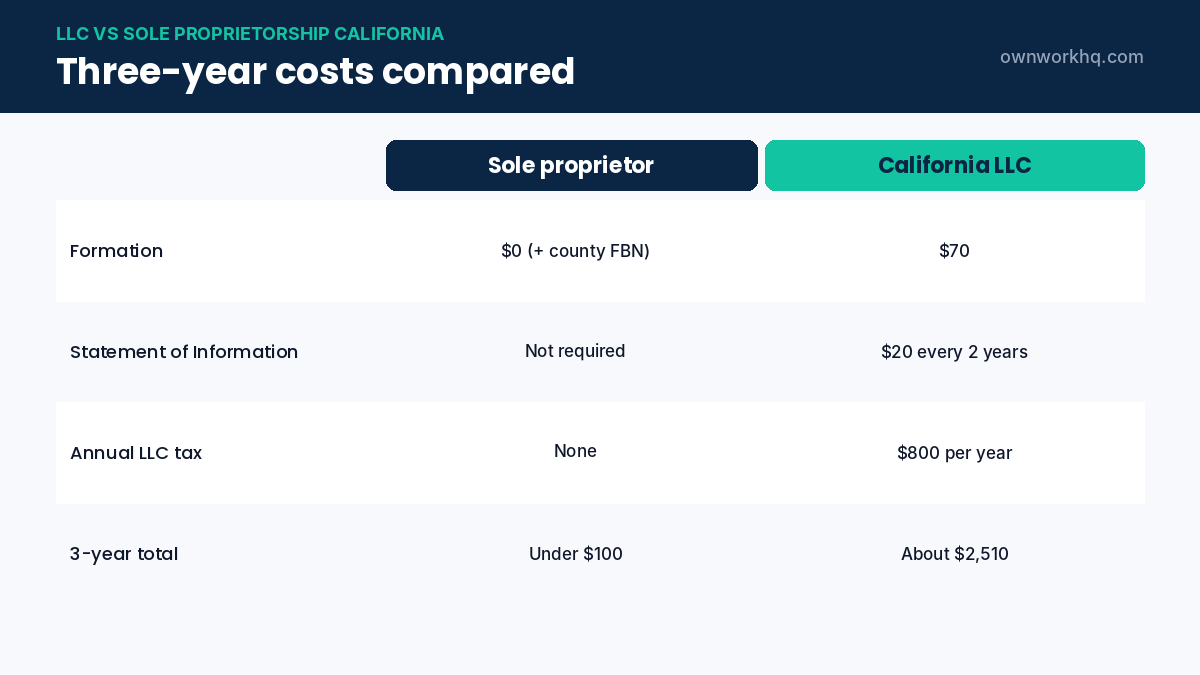
Over three years, a California LLC costs about $2,500 more than staying a sole proprietor, before any registered agent or accountant fees. Whether that’s worth it depends on what the liability protection is worth to you.
California LLC fee at higher gross receipts
| California gross receipts | LLC fee (in addition to the $800 tax) |
|---|---|
| Under $250,000 | $0 |
| $250,000 – $499,999 | $900 |
| $500,000 – $999,999 | $2,500 |
| $1,000,000 – $4,999,999 | $6,000 |
| $5,000,000 or more | $11,790 |
The fee is based on gross receipts, not profit. Most solo freelancers stay under $250,000 and pay only the $800 tax, but it’s worth knowing before a big growth year. See the Franchise Tax Board LLC page for current rules.
Key deadlines for a new California LLC
| Deadline | What’s due |
|---|---|
| Within 90 days of formation | Statement of Information ($20) with the Secretary of State |
| 15th day of the 4th month after formation | First $800 annual tax payment (Form 3522) |
| 15th day of the 4th month each year after | $800 annual tax for the new tax year |
| With your tax filing | Form 568 (LLC return), even for a single-member LLC |
| Every two years | Statement of Information renewal |
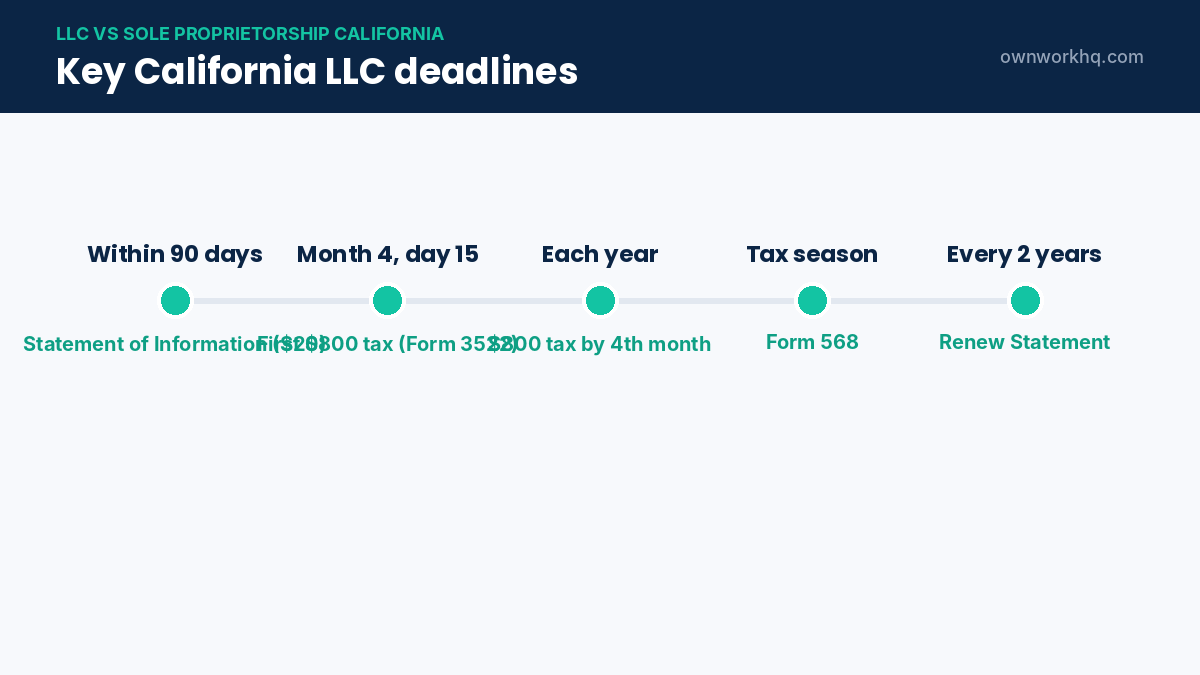
Missing these deadlines leads to penalties and can result in the LLC being suspended, which means it can’t legally do business or defend itself in court.
Sole proprietor obligations in California
- Fictitious business name with your county if you use a name other than your own.
- City business license or business tax registration, required by many California cities even for home-based freelancers.
- State income tax on your freelance profit, with quarterly estimated payments on California’s front-loaded schedule.
- Seller’s permit only if you sell taxable goods.
Closing a California LLC properly
If you decide the LLC isn’t worth the $800 a year, close it formally by filing the dissolution and cancellation forms and a final Form 568. An LLC that’s simply abandoned can keep accruing the annual tax and penalties. Plan the timing so the cancellation is complete before the next year’s tax is due.
Liability protection: does a California LLC actually protect you?
An LLC can separate business debts and claims from your personal assets, but it doesn’t protect you from your own professional mistakes. If you personally give bad advice or make an error in your work, you can still be sued personally. That’s why many California freelancers rely on insurance first and add an LLC when the business grows.
- Keep finances separate with a dedicated business bank account.
- Sign contracts in the LLC’s name with your title.
- Stay in good standing by paying the annual tax and filing the Statement of Information.
- Carry the right insurance, such as professional liability for client work.
Break-even: when the $800 makes sense
There’s no single income level where a California LLC becomes worth it, because the main benefit is liability protection rather than tax savings. A practical way to decide is to compare the yearly cost with the risk you’re carrying:
| Your situation | Typical choice |
|---|---|
| Low-risk work, under about $40,000 profit | Sole proprietor plus insurance |
| Clients require an entity | California LLC |
| Higher-risk work or significant personal assets | California LLC plus insurance |
| Profit high enough for S corp savings | LLC taxed as an S corp (see below) |
If you’re unsure, start as a sole proprietor with good insurance and contracts, and revisit the decision every year.
S corp election for a California LLC
At higher profits, some freelancers elect S corporation taxation to reduce self-employment tax by paying themselves a reasonable salary. In California, an S corp pays a 1.5% franchise tax on net income with an $800 minimum, and payroll adds cost and paperwork. Run the numbers with our S corp vs LLC guide and a tax professional before electing.
Taxes for a California sole proprietor
As a sole proprietor, you report freelance profit on Schedule C and pay federal income tax, self-employment tax and California income tax. California’s estimated payment schedule is front-loaded, with 30% due in April, 40% in June, nothing in September and 30% in January. A single-member California LLC files the same Schedule C for income tax, plus Form 568 and the annual LLC tax.
A first-year timeline for a new California LLC
- File Articles of Organization (Form LLC-1) online with the Secretary of State.
- Get an EIN from the IRS and open a business bank account.
- File the Statement of Information within 90 days.
- Pay the first annual tax with Form 3522 by the 15th day of the 4th month.
- Register for any city business license or tax certificate.
- Send clients a new W-9 and update contracts and invoices.
- File Form 568 with your tax return the following spring.
Set calendar reminders for each recurring deadline right after you form the LLC; most penalties come from simply forgetting.
Common mistakes California freelancers make
- Forming an LLC in Nevada or Delaware to avoid California fees, then owing California’s tax anyway.
- Assuming the LLC lowers income tax. By default it doesn’t.
- Forgetting the Statement of Information, which leads to penalties.
- Leaving an unused LLC open, so the annual tax keeps accruing.
- Skipping insurance because the LLC seems to provide protection.
Records to keep either way
Whether you stay a sole proprietor or form a California LLC, keep invoices, receipts, bank statements, mileage logs and copies of every state filing for at least four years, since California generally has a longer review window than the IRS for state returns. Store them digitally in one folder per year. Good records make tax season faster and support your deductions if the Franchise Tax Board or IRS ever asks questions.
To estimate your California income tax alongside federal and self-employment tax, try our income tax calculator.
Frequently asked questions
How much does an LLC cost in California per year?
At minimum, $800 per year in annual tax, plus $20 every two years for the Statement of Information. The first year also includes the $70 formation fee. LLCs with more than $250,000 in California gross receipts pay an additional LLC fee.
Is there still a first-year exemption for the $800 LLC tax?
No. The exemption only applied to LLCs organized between January 1, 2021 and January 1, 2024. LLCs formed now owe the $800 tax starting in their first year.
Does a California sole proprietor pay the $800 tax?
No. The $800 minimum tax applies to LLCs, corporations and certain partnerships. Sole proprietors pay personal income tax on their profits but no minimum franchise tax.
Do I need a business license as a freelancer in California?
Many California cities require a business license or business tax registration, even for home-based freelancers. Check with your city or county.
Will an LLC save me taxes in California?
Usually not by itself, because it adds the $800 annual tax. Tax savings may come from an S corp election at higher profit levels, which has its own costs, including California’s 1.5% franchise tax on S corporations (with an $800 minimum).
Is there still a first-year exemption from the $800 California LLC tax?
No. The exemption only applied to LLCs organized from January 1, 2021 through January 1, 2024. New LLCs now owe the $800 tax for their first year.
Does a California LLC pay less income tax than a sole proprietor?
No. By default, a single-member LLC is taxed like a sole proprietor for federal and California income tax. The LLC adds the $800 annual tax and any LLC fee on top.
Can I avoid the $800 tax by forming an LLC in another state?
Generally no. If you live and work in California, an out-of-state LLC usually has to register in California and pay the same $800 tax, plus fees in its home state.
Does a sole proprietor in California pay the $800 minimum tax?
No. The $800 annual tax applies to LLCs, corporations and some partnerships registered in California. A sole proprietor pays only income and self-employment tax on profit.
Is a California LLC worth it for a freelancer earning $50,000?
It depends on your risk and client requirements more than income. Many freelancers at that level choose a sole proprietorship with professional liability insurance, and form an LLC later.
Sources
- California Franchise Tax Board: Limited liability company
- California Secretary of State: Business entity forms
- IRS: Single-member LLCs
Disclaimer: This article is for informational purposes only and is not legal, tax or financial advice. OwnWork HQ is not a law firm. Rules vary by state and change over time, so confirm details with the relevant state agency or a qualified professional.
About OwnWork HQ Editorial
We write plain-English guides for US freelancers and check every rate, limit and deadline against IRS and state agency publications. We are not CPAs or financial advisors; for advice on your situation, talk to a qualified professional.