How to Form an LLC as a Freelancer (2026): 8 Steps, Costs by State & Taxes
In short: A step-by-step guide to forming an LLC as a freelancer in 2026: name, registered agent, articles of organization, operating agreement, EIN, banking, filing fees by state and how LLCs are taxed.


On this page
- Do you need an LLC as a freelancer?
- How to form an LLC as a freelancer: 8 steps
- Step 1: choose and check your LLC name
- Step 2: appoint a registered agent
- Step 3: file articles of organization
- Step 4: sign an operating agreement
- Step 5: get an EIN
- Step 6: open a business bank account
- Step 7: get licenses and update your paperwork
- Step 8: keep the LLC in good standing
- LLC vs sole proprietorship at a glance
- How much does it cost to form an LLC?
- Should you form your LLC in Delaware or Wyoming?
- How an LLC is taxed
- What an LLC protects, and what it doesn’t
- What to include in your operating agreement
- When is the right time to form an LLC?
- Three-year cost example
- Forming an LLC with a business partner
- Mistakes to avoid when you form an LLC
- Checklist after you form an LLC
- If you change your mind later
- DIY or use a formation service?
- Frequently asked questions
- Sources
A limited liability company is the most popular way for freelancers to give their business its own legal identity. It separates business debts and contracts from your personal assets, looks more established to clients and keeps the simple taxes of a sole proprietorship by default. Learning how to form an LLC as a freelancer takes an afternoon, and in many states it costs less than $200 to start.
Key takeaways
- Form the LLC in the state where you live and work; out-of-state LLCs usually still have to register at home.
- State filing fees range from about $35 to $500, plus annual fees in most states.
- A single-member LLC files Schedule C and pays self-employment tax, just like a sole proprietor.
- An LLC protects against business debts, but not against your own professional mistakes; you still need insurance.
- U.S. LLCs no longer need to file beneficial ownership (BOI) reports with FinCEN.
Do you need an LLC as a freelancer?
You don’t need an LLC to freelance legally. Most freelancers start as sole proprietors and form an LLC later, when one of these becomes true:
- Clients ask you to contract through a business entity.
- Your work could cause clients significant financial loss, and you want to separate business and personal liability.
- You’re signing leases, loans or larger contracts in the business’s name.
- Your profit is high enough that an S corp election could save self-employment tax.
If you’re still deciding, compare the options in our state guides: LLC vs sole proprietorship in Texas and LLC vs sole proprietorship in California.
How to form an LLC as a freelancer: 8 steps
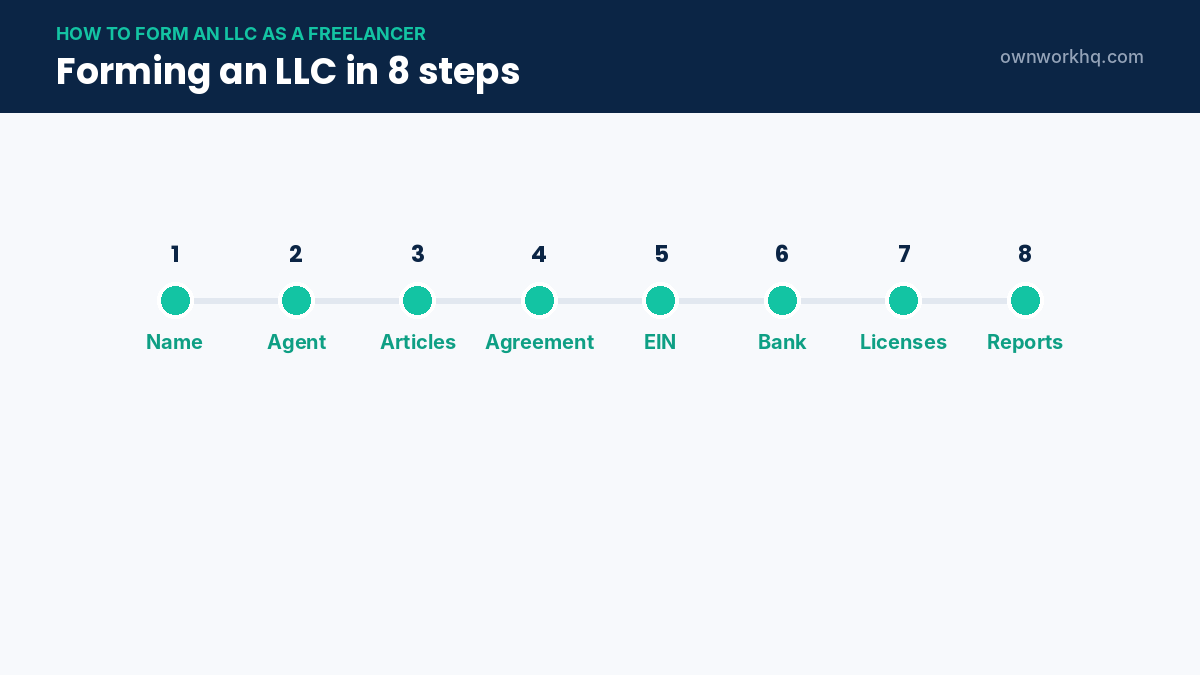
Step 1: choose and check your LLC name
Your LLC’s name must be distinguishable from other businesses registered in your state and usually must end with “LLC” or “Limited Liability Company.” Search your Secretary of State’s business database, check that a matching domain and social handles are available, and do a quick search of the USPTO trademark database to avoid conflicts. Many states let you reserve a name for a small fee if you’re not ready to file.
Step 2: appoint a registered agent
Every LLC needs a registered agent with a physical address in the state to receive legal papers and official mail. You can be your own agent if you’re usually available at your address during business hours, but that address becomes public. Many freelancers use a commercial registered agent service, often $50 to $300 a year, for privacy and reliability.
Step 3: file articles of organization
This is the document that creates the LLC. It’s called articles of organization in most states and a certificate of formation in some, such as Texas. You’ll typically provide the LLC name, registered agent, principal address, whether the LLC is member-managed or manager-managed, and the organizer’s name. Most states accept online filings and approve them within days.
Step 4: sign an operating agreement
An operating agreement sets out who owns the LLC, how decisions are made and what happens if a member leaves. Only a few states require one, but every freelancer should have one, even for a single-member LLC. It helps show that the LLC is a separate business, which supports your liability protection, and banks sometimes ask for it.
Step 5: get an EIN
An employer identification number is free from the IRS and takes minutes to get online. Even a single-member LLC without employees benefits from one: you’ll use it to open a business bank account and on the Form W-9 you give clients, instead of your Social Security number. Our guide on how to get an EIN walks through the application.
Step 6: open a business bank account
Keep LLC money completely separate from personal money. Mixing funds is one of the main reasons courts disregard an LLC’s liability protection. Open an account in the LLC’s exact legal name, and pay yourself through owner draws or transfers rather than using the business card for personal purchases. Compare options in best business bank accounts for freelancers.
Step 7: get licenses and update your paperwork
- Check city and county business license or registration requirements.
- Register for sales tax if you sell taxable products or services.
- Send clients a new W-9 with the LLC’s name and EIN.
- Update contracts, invoices, your website and payment platforms to the LLC name.
- Review insurance policies so they name the LLC as the insured.
Step 8: keep the LLC in good standing
Most states require an annual or biennial report and fee. Missing it can lead to penalties and, eventually, administrative dissolution, which can strip your liability protection. Put the deadline in your calendar the day the LLC is approved.
One requirement has disappeared: in 2025 FinCEN exempted U.S. companies from beneficial ownership information (BOI) reporting, and an August 2026 final rule made that exemption permanent. LLCs formed in the United States don’t need to file BOI reports.
LLC vs sole proprietorship at a glance
| Sole proprietorship | Single-member LLC | |
|---|---|---|
| Setup | Nothing to file (a DBA if you use a business name) | Articles of organization and state fee |
| Liability for business debts | Personal | Generally limited to the LLC |
| Federal taxes | Schedule C and self-employment tax | Same by default |
| Ongoing paperwork | Minimal | Annual report and fees in most states |
| Credibility with clients | Fine for most clients | Often preferred by larger clients |
| S corp election | Not available | Available |
For many freelancers, the deciding factor isn’t taxes but risk and client expectations. If neither pushes you toward an LLC yet, staying a sole proprietor with good insurance and contracts is a reasonable choice, and you can form an LLC later.
How much does it cost to form an LLC?
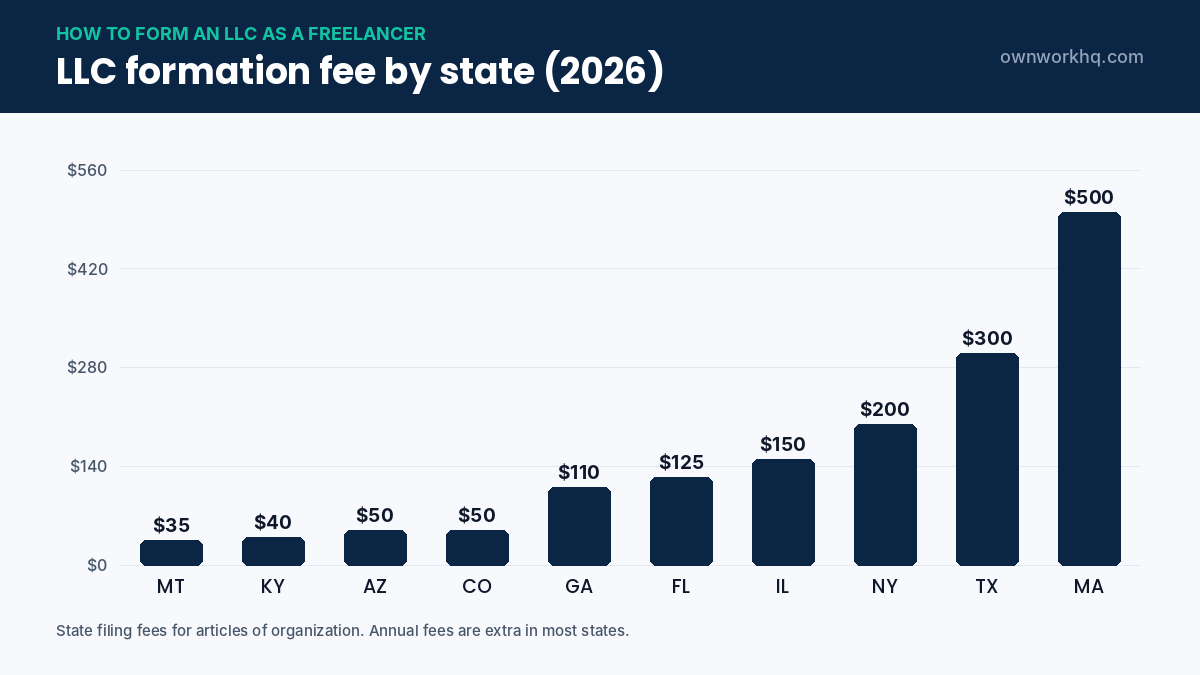
| State | Formation filing fee | Ongoing state fee |
|---|---|---|
| Montana | $35 | $20 per year |
| Kentucky | $40 | $15 per year |
| Arizona | $50 | No annual report fee |
| Colorado | $50 | $25 per year |
| Georgia | $110 | $60 per year |
| Florida | $125 | $138.75 per year |
| Illinois | $150 | $75 per year |
| New York | $200 (plus a publication requirement) | $9 every 2 years |
| Texas | $300 | No fee for most LLCs; annual report required |
| California | $70 | $800 minimum franchise tax per year, plus $20 every 2 years |
| Massachusetts | $500 | $500 per year |
Fees change, so confirm them with your Secretary of State before filing. Beyond state fees, budget for a registered agent if you use one, local licenses, and possibly an accountant. New York’s publication requirement can cost from under $100 to over $1,000 depending on the county.
Should you form your LLC in Delaware or Wyoming?
Usually not. If you live and work in one state, an LLC formed elsewhere generally must also register as a foreign LLC in your home state, which means paying fees in both states and needing a registered agent in each. Delaware and Wyoming mainly benefit businesses raising outside investment or operating in many states. For a solo freelancer, forming in your home state is simpler and cheaper.
How an LLC is taxed
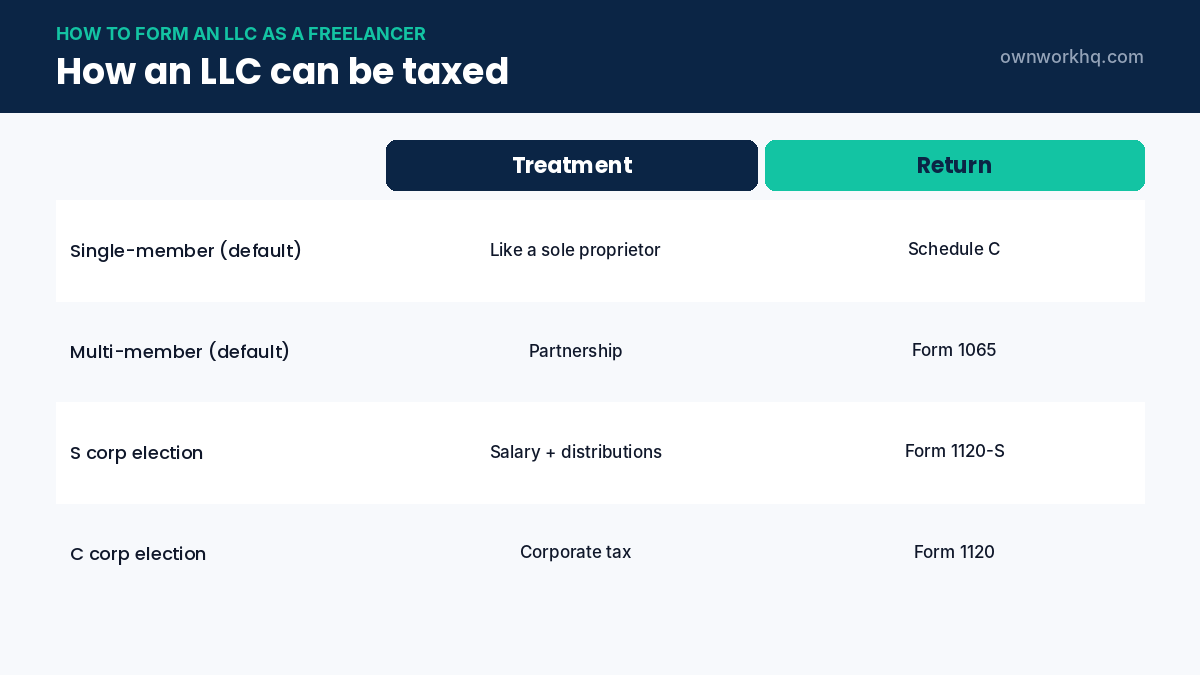
| LLC type | Default tax treatment | What you file |
|---|---|---|
| Single-member LLC | Disregarded entity, taxed like a sole proprietorship | Schedule C with your Form 1040, plus Schedule SE |
| Multi-member LLC | Partnership | Form 1065 and a Schedule K-1 for each member |
| LLC electing S corp | S corporation | Form 1120-S, payroll for the owner’s salary, K-1 |
| LLC electing C corp | C corporation | Form 1120 |
Forming an LLC doesn’t change your federal taxes by itself. You still pay income tax and self-employment tax on profit. The S corp election is what can reduce self-employment tax at higher profits; see S corp vs LLC for freelancers.
What an LLC protects, and what it doesn’t
| Usually protected | Usually not protected |
|---|---|
| Business debts and contracts signed by the LLC | Your own professional negligence or mistakes |
| Claims against the business that exceed its assets | Debts you personally guarantee, such as some loans and leases |
| Liabilities caused by other members (in a multi-member LLC) | Taxes the business fails to pay that you’re responsible for |
This is why insurance still matters. Professional liability coverage protects you against claims about your work, which an LLC alone doesn’t. Read how much business insurance costs for freelancers.
What to include in your operating agreement
- Ownership: who the members are and what percentage each owns.
- Management: whether the LLC is member-managed or manager-managed, and who can sign contracts.
- Money: how profits are distributed, how owners contribute capital and how draws work.
- Taxes: how the LLC is taxed and who handles filings.
- Changes: what happens if a member leaves, dies or wants to sell, and how to dissolve the LLC.
- Records: where books and records are kept and how decisions are documented.
For a single-member LLC, the operating agreement can be short: a few pages confirming you own 100% of the company, that it’s separate from you personally, and how money moves between you and the business. Store a signed copy with your formation documents.
When is the right time to form an LLC?
Many freelancers form an LLC when they land their first large contract, sign a lease, hire a subcontractor or reach a profit level where an S corp election is worth considering. Forming at the start of a calendar year keeps bookkeeping and tax filing simpler, because the whole year falls under one structure. If you form an LLC mid-year as a single member, your Schedule C simply covers the year, but you’ll want clean records of when banking and contracts moved to the LLC.
Three-year cost example
| Cost | Arizona | Florida | California |
|---|---|---|---|
| Formation filing | $50 | $125 | $70 |
| Annual state fees (3 years) | $0 | About $416 | $2,400 franchise tax + $20 |
| Registered agent (optional, 3 years) | About $300 | About $300 | About $300 |
| Approximate total | About $350 | About $841 | About $2,790 |
These figures use the state fees above and a typical $100-a-year registered agent; acting as your own agent removes that cost. The difference between states is why it’s worth checking your own state’s numbers before you form an LLC.
Forming an LLC with a business partner
If you freelance with a partner, a multi-member LLC is taxed as a partnership by default. That means a separate partnership return, Form 1065, and a Schedule K-1 for each member. The operating agreement becomes much more important: decide in writing how you’ll split work, profits and decisions, and what happens if one of you wants out. Many partners also consider buy-sell provisions and life or disability insurance to fund them.
Mistakes to avoid when you form an LLC
- Forming in another state to save fees, then paying twice after registering at home.
- Skipping the operating agreement, which weakens your separation from the business.
- Mixing personal and business money in one account.
- Forgetting the annual report and losing good standing.
- Expecting the LLC to cut taxes without an S corp election.
- Dropping insurance because you think the LLC protects you from every claim.
Checklist after you form an LLC
- Save the approved articles and the signed operating agreement.
- Get an EIN and open the business bank account.
- Send new W-9s to clients and update invoices and contracts.
- Register for any local licenses and sales tax.
- Set reminders for the annual report and any state taxes.
- Talk to a tax professional about whether an S corp election makes sense.
If you change your mind later
If the LLC no longer makes sense, close it formally instead of letting it lapse. Most states require articles of dissolution or a certificate of cancellation, and some require tax clearance first. File a final tax return for the business if it had one, close the business bank account and tell clients to pay you personally again. An abandoned LLC can keep accruing annual fees and penalties, especially in states with a minimum franchise tax such as California.
DIY or use a formation service?
Forming an LLC yourself on your state’s website is straightforward and costs only the state fee. Formation services charge from nothing to a few hundred dollars plus state fees, and often bundle a registered agent, an operating agreement template and reminders. They’re convenient but not necessary. Watch for upsells you don’t need, such as expensive compliance packages, and for automatic renewals.
Frequently asked questions
How long does it take to form an LLC?
Online filings are often approved within one to ten business days, depending on the state. Some states offer expedited processing for an extra fee.
Can I form an LLC myself?
Yes. You can file directly with your Secretary of State, act as your own registered agent if you meet the requirements, and write a simple operating agreement.
Does an LLC save taxes for freelancers?
Not by default. A single-member LLC is taxed like a sole proprietorship. Tax savings usually come from electing S corp status once profit is high enough.
Do I need a new bank account for my LLC?
Yes. A separate account in the LLC’s name keeps finances separate, simplifies bookkeeping and helps preserve your liability protection.
Do I need a lawyer to form an LLC?
Not for a simple single-member LLC. Many freelancers file online themselves. A lawyer is worth considering for multi-member LLCs, unusual ownership arrangements or high-risk businesses.
Can I form an LLC as a freelancer in another country?
U.S. citizens and residents living abroad can form an LLC in a U.S. state, but tax and registration rules get more complex. Get professional advice before forming one if you live outside the United States.
Can I change my sole proprietorship into an LLC?
Yes. You form a new LLC, then move contracts, banking, invoicing and licenses to it. Your past income stays on your personal return as sole proprietorship income.
Sources
- SBA: Choose a business structure
- IRS: Limited liability company (LLC)
- FinCEN: Beneficial ownership information reporting
- LLC University: LLC filing fees by state
Disclaimer: This article is for informational purposes only and is not legal, tax or financial advice. OwnWork HQ is not a law firm. Rules vary by state and change over time, so confirm details with the relevant state agency or a qualified professional.
About OwnWork HQ Editorial
We write plain-English guides for US freelancers and check every rate, limit and deadline against IRS and state agency publications. We are not CPAs or financial advisors; for advice on your situation, talk to a qualified professional.