Tax Deductions for Photographers (2026): Gear, Mileage, Studio & More
In short: The tax deductions photographers can claim for 2026: cameras and lenses, mileage, studio and home office, software, prints, contractors and insurance, with IRS rules explained.


On this page
- Tax deductions for photographers: quick list
- 1. Camera gear and equipment
- 2. Vehicle and travel expenses
- 3. Studio, home office and rent
- 4. Software and online services
- 5. Cost of goods sold: prints, albums and products
- 6. People you pay
- 7. Insurance and professional costs
- Deductions outside Schedule C
- Record-keeping tips for photographers
- Example: what $12,000 in deductions saves
- Camera gear: three ways to deduct it
- Mileage in 2026: two rates
- Travel for destination shoots
- Deductions photographers often miss
- Prints, albums and inventory
- Paying second shooters and assistants
- Mistakes that cost photographers money
- Studio rent vs home office
- Retirement and health deductions for photographers
- Hobby or business?
- Year-end moves for photographers
- Frequently asked questions
- Sources
Photography is an equipment-heavy business, which makes tax deductions especially valuable. Cameras, lenses, lighting, editing software, travel to shoots and studio rent can add up to thousands of dollars a year, and all of it can reduce your taxable income if you claim it correctly. Here are the tax deductions for photographers that matter most for the 2026 tax year.
Key takeaways
- Cameras and lenses can usually be expensed immediately via the $2,500 de minimis safe harbor, bonus depreciation or Section 179.
- Mileage to shoots is deductible: 72.5¢/mile (Jan–Jun 2026) and 76¢/mile (from July 1, 2026), or actual vehicle costs.
- Prints, albums and products you sell to clients are part of cost of goods sold.
- Business meals are 50% deductible; personal travel isn’t, even if you take photos.
- Keep receipts, mileage logs and notes on business purpose for every expense.
Tax deductions for photographers: quick list
| Expense | Typically deductible? | Notes |
|---|---|---|
| Cameras, lenses, drones, flashes | ✅ Yes | Business-use share; often fully deductible in year one |
| Memory cards, batteries, bags, tripods | ✅ Yes | Supplies; usually expensed immediately |
| Computer and monitors for editing | ✅ Yes | Business-use share |
| Editing software (Lightroom, Photoshop, Capture One) | ✅ Yes | Subscriptions are business expenses |
| Client gallery and studio management software | ✅ Yes | Pixieset, HoneyBook, Studio Ninja, etc. |
| Studio rent or home studio/office | ✅ Yes | Home office requires regular and exclusive use |
| Props, backdrops, wardrobe for shoots | ✅ Yes | Not clothing you wear personally |
| Model, assistant and second-shooter fees | ✅ Yes | Contractors may need a 1099-NEC if paid $2,000+ (2026 rule) |
| Prints, albums, frames sold to clients | ✅ Yes | Cost of goods sold |
| Mileage and travel to shoots | ✅ Yes | Keep a log |
| Insurance (liability, equipment) | ✅ Yes | Business insurance premiums |
| Website, portfolio, advertising | ✅ Yes | Including wedding directory listings |
| Workshops and education | ✅ Yes | If they improve skills for your current business |
| Equipment repairs and sensor cleaning | ✅ Yes | Ordinary maintenance |
| Personal vacations with your camera | ❌ No | Unless the trip is primarily for business |
1. Camera gear and equipment
Camera bodies, lenses, lighting, drones, gimbals and editing computers are your biggest deductions. You have several ways to deduct them:
- De minimis safe harbor: generally expense items costing up to $2,500 per item or invoice by making the election on your return.
- Bonus depreciation: the 2025 federal tax law restored 100% bonus depreciation for qualifying property acquired after January 19, 2025, so a $4,000 camera body can usually be deducted in full in the year you start using it.
- Section 179: another way to expense equipment immediately, limited to your business income.
- Regular depreciation: spreading the cost over several years can make sense if you expect higher income (and a higher tax bracket) in later years.
If you sell gear later, part of the sale price may be taxable because you’ve already deducted it. Keep purchase and sale records.
2. Vehicle and travel expenses
Driving to client sessions, weddings, scouting locations or picking up equipment is deductible. Choose one method:
- Standard mileage rate: 72.5 cents per mile for business driving from January 1 to June 30, 2026, and 76 cents per mile from July 1, 2026, plus parking and tolls.
- Actual expenses: the business percentage of gas, insurance, repairs, registration and depreciation.
For overnight trips (a destination wedding, for example), airfare, lodging, rental cars and 50% of meals are deductible when the trip is primarily for business.
3. Studio, home office and rent
Rent for a commercial studio is fully deductible. If you work from home, you can claim a home office deduction for space used regularly and exclusively for business, such as an editing room or a dedicated home studio. The simplified method allows $5 per square foot up to 300 square feet ($1,500); the regular method uses actual costs.
4. Software and online services
Editing suites, cloud backup, gallery delivery, client management and booking tools, website hosting and portfolio platforms are all deductible. If you’re choosing a client management tool, see our comparison of the best invoicing software for photographers.
5. Cost of goods sold: prints, albums and products
If you sell physical products such as prints, canvases, albums or USB drives, their cost (printing, materials, shipping to you) is reported as cost of goods sold on Schedule C rather than as a general expense. Track product costs separately from session income.
6. People you pay
Second shooters, assistants, makeup artists and models you hire as contractors are deductible. For payments made in 2026 and later, the federal threshold for filing Form 1099-NEC rose to $2,000 per contractor per year (from $600), under the 2025 federal tax law. Collect a Form W-9 before you pay anyone.
7. Insurance and professional costs
Premiums for general liability, equipment (inland marine) and professional liability insurance are deductible. If you haven’t set up coverage yet, read our guide to general liability insurance for photographers. Professional memberships, contest fees, legal and accounting fees, and payment processing fees are deductible as well.
Deductions outside Schedule C
- Half of self-employment tax, as an adjustment to income.
- Self-employed health insurance premiums (Form 7206), if you’re not eligible for an employer plan.
- Retirement contributions to a SEP IRA or Solo 401(k). See Solo 401(k) vs. SEP IRA.
- Qualified business income deduction of up to 20% for many photographers, subject to income limits.
Record-keeping tips for photographers
- Run all business purchases through a separate business account.
- Keep a gear inventory with purchase dates, prices and serial numbers (useful for taxes and insurance claims).
- Use a mileage app and note the client or shoot for each trip.
- Save receipts with business purpose notes, especially for props and wardrobe.
- Review your profit each quarter to adjust your quarterly estimated taxes.
Example: what $12,000 in deductions saves
Deductions reduce your Schedule C profit, which lowers both self-employment tax and income tax. Here’s a simplified 2026 example for a single photographer with $75,000 in profit before deductions:
| Before deductions | After $12,000 in deductions | |
|---|---|---|
| Net profit | $75,000 | $63,000 |
| Self-employment tax | About $10,600 | About $8,900 |
| Taxable income (after standard and QBI deductions) | About $42,880 | About $33,960 |
| Federal income tax | About $4,900 | About $3,830 |
| Total federal tax | About $15,500 | About $12,730 |
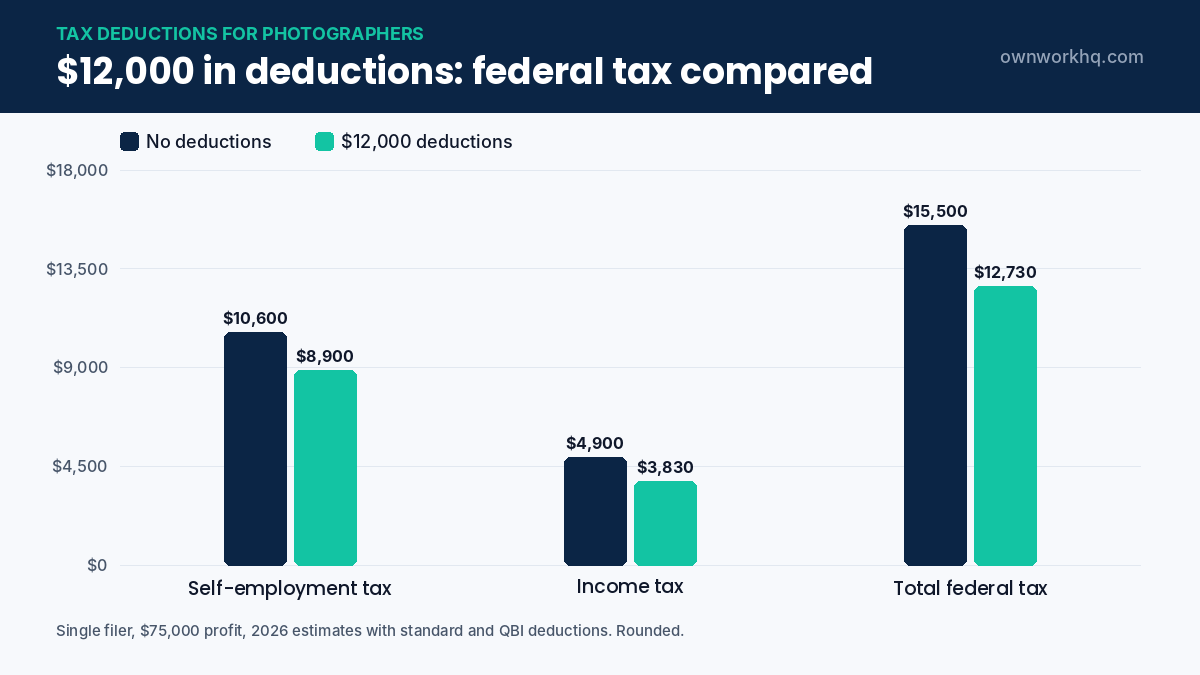
That’s roughly $2,770 in federal tax saved, plus any state income tax savings. These are rounded estimates; your result depends on your filing status, other income and credits.
Camera gear: three ways to deduct it
| Method | How it works | Good for |
|---|---|---|
| De minimis safe harbor | Expense items up to $2,500 per item or invoice with an election on your return | Lenses, flashes, smaller accessories |
| Bonus depreciation | 100% first-year deduction for qualifying property acquired after January 19, 2025 | Camera bodies, computers, larger purchases |
| Section 179 | Elect to expense equipment, limited to your business income | Controlling the deduction amount |
| Regular depreciation | Spread the cost over several years | Smoothing deductions across years |
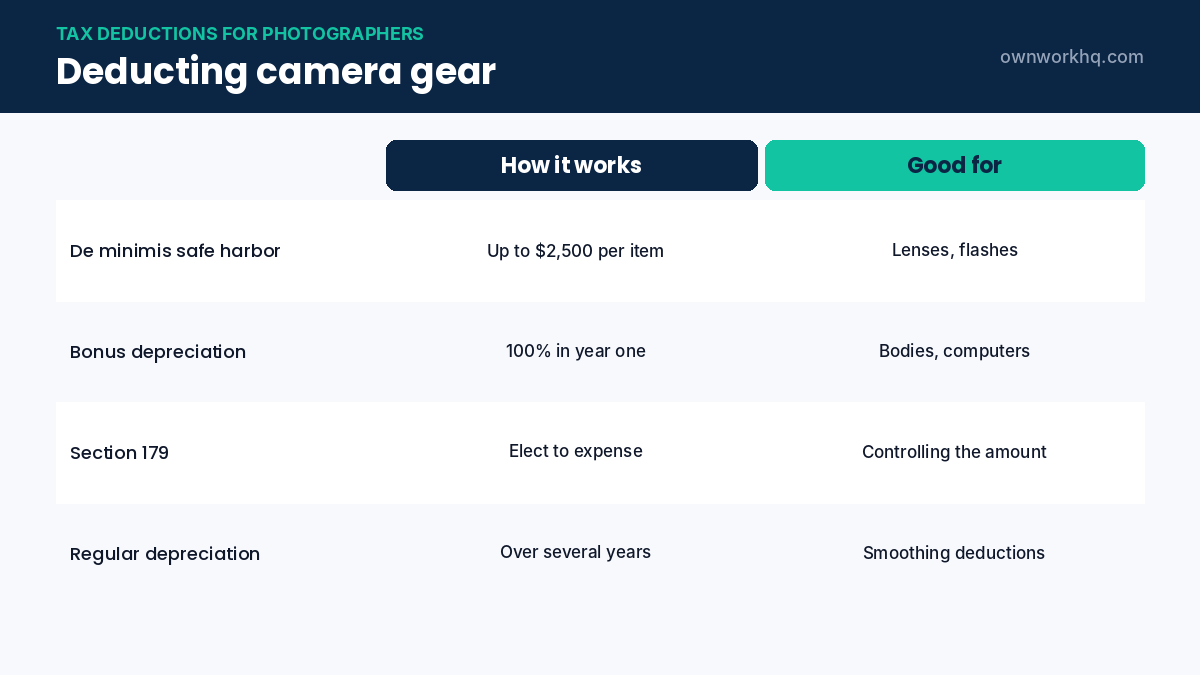
If you also use gear for personal photography, only the business-use share is deductible. And if business use of certain listed property drops to 50% or less in a later year, some of the deduction may have to be recaptured. Keep a simple record of how each major item is used.
Mileage in 2026: two rates
For 2026, the IRS standard mileage rate is 72.5 cents per mile for business driving from January 1 to June 30 and 76 cents per mile from July 1. Photographers drive a lot, to shoots, scouting trips, client meetings and print labs, so a good log matters.
| Example trip | Miles | Deduction |
|---|---|---|
| Wedding in May (round trip) | 120 | $87 (120 × $0.725) |
| Engagement shoot in August | 60 | $45.60 (60 × $0.76) |
| Location scouting in October | 40 | $30.40 (40 × $0.76) |
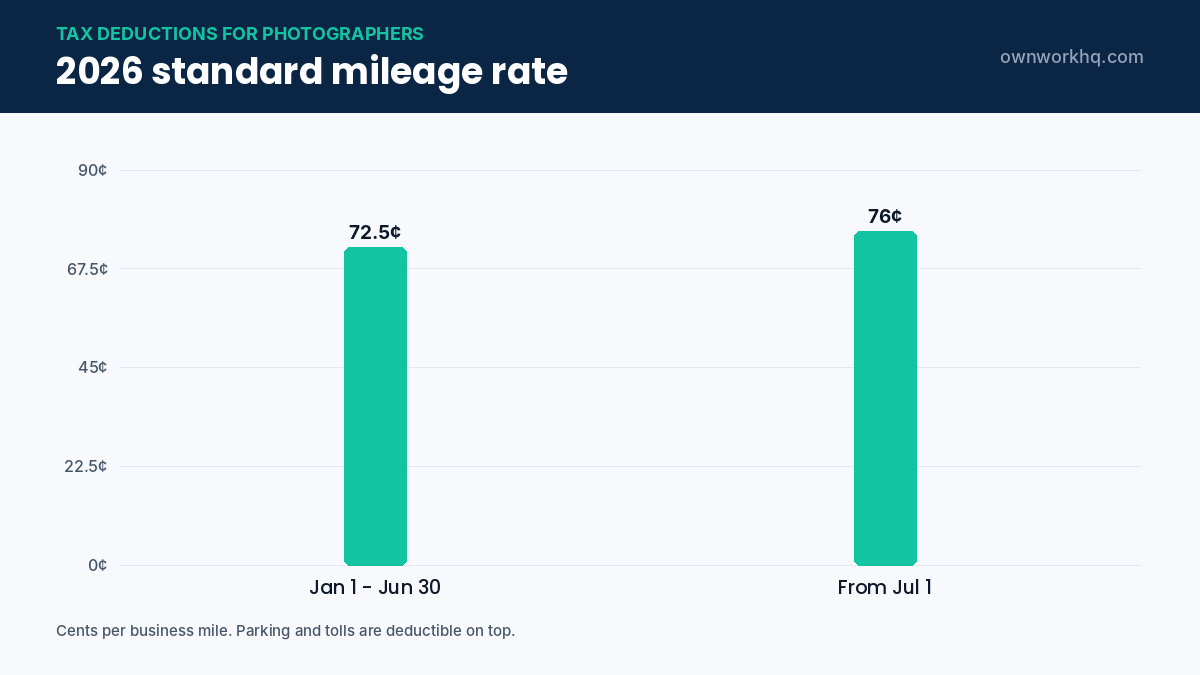
Parking and tolls are deductible on top of the standard mileage rate. Commuting from home to a regular studio generally isn’t deductible, but driving from a home office to a shoot usually is.
Travel for destination shoots
When a shoot requires an overnight trip away from your tax home, travel costs are generally deductible: airfare, lodging, baggage fees for gear, local transportation and 50% of meals. If you add personal vacation days, only the business portion of the trip is deductible, and the main purpose of the trip must be business. Keep the client contract, itinerary and receipts together for each trip.
Deductions photographers often miss
- Props, backdrops and wardrobe used only for shoots.
- Model and location fees, and permit costs for public locations.
- Gallery and cloud storage subscriptions for client delivery and backups.
- Equipment repairs, cleaning and rentals.
- Website, portfolio and booking software, including invoicing software for photographers.
- Education such as workshops that improve your current photography skills.
- Payment processing fees on client payments.
- Business insurance, including general liability insurance for photographers and equipment coverage.
Prints, albums and inventory
If you sell prints, albums or products, their cost generally goes into cost of goods sold rather than ordinary expenses. Track what you spend on products for each client order, and match it with the sale. Small businesses can often use simpler inventory methods, but keep enough detail to show what you bought and sold during the year.
Paying second shooters and assistants
Payments to second shooters, assistants, retouchers and editors are deductible as contract labor. Collect a W-9 before you pay anyone, and file Form 1099-NEC for each contractor you paid $2,000 or more in 2026 (the reporting threshold rose from $600 under the 2025 tax law). Payments made through card processors and some payment apps may be reported by the platform instead.
Mistakes that cost photographers money
- No mileage log, so the largest deduction for many photographers can’t be supported.
- Deducting personal gear in full when it’s used for both business and personal photography.
- Forgetting gear bought late in the year or with a personal card.
- Missing quarterly payments during busy wedding season.
- Not keeping receipts for cash expenses such as parking.
Set aside part of every booking for taxes and pay quarterly estimated taxes on time to avoid penalties that cancel out your deduction savings.
Studio rent vs home office
If you rent a studio, the rent, utilities and insurance for the space are generally deductible business expenses. If you work from home, you may be able to claim the home office deduction for space used regularly and exclusively for your business, such as an editing room. A home office used for editing can also make trips from home to shoots deductible as business travel rather than commuting.
| Rented studio | Home office | |
|---|---|---|
| What you deduct | Rent, utilities, insurance, repairs | Simplified ($5/sq ft up to 300 sq ft) or actual business share |
| Requirements | Used for business | Regular and exclusive business use |
| Records | Lease and bills | Office measurements and home expenses |
Retirement and health deductions for photographers
- SEP IRA or Solo 401(k) contributions can reduce income tax significantly in a strong year; see Solo 401(k) vs SEP IRA.
- Self-employed health insurance premiums are generally deductible if you aren’t eligible for an employer plan.
- Half of self-employment tax is deducted automatically.
- HSA contributions are deductible with a qualifying high-deductible health plan.
Hobby or business?
Many photographers start part-time. If you rarely earn a profit and don’t run photography like a business, the IRS may treat it as a hobby, and hobby expenses generally aren’t deductible. Keep records, a separate account, a website and a pricing plan, and show you’re working toward a profit, so the tax deductions for photographers in this guide remain available to you.
Year-end moves for photographers
- Buy needed gear before December 31 if you’ll use it in the business this year.
- Total your mileage log and confirm the dates for each rate.
- Collect W-9s and prepare 1099-NEC forms for contractors.
- Fund retirement accounts within the deadlines for each plan.
- Send your profit and loss report and gear list to your tax preparer.
Finally, state rules can differ from federal rules for some deductions, especially depreciation on expensive gear. If your state has an income tax, check how it treats bonus depreciation and Section 179, and ask a tax professional to review large purchases. A quick check each year keeps your federal and state returns consistent and avoids surprises later.
To see how much your deductions save, lower your net profit in our income tax calculator and compare the totals.
Frequently asked questions
Can photographers write off cameras?
Yes. Cameras and lenses used for your photography business are deductible. Items up to $2,500 can generally be expensed immediately, and more expensive gear can often be deducted in full in the year you start using it with bonus depreciation or Section 179.
Can I deduct clothes I wear to shoot weddings?
Generally no. Clothing suitable for everyday wear isn’t deductible, even if you only wear it to work. Wardrobe and props bought specifically for client shoots are a different matter.
Is a trip deductible if I take photos while traveling?
Only if the trip is primarily for business, such as a paid destination shoot or a workshop. Personal travel isn’t deductible just because you take photos.
Do I need to send 1099s to second shooters?
For payments made in 2026 and later, you generally need to file Form 1099-NEC if you pay a contractor $2,000 or more in the year. Collect a Form W-9 before paying.
What records do I need for mileage?
A log with the date, destination, business purpose and miles for each trip, plus total miles driven during the year. Mileage apps make this easy.
Can photographers deduct a new camera in full?
Often yes. Items up to $2,500 can generally be expensed under the de minimis safe harbor, and more expensive gear can usually be deducted in full with bonus depreciation or Section 179, for the business-use share.
What mileage rate do photographers use for 2026?
72.5 cents per mile for business miles driven from January 1 to June 30, 2026, and 76 cents per mile from July 1, 2026, plus parking and tolls.
Are clothes for shoots deductible?
Only if they’re suitable solely for business, such as costumes or props. Everyday clothing you wear to shoots generally isn’t deductible, even if you bought it for work.
Can I deduct my phone as a photographer?
Yes, the business-use share of your phone and plan. If you use it for client calls, booking apps and social media for your business, estimate a reasonable percentage and apply it consistently.
Sources
- IRS: Deducting business expenses
- IRS Publication 946: How to depreciate property
- IRS: 2026 standard mileage rate
- Thomson Reuters: Midyear mileage rate increase
- Paylocity: 1099 reporting threshold increased to $2,000
Disclaimer: This article is for informational purposes only and is not tax, legal or financial advice. OwnWork HQ is not a CPA or tax advisor. Tax rules change and depend on your situation, so confirm details with the IRS or a qualified tax professional before you act.
About OwnWork HQ Editorial
We write plain-English guides for US freelancers and check every rate, limit and deadline against IRS and state agency publications. We are not CPAs or financial advisors; for advice on your situation, talk to a qualified professional.