Tax Deductions for Freelance Writers (2026): 15 Write-Offs You Shouldn’t Miss
In short: The tax deductions freelance writers can claim for 2026: home office, laptop, software, research materials, travel, insurance, retirement and more, with the IRS rules to claim them.


On this page
- Tax deductions for freelance writers: quick list
- 1. Home office deduction
- 2. Computer, equipment and furniture
- 3. Software, subscriptions and online tools
- 4. Research materials
- 5. Internet, phone and utilities
- 6. Professional development
- 7. Travel and meals
- 8. Insurance, fees and other business costs
- Deductions outside Schedule C
- Record-keeping: how to make deductions stick
- Example: what deductions are worth in real dollars
- Home office: simplified vs regular method
- Deductions specific to writers
- Writers with royalties and book income
- Deductions that are often overlooked
- Common mistakes freelance writers make
- A year-round routine for writers
- Retirement and health: deductions outside Schedule C
- Travel and conferences for writers
- Equipment for freelance writers
- Hobby or business?
- Frequently asked questions
- Sources
Freelance writers often pay more tax than they need to, simply because they don’t track the everyday costs of running a writing business. Your laptop, writing software, research books, home office and even part of your internet bill can reduce your taxable income. This guide covers the tax deductions for freelance writers that matter most for the 2026 tax year, with the rules you need to claim them correctly.
Key takeaways
- Business expenses must be ordinary and necessary for your writing business, and you need records.
- Home office: the simplified method allows $5 per square foot, up to 300 sq ft ($1,500).
- Equipment like laptops can usually be deducted in full the year you buy them under the de minimis safe harbor (up to $2,500 per item) or bonus depreciation.
- Business meals are generally 50% deductible; entertainment isn’t.
- Don’t forget deductions outside Schedule C: half of SE tax, health insurance, retirement contributions and the QBI deduction.
Tax deductions for freelance writers: quick list
| Expense | Typically deductible? | Notes |
|---|---|---|
| Home office | ✅ Yes | Regular and exclusive business use required |
| Laptop, monitor, printer | ✅ Yes | Business-use share; often fully deductible in year one |
| Writing and editing software (Scrivener, Grammarly, Microsoft 365) | ✅ Yes | Subscriptions are deductible business expenses |
| Research books, magazines, newspaper subscriptions | ✅ Yes | When used for your writing work |
| Internet and cell phone | ✅ Partially | Business-use percentage only |
| Website, domain, email hosting | ✅ Yes | Includes portfolio sites and newsletters |
| Courses, conferences, workshops | ✅ Yes | If they maintain or improve skills for your current work |
| Professional memberships | ✅ Yes | Writers’ associations, union dues |
| Travel for assignments or conferences | ✅ Yes | Transportation, lodging; meals at 50% |
| Business meals with editors or clients | ✅ 50% | Must have a business purpose; keep notes |
| Agent or platform fees | ✅ Yes | Including payment processing fees |
| Business insurance | ✅ Yes | Professional / media liability, general liability |
| Clothing, personal Netflix, gym | ❌ No | Personal expenses, even if they “inspire” you |
1. Home office deduction
If you use part of your home regularly and exclusively for your writing business (a spare room or a clearly defined area used only for work), you can claim a home office deduction. You have two methods:
- Simplified method: $5 per square foot of office space, up to 300 square feet, for a maximum of $1,500. Very little record-keeping. See the IRS simplified home office option.
- Regular method: deduct the business percentage of actual costs (rent or mortgage interest, utilities, insurance, repairs, depreciation) using Form 8829. This often gives a larger deduction in high-cost areas, but needs more records.
A kitchen table you also use for meals doesn’t qualify. A desk in a corner used only for work can, if it’s a separately identifiable space.
2. Computer, equipment and furniture
Laptops, monitors, keyboards, desks and chairs used for your business are deductible. Instead of depreciating them over several years, most freelancers can deduct them immediately:
- De minimis safe harbor: taxpayers without audited financial statements can generally expense items costing up to $2,500 per item or invoice by electing it on their return.
- Bonus depreciation / Section 179: for more expensive equipment, the 2025 federal tax law restored 100% bonus depreciation for qualifying property acquired after January 19, 2025, and Section 179 limits are far above what a freelancer typically spends.
If you also use the equipment personally, deduct only the business-use percentage.
3. Software, subscriptions and online tools
Writers rely on a stack of tools, and nearly all of them are deductible when used for business: word processors, Scrivener, Grammarly, ProWritingAid, AI writing assistants, cloud storage, password managers, SEO tools, stock photo subscriptions and accounting software. If you’re picking accounting tools, see the best accounting software for freelancers.
4. Research materials
Books, magazines, newspaper and journal subscriptions, paywalled databases and reference materials used for your writing are deductible. Keep a short note of how each relates to your work, especially for items that could look personal (for example, novels you read as research for a book review column).
5. Internet, phone and utilities
You can deduct the business-use percentage of your internet and cell phone bills. If you estimate 60% business use, deduct 60%. Track it for a representative month and keep the calculation.
6. Professional development
Writing courses, editing certifications, conferences, workshops and coaching are deductible when they maintain or improve skills you use in your current business. Education that qualifies you for a new profession generally isn’t.
7. Travel and meals
- Business travel away from home overnight (for an assignment, interview or conference): airfare, lodging, rental cars, and 50% of meals.
- Local driving for business: use actual costs or the standard mileage rate (72.5 cents per mile from January 1 to June 30, 2026, and 76 cents per mile from July 1, 2026).
- Business meals with clients, editors or sources: generally 50% deductible with a clear business purpose.
8. Insurance, fees and other business costs
Business insurance premiums are deductible, including the professional liability insurance freelance writers often carry. So are payment processing fees, bank fees on your business account, agent commissions, contest entry fees for professional work, postage and copyright registration fees.
Deductions outside Schedule C
| Deduction | What it is |
|---|---|
| Half of self-employment tax | Deducted as an adjustment to income |
| Self-employed health insurance | Premiums for you and your family, if you’re not eligible for an employer plan (Form 7206) |
| Retirement contributions | SEP IRA or Solo 401(k) contributions |
| Qualified business income (QBI) | Up to 20% of qualified business income for many freelancers, subject to income limits |
Retirement accounts can be one of the largest deductions available to writers. See Solo 401(k) vs. SEP IRA for the 2026 limits.
Record-keeping: how to make deductions stick
- Use a separate business bank account and card for all writing expenses.
- Save receipts digitally (photo or PDF), with a note on the business purpose.
- Track mileage with an app or a simple log: date, destination, purpose, miles.
- Measure your home office and take a photo for your records.
- Keep records for at least three years after filing, longer in some cases.
Deductions lower what you owe, which also lowers your quarterly estimated tax payments.
Example: what deductions are worth in real dollars
Deductions lower your taxable profit, which reduces both income tax and self-employment tax. Here’s a simplified example for a single freelance writer with $60,000 in gross income:
| Without deductions | With $8,000 in deductions | |
|---|---|---|
| Net profit (Schedule C) | $60,000 | $52,000 |
| Self-employment tax (about 14.1% of profit) | About $8,480 | About $7,350 |
| Taxable income (after standard deduction, half of SE tax and QBI deduction) | About $31,730 | About $25,780 |
| Federal income tax (approximate) | About $3,560 | About $2,850 |
| Total federal tax | About $12,040 | About $10,190 |
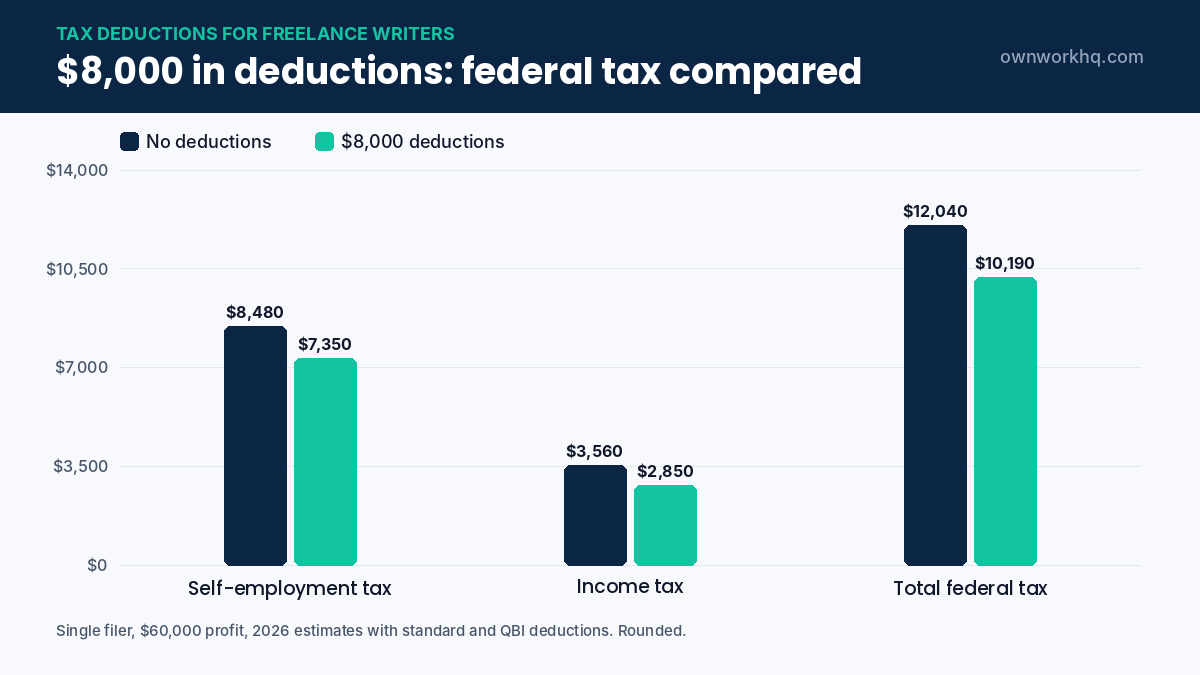
In this example, $8,000 of tax deductions for freelance writers saves about $1,850 in federal tax, before any state income tax savings. The figures are rounded 2026 estimates using the standard deduction and the 20% QBI deduction; your numbers will differ.
Home office: simplified vs regular method
| Simplified method | Regular method | |
|---|---|---|
| How it works | $5 per square foot of office space | Business share of actual home expenses |
| Maximum | 300 sq ft ($1,500) | No fixed cap (limited to business income) |
| Records needed | Office size and exclusive use | Rent or mortgage interest, utilities, insurance, repairs |
| Depreciation | None | Yes, if you own the home |
| Best for | Small offices, simple records | Larger offices or high housing costs |
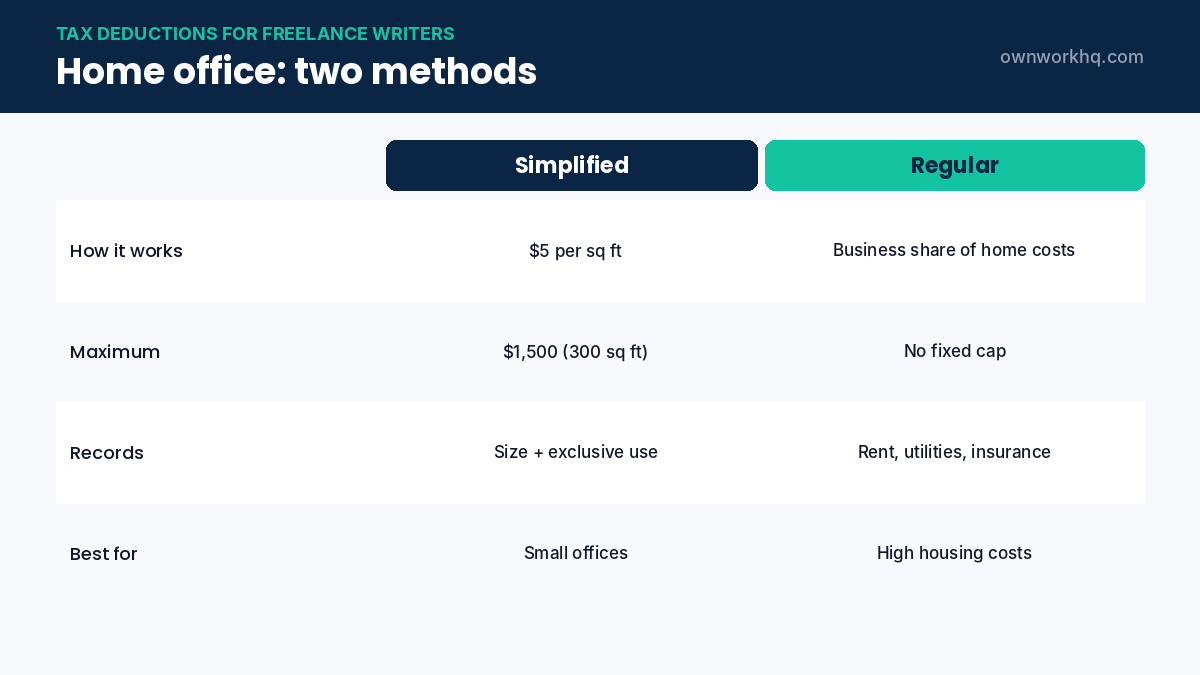
The space must be used regularly and exclusively for your writing business. A desk in the corner of a guest room you also use for guests generally doesn’t qualify; a dedicated office or a clearly separated area used only for work can. See the IRS home office deduction page for details.
Deductions specific to writers
- Books, magazines and research subscriptions you use for client work or your own writing business.
- Writing and editing tools such as grammar checkers, word processors, and reference databases.
- Portfolio website costs: domain, hosting, themes and design.
- Contest and submission fees for professional publications.
- Professional memberships in writers’ or journalists’ associations.
- Courses and workshops that maintain or improve your current writing skills.
- Agent and editor fees if you publish books as a business.
- Interview and research costs, such as transcription services or document fees.
Keep a note of the business purpose for anything that could look personal, such as a novel bought for research. A short note in your expense tracker is usually enough.
Writers with royalties and book income
If you earn royalties from books you wrote as part of your writing business, they’re generally self-employment income reported on Schedule C. Costs of producing the book, such as editing, cover design and marketing, are usually deductible. Royalties from work that isn’t part of an active business may be reported differently, so check with a tax professional if you also have investment-style royalties.
Deductions that are often overlooked
- Bank and payment processor fees on client payments.
- Business insurance, including professional liability insurance for writers.
- Tax preparation fees for the business part of your return.
- The business share of your phone and internet.
- Coworking space memberships and day passes.
- Postage and shipping for contracts, books or samples.
Common mistakes freelance writers make
- Mixing personal and business spending on one card, which makes deductions hard to prove.
- Claiming 100% of a phone or internet bill when part of it is personal use.
- Deducting a home office that isn’t used exclusively for work.
- Forgetting the self-employed health insurance deduction, which is taken on Schedule 1, not Schedule C.
- Missing quarterly payments and paying underpayment penalties that wipe out deduction savings.
Set aside money for taxes from every payment. Our guide to quarterly estimated taxes shows how much to save.
A year-round routine for writers
| When | Task |
|---|---|
| Weekly | Categorize new expenses and save receipts |
| Monthly | Reconcile your business account and review subscriptions |
| Quarterly | Calculate profit and pay estimated taxes |
| Year-end | Buy needed equipment, fund retirement, collect 1099s |
| Tax season | Send reports to your preparer or file Schedule C yourself |
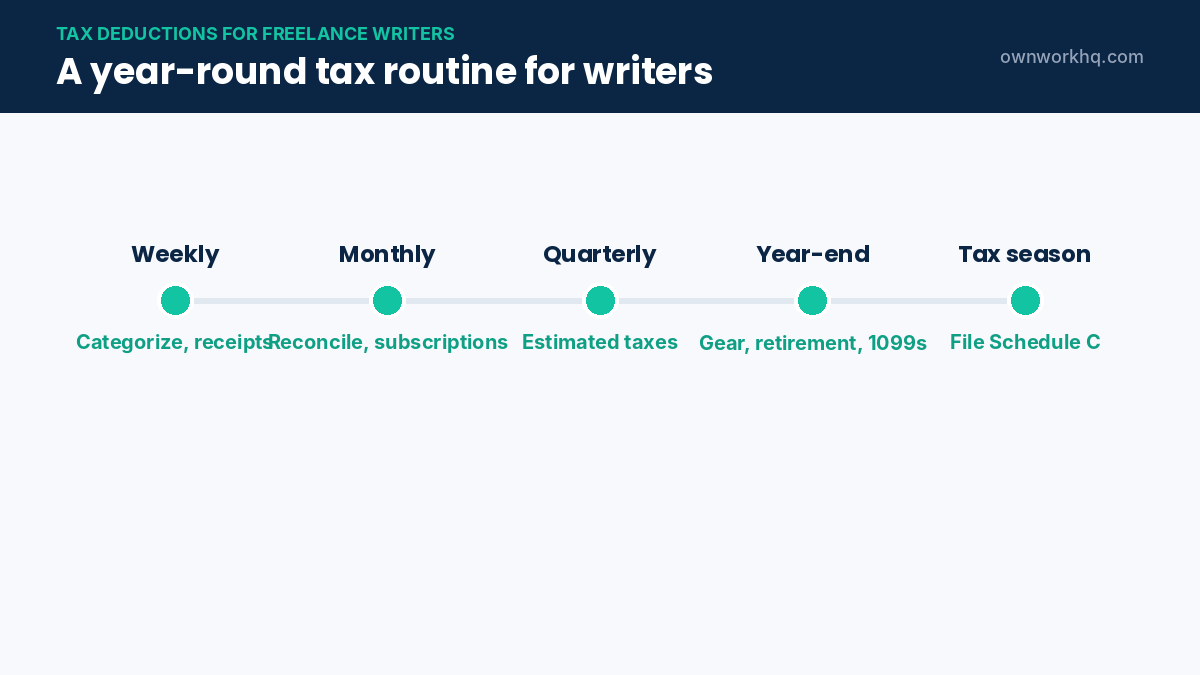
This routine takes less than an hour a month and makes sure every deduction you’re entitled to ends up on your return.
Retirement and health: deductions outside Schedule C
Some of the most valuable tax deductions for freelance writers aren’t business expenses at all. They’re taken on Schedule 1 of Form 1040 and reduce your income tax, though not your self-employment tax:
- Half of self-employment tax, calculated automatically on Schedule SE.
- Self-employed health insurance premiums for you and your family, if you’re not eligible for an employer plan.
- Retirement contributions to a SEP IRA or Solo 401(k); see Solo 401(k) vs SEP IRA.
- HSA contributions if you have a qualifying high-deductible health plan.
Retirement contributions are especially powerful in a good year, because they can lower your tax bill while building savings.
Travel and conferences for writers
Trips to writing conferences, book fairs, interviews or on-location research can be deductible if their main purpose is business. Deductible costs generally include transportation, lodging and 50% of meals while you’re away. Keep the conference agenda, interview notes or assignment letter, along with receipts. If you combine a trip with vacation days, only the business portion of the costs is deductible.
Equipment for freelance writers
Laptops, monitors, ergonomic chairs, microphones for interviews and backup drives are common writer purchases. Items up to $2,500 can generally be expensed in the year you buy them under the de minimis safe harbor, and more expensive equipment can often be deducted in full with bonus depreciation or Section 179. If you also use the item personally, deduct only the business-use percentage and keep a note of how you estimated it.
Hobby or business?
If you write as a side activity and rarely make money, the IRS may treat it as a hobby rather than a business. Hobby income is still taxable, but hobby expenses generally aren’t deductible. Running your writing like a business, with records, a separate account, marketing and an intent to make a profit, helps show it’s a real business.
Finally, remember that state rules can differ from federal rules for some deductions. If you live in a state with income tax, check whether your state follows the federal treatment for items like bonus depreciation, and ask a tax professional if you’re unsure. A short review each year helps you claim every deduction you’re entitled to without surprises.
To see how much your deductions save, lower your net profit in our income tax calculator and compare the totals.
Frequently asked questions
Can freelance writers deduct books?
Yes, books and reference materials used for your writing work are deductible business expenses. Keep receipts and a short note on how each relates to your work.
Is the home office deduction an audit risk?
Claiming it correctly is not a problem. Make sure the space is used regularly and exclusively for business, keep measurements and photos, and use the method that fits your situation.
Can I deduct my laptop in one year?
Usually yes. Items up to $2,500 can generally be expensed under the de minimis safe harbor, and more expensive equipment can often be deducted in full using bonus depreciation or Section 179, for the business-use share.
Are AI writing tools tax deductible?
Subscriptions to AI tools used for your writing business are generally deductible like any other business software.
Can I deduct expenses if I didn’t earn much yet?
Yes, if you’re operating a real business with a profit motive. If your activity looks like a hobby, deductions may be limited, so keep records showing you run it as a business.
Can freelance writers deduct books they read for research?
Generally yes, if the books are ordinary and necessary for your writing business, for example research for an assigned article or a book under contract. Keep a note linking the purchase to the project.
Is a writing course tax deductible?
Courses that maintain or improve skills you already use in your writing business are generally deductible. Education that qualifies you for a new trade or profession usually isn’t.
Do I need receipts for every deduction?
You need records that prove the amount and business purpose. Bank and card statements help, but receipts or invoices are stronger, especially for meals, travel and equipment.
Can I deduct my home internet as a freelance writer?
Yes, the business-use share. If you use your internet about half the time for work, you can generally deduct about half of the bill. Keep a note of how you estimated the percentage.
Sources
- IRS: Deducting business expenses
- IRS: Simplified option for home office deduction
- IRS Publication 587: Business use of your home
- IRS: 2026 standard mileage rate
- Thomson Reuters: Midyear mileage rate increase
Disclaimer: This article is for informational purposes only and is not tax, legal or financial advice. OwnWork HQ is not a CPA or tax advisor. Tax rules change and depend on your situation, so confirm details with the IRS or a qualified tax professional before you act.
About OwnWork HQ Editorial
We write plain-English guides for US freelancers and check every rate, limit and deadline against IRS and state agency publications. We are not CPAs or financial advisors; for advice on your situation, talk to a qualified professional.