Solo 401(k) Deadlines for 2026: Setup, Contributions & Form 5500-EZ
In short: The 2026 Solo 401(k) deadlines for freelancers: opening the plan, electing and depositing employee deferrals, employer contributions for sole proprietors and S corps, and Form 5500-EZ.


On this page
- Solo 401k deadline overview for 2026
- Deadline 1: opening the plan
- Deadline 2: electing employee deferrals
- Deadline 3: depositing contributions
- Deadline 4: Form 5500-EZ
- 2026 Solo 401(k) contribution limits
- Example: a freelancer’s 2026 timeline
- Solo 401(k) vs SEP IRA deadlines
- What happens if you miss a deadline?
- Roth Solo 401(k) contributions
- Adding a spouse to your Solo 401(k)
- How to choose a Solo 401(k) provider
- A year-end Solo 401(k) checklist
- Closing or changing your plan
- How much you can contribute at different profit levels
- Common Solo 401(k) mistakes
- How contributions show up on your tax return
- Looking ahead to 2027
- Withdrawals and loans
- Eligibility: who can use a Solo 401(k)?
- Frequently asked questions
- Sources
A Solo 401(k) lets a self-employed person contribute as both employee and employer, which is why it often allows the biggest tax-deductible savings of any account. But it has more moving parts than an IRA, and missing a Solo 401k deadline can cost you a year’s worth of deductions. This guide lists every date that matters for 2026.
Key takeaways
- Elect employee deferrals by December 31 for an existing plan; many providers need paperwork earlier.
- Employer contributions are due by your filing deadline, including extensions.
- A new plan can be established up to your filing deadline for employer contributions.
- Sole proprietors with a new plan may make first-year employee deferrals until the filing deadline (without extensions).
- File Form 5500-EZ by July 31 once plan assets exceed $250,000 at year-end.
Solo 401k deadline overview for 2026
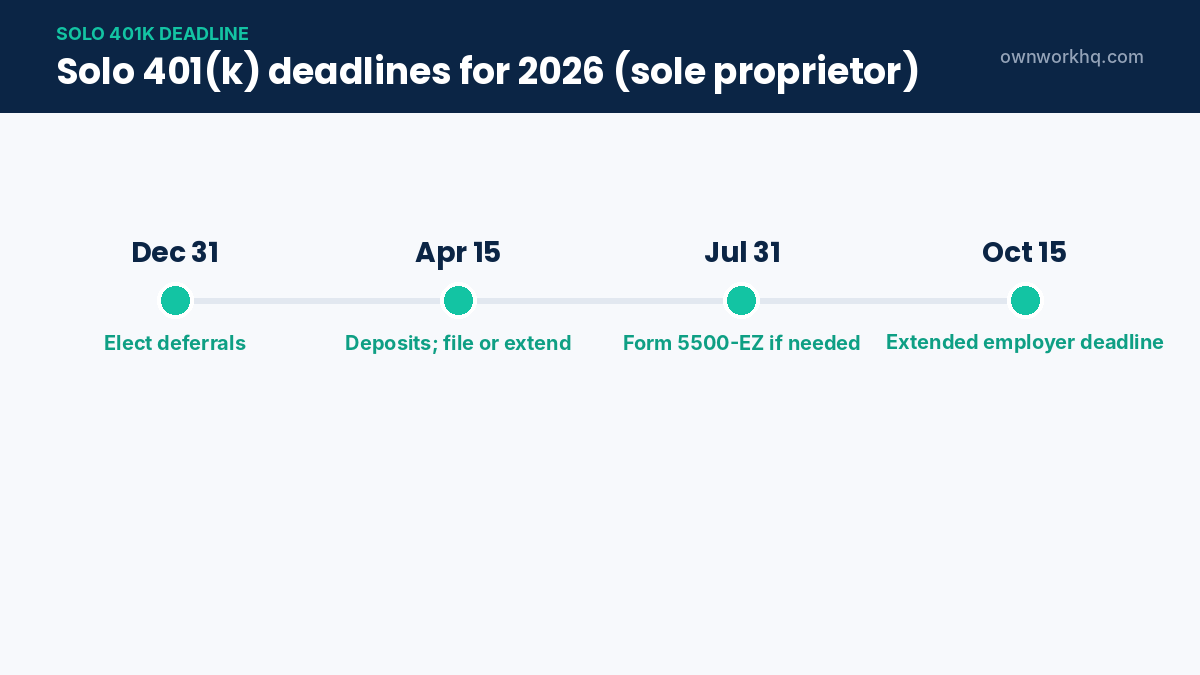
| Task | Sole proprietor or single-member LLC | S corporation owner |
|---|---|---|
| Open a plan to make 2026 employee deferrals (existing-plan rules) | By December 31, 2026 | By December 31, 2026 |
| Open a new plan for 2026 employer contributions | By your filing deadline, including extensions | By the S corp filing deadline, including extensions |
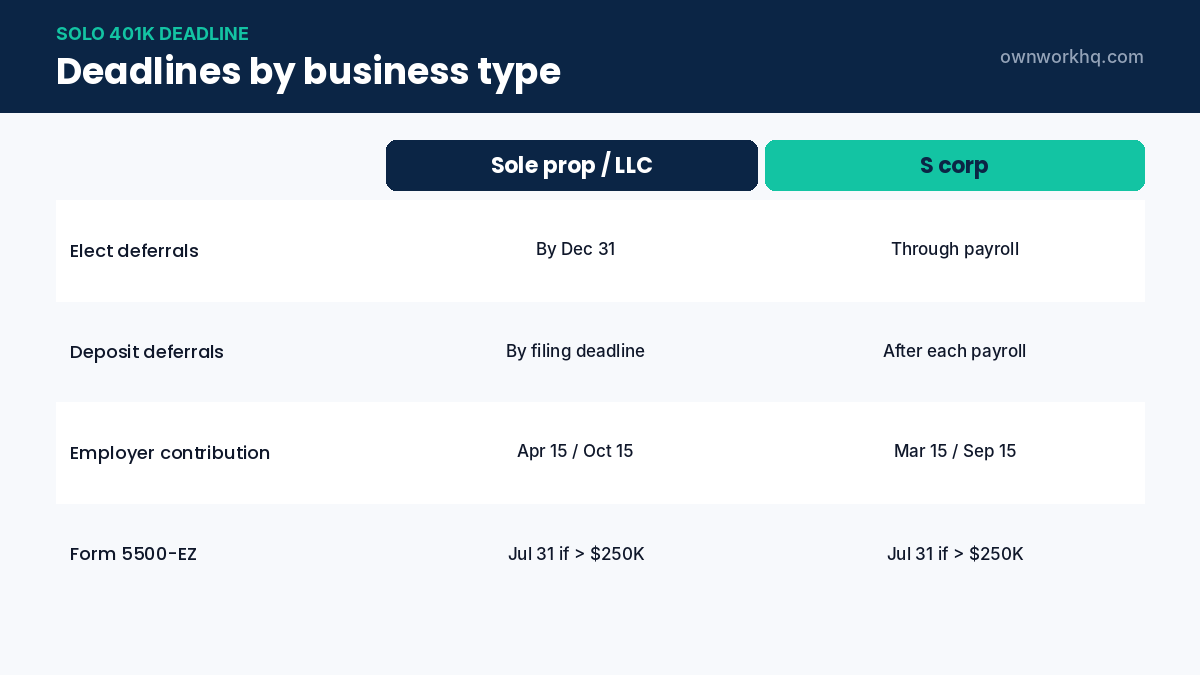
| Elect employee deferrals | By December 31, 2026 (existing plan) | Through payroll by December 31, 2026 |
| Deposit employee deferrals | By your filing deadline | Shortly after each payroll |
| Employer (profit-sharing) contributions | April 15, 2027, or October 15, 2027 with an extension | March 15, 2027, or September 15, 2027 with an extension |
| Form 5500-EZ (if required) | July 31, 2027 | July 31, 2027 |
These dates assume a calendar tax year. Providers often set earlier internal cutoffs for opening accounts and processing December paperwork, so check with yours in early December.
Deadline 1: opening the plan
Since 2020, an employer can establish a new retirement plan for a year as late as its tax filing deadline, including extensions, and make employer contributions for that year. For a freelancer that means you could open a Solo 401(k) in March 2027 and still make 2026 employer contributions.
Employee deferrals are different. Under the SECURE 2.0 Act, a sole proprietor or single-member LLC owner who opens a brand-new Solo 401(k) after year-end can still make employee deferrals for the plan’s first year, up to the tax return due date without extensions. This relief applies only in the first plan year and only to businesses without employees. If you want certainty, open the plan before December 31.
Deadline 2: electing employee deferrals
For an existing plan, the employee deferral election should be made by December 31. For self-employed people, compensation is treated as received on the last day of the year, so the IRS expects the decision to defer to be made by then, even though the money can be deposited later. Put the election in writing: many providers have a simple deferral election form. Note the amount, or a formula, and the date.
Deadline 3: depositing contributions
- Sole proprietors and single-member LLCs: employee deferrals and employer contributions can be deposited by the tax filing deadline, including extensions for the employer part.
- S corporation owners: employee deferrals come out of salary through payroll, and should be deposited promptly after each payroll, generally within a few business days for a small plan. Employer contributions are due by the S corp’s filing deadline.
Make deposits from your business account and keep records showing which contributions are employee deferrals and which are employer contributions, and which tax year they apply to. Most providers ask you to label deposits by type and year.
Deadline 4: Form 5500-EZ
A Solo 401(k) generally must file Form 5500-EZ when total plan assets exceed $250,000 at the end of the plan year, and for the final year of the plan, whatever the balance. For a calendar-year plan the form is due July 31 of the following year. Late filing penalties can be steep, though the IRS offers a penalty relief program for late filers who come forward on their own.
2026 Solo 401(k) contribution limits
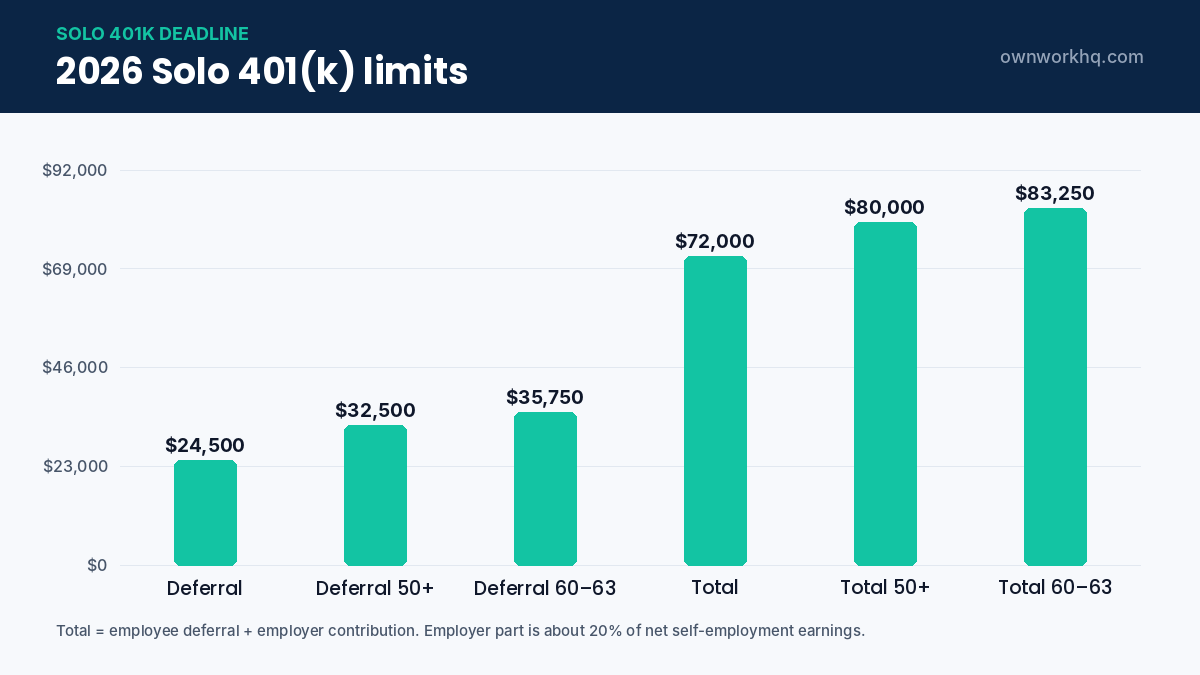
| Contribution | 2026 limit |
|---|---|
| Employee deferral (traditional or Roth) | $24,500 |
| Catch-up, age 50 or older | +$8,000 |
| Catch-up, ages 60 to 63 | +$11,250 (instead of $8,000) |
| Employer contribution | About 20% of net self-employment earnings for sole proprietors; 25% of W-2 salary for S corp owners |
| Total of employee and employer contributions | $72,000, plus any catch-up |
Employee deferrals count toward one limit across all 401(k) and 403(b) plans you participate in. If you also contribute at a day job, your Solo 401(k) deferral room is reduced, but employer contributions to your own plan are counted separately. Compare the Solo 401(k) with a SEP IRA in Solo 401(k) vs SEP IRA.
Example: a freelancer’s 2026 timeline
Jordan, 42, is a sole proprietor expecting about $110,000 of net profit in 2026. Here’s how the deadlines play out:
- Early December 2026: opens a Solo 401(k) with a provider and signs a deferral election for $24,500.
- December 2026 to April 2027: deposits the $24,500 employee deferral from the business account.
- March 2027: finalizes 2026 profit and calculates the employer contribution of about 20% of net earnings after the deduction for half of self-employment tax.
- April 15, 2027: files an extension so there’s more time to fund the employer contribution.
- By October 15, 2027: deposits the employer contribution and files the 2026 return.
Jordan’s total contributions stay within the $72,000 limit, and every dollar is deductible for 2026. The deductions reduce income tax but not self-employment tax.
Solo 401(k) vs SEP IRA deadlines
| Solo 401(k) | SEP IRA | |
|---|---|---|
| Open the plan | By year-end for deferrals; by filing deadline for employer contributions | By your filing deadline, including extensions |
| Employee deferrals | Yes | No |
| Employer contributions | By filing deadline with extensions | By filing deadline with extensions |
| Annual filing | Form 5500-EZ above $250,000 | None |
If you miss the window to open a Solo 401(k) for employee deferrals, a SEP IRA can still give you a large deduction for 2026, because it can be opened and funded until your extended filing deadline.
What happens if you miss a deadline?
- Missed the December 31 election: you may lose the employee deferral for that year if the plan already existed; employer contributions can still be made.
- Missed the filing deadline for employer contributions: contributions made later count for the next year instead.
- Late Form 5500-EZ: file as soon as possible and consider the IRS penalty relief program.
- Excess contributions: contact your provider to withdraw the excess and earnings before the tax filing deadline to limit penalties.
Roth Solo 401(k) contributions
Many Solo 401(k) plans let you make employee deferrals as Roth contributions: no deduction now, but tax-free withdrawals in retirement. Since the SECURE 2.0 Act, plans may also allow employer contributions to be designated as Roth, which are taxable in the year contributed. The deadlines are the same as for traditional contributions, but you must tell your provider which type each deposit is. Roth makes the most sense in lower-income years, when your current tax rate is low.
Adding a spouse to your Solo 401(k)
If your spouse works in your business and earns compensation from it, they can participate in the same Solo 401(k) and make their own employee deferrals and receive employer contributions, effectively doubling the household’s contribution room. Their compensation must be real and reasonable for the work they do, and the same election and deposit deadlines apply to their contributions.
How to choose a Solo 401(k) provider
- Roth options: check whether both employee and employer Roth contributions are supported.
- Fees: many brokerages offer Solo 401(k) plans with no annual fee; others charge for plan documents and administration.
- Investment choices: look for low-cost index funds or ETFs.
- Paperwork deadlines: ask when they need account applications and December deferral forms.
- Form 5500-EZ help: some providers remind you or prepare the form when your balance passes $250,000.
- Rollovers: confirm whether the plan accepts rollovers from old employer plans and IRAs.
A year-end Solo 401(k) checklist
- Confirm your plan is open and active, or open one before December 31 if you want certainty for employee deferrals.
- Estimate your 2026 net profit and maximum contributions.
- Sign a written deferral election by December 31.
- Schedule deposits from your business account.
- Label each deposit by type and tax year.
- Put April 15, October 15 and July 31 in your calendar.
Pair this with the rest of your year-end tax planning, such as equipment purchases and estimated tax payments.
Closing or changing your plan
If you hire employees, switch to a different provider or stop freelancing, you may need to terminate the plan or move it. Terminating usually requires a written resolution, distributing or rolling over the assets, and filing a final Form 5500-EZ for the plan’s last year, regardless of the balance. Moving to a new provider is often done as a plan-to-plan transfer without closing the plan.
How much you can contribute at different profit levels
| Net profit (sole proprietor, under 50) | Employee deferral | Employer contribution | Maximum total |
|---|---|---|---|
| $40,000 | $24,500 | $7,435 | $31,935 |
| $60,000 | $24,500 | $11,152 | $35,652 |
| $80,000 | $24,500 | $14,870 | $39,370 |
| $100,000 | $24,500 | $18,587 | $43,087 |
| $150,000 | $24,500 | $27,881 | $52,381 |
| $200,000 | $24,500 | $37,177 | $61,677 |
The employer contribution is 20% of net profit minus the deduction for half of self-employment tax. At lower incomes, the employee deferral can’t exceed your net earnings after that deduction. These are 2026 maximums; you can contribute any amount up to them, and you don’t have to contribute every year.
Common Solo 401(k) mistakes
- Waiting until April to open a plan and expecting to make full employee deferrals under the existing-plan rules.
- No written deferral election by December 31.
- Exceeding the deferral limit across a day-job 401(k) and your Solo 401(k).
- Mislabeling deposits, so employer and employee contributions or tax years get mixed up.
- Forgetting Form 5500-EZ once the balance passes $250,000.
- Hiring an employee and continuing to run the plan as a one-participant plan.
How contributions show up on your tax return
For a sole proprietor, Solo 401(k) contributions aren’t a Schedule C expense. They’re deducted on Schedule 1 as self-employed retirement contributions, which reduces income tax but not self-employment tax. Solo 401(k) contributions for a sole proprietor also reduce qualified business income for the QBI deduction, so the net tax benefit is a little smaller than your marginal rate suggests. For an S corp, employee deferrals come out of W-2 wages and employer contributions are a business deduction on the S corp return. Our income tax calculator lets you enter 401(k) contributions to see the effect.
Looking ahead to 2027
The IRS usually announces the next year’s 401(k) limits in the fall, and the Social Security wage base that affects your self-employment tax changes each year too. When the 2027 limits are published, update your deferral election for the new year in January so your contributions start on the right foot. If your income is uneven, you can set the election as a percentage of net earnings rather than a fixed dollar amount, then fine-tune deposits once the year closes.
Withdrawals and loans
Money in a Solo 401(k) follows the same basic rules as other 401(k) plans. Withdrawals before age 59½ are generally taxed and may face a 10% additional tax unless an exception applies. Some plans allow loans of up to 50% of your vested balance, to a maximum of $50,000, repaid with interest over five years in most cases. Loans must be allowed by the plan document, so ask your provider before you rely on that feature. Required minimum distributions generally begin at age 73 for traditional balances, while Roth balances in a 401(k) are no longer subject to lifetime required distributions.
Eligibility: who can use a Solo 401(k)?
A Solo 401(k) is for business owners with no full-time employees other than themselves and a spouse. If you hire employees who meet the plan’s eligibility rules, you’ll generally need to convert to a standard 401(k) and include them. Part-time workers and independent contractors usually don’t affect eligibility, though recent law changes extend some plan rights to long-term part-time employees. Freelancers with only 1099 contractors qualify.
Frequently asked questions
What is the Solo 401k deadline to open a plan for 2026?
To make employee deferrals under the regular rules, open the plan by December 31, 2026. A new plan for employer contributions can be opened up to your filing deadline including extensions, and sole proprietors may make first-year deferrals until the filing deadline without extensions.
When are Solo 401(k) employer contributions due?
By your tax filing deadline, including extensions. For a sole proprietor that’s April 15, 2027, or October 15, 2027 with an extension, for the 2026 tax year.
Can I contribute to a Solo 401(k) after December 31 for the previous year?
Yes. Deposits of employee deferrals elected by December 31 and employer contributions can be made after year-end, up to the applicable deadlines.
Do I need to file Form 5500-EZ?
Only if plan assets exceed $250,000 at the end of the plan year, or in the plan’s final year. It’s due July 31 for calendar-year plans.
Is the Solo 401k deadline different for an S corp?
Yes. For an S corp owner, employee deferrals come out of salary through payroll during the year, and employer contributions are due by the S corp’s filing deadline: March 15, or September 15 with an extension, for calendar-year companies.
What if I opened my Solo 401(k) in January for last year?
A plan opened after December 31 can still receive employer contributions for the prior year if it’s established by your filing deadline. As a sole proprietor with no employees, you may also be able to make first-year employee deferrals until the filing deadline without extensions.
Do Solo 401(k) contributions lower my self-employment tax?
No. They reduce income tax, but self-employment tax is calculated on Schedule SE before the retirement deduction. Business expenses and an S corp election are what reduce self-employment tax.
Can I have a Solo 401(k) and a 401(k) at my day job?
Yes. Your employee deferrals are limited to $24,500 in total across both plans for 2026, plus catch-ups, but employer contributions to your Solo 401(k) are counted separately.
Sources
- IRS: One-participant 401(k) plans
- IRS: Form 5500 corner
- IRS: 401(k) contribution limits
- IRS: How much can I contribute if I’m self-employed?
Disclaimer: This article is for informational purposes only and is not tax, legal or financial advice. OwnWork HQ is not a CPA or tax advisor. Tax rules change and depend on your situation, so confirm details with the IRS or a qualified tax professional before you act.
About OwnWork HQ Editorial
We write plain-English guides for US freelancers and check every rate, limit and deadline against IRS and state agency publications. We are not CPAs or financial advisors; for advice on your situation, talk to a qualified professional.