Mileage Deduction for Freelancers (2026): Rates, Rules & Log Template
In short: How the mileage deduction works for freelancers in 2026: the two standard mileage rates, standard vs actual expense method, which trips count as business, and what your log needs.

On this page
- 2026 mileage rates
- How the mileage deduction for freelancers works
- Which trips count as business mileage?
- Example: a photographer’s 2026 mileage
- Quick estimate: what your miles are worth
- What your mileage log needs
- Standard rate rules to know
- Using the actual expense method
- Standard rate vs actual expenses: a comparison
- Mileage tips by type of freelancer
- Billing clients for mileage
- S corp owners: use an accountable plan
- Electric and hybrid cars
- Overnight business travel
- If you didn’t keep a log
- Paper log or mileage app?
- Two cars or a change of car
- State taxes
- Freelancing on the side of a W-2 job
- How long to keep mileage records
- Where to report it
- Common mileage mistakes
- Frequently asked questions
- Sources
If you drive for your business, every business mile can lower your taxes. The mileage deduction for freelancers is one of the easiest write-offs to claim and one of the easiest to lose, because it depends on records most people don’t keep. For 2026 it’s also unusual: the IRS raised the standard mileage rate in the middle of the year, so the date of each trip matters.
Key takeaways
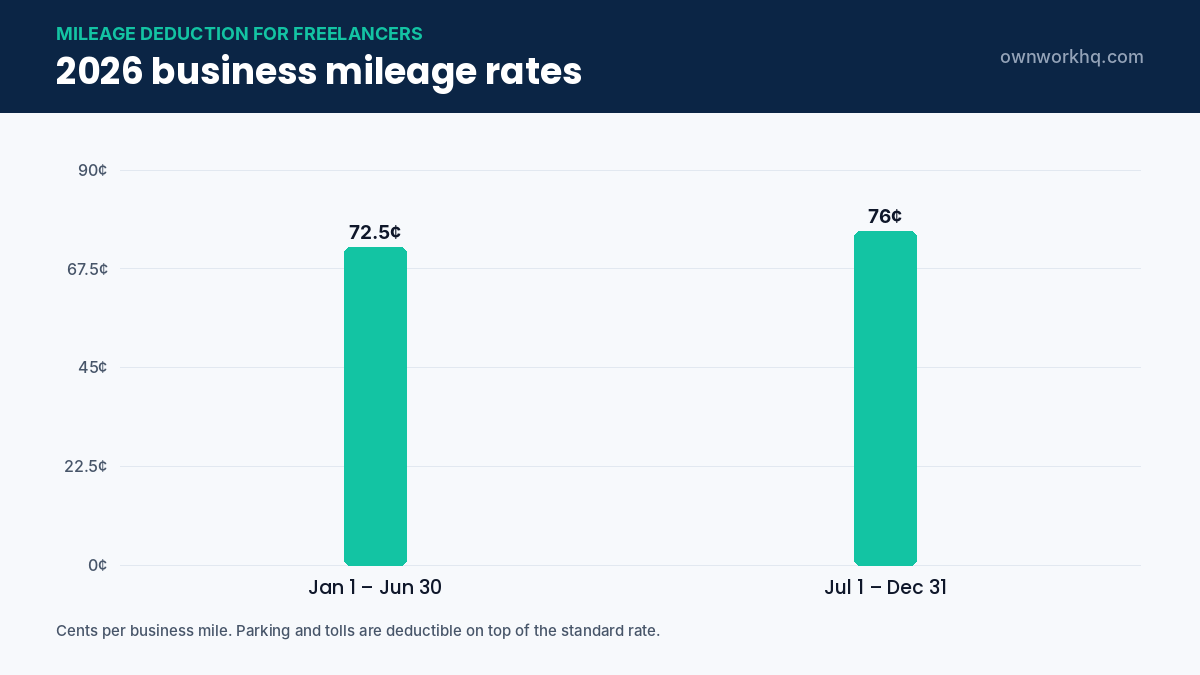
- 2026 standard mileage rate: 72.5¢ per mile through June 30 and 76¢ from July 1.
- Parking fees and tolls for business trips are deductible on top of the standard rate.
- Commuting isn’t deductible, but a qualifying home office makes trips from home to clients business travel.
- Choose the standard rate in the first year you use a car for business if you want to keep that option later.
- Keep a contemporaneous log; estimates made at tax time are weak support.
2026 mileage rates
| Period | Business rate per mile |
|---|---|
| January 1 – June 30, 2026 | 72.5 cents |
| July 1 – December 31, 2026 | 76 cents |
The IRS set the 2026 business rate at 72.5 cents in its annual announcement, then raised it to 76 cents for the second half of the year. Total your business miles separately for each period, multiply by the matching rate, and add the results.
How the mileage deduction for freelancers works
Self-employed people deduct business vehicle costs on Schedule C, which reduces both income tax and self-employment tax. You choose one of two methods for each vehicle:
| Standard mileage rate | Actual expense method | |
|---|---|---|
| What you deduct | Business miles × IRS rate, plus parking and tolls | Business % of gas, insurance, repairs, registration, lease payments or depreciation |
| Records | Mileage log plus parking and toll receipts | Mileage log plus every car expense receipt |
| Best for | Most freelancers, efficient cars, simple records | Expensive or costly-to-run vehicles, high business use |
| Switching | Can switch to actual later if you used standard in year one | Generally can’t switch to standard for an owned car after using actual |
For most freelancers, the standard mileage rate is simpler and often larger, especially with an economical car. Run both numbers in your first year, because the choice affects later years.
Which trips count as business mileage?
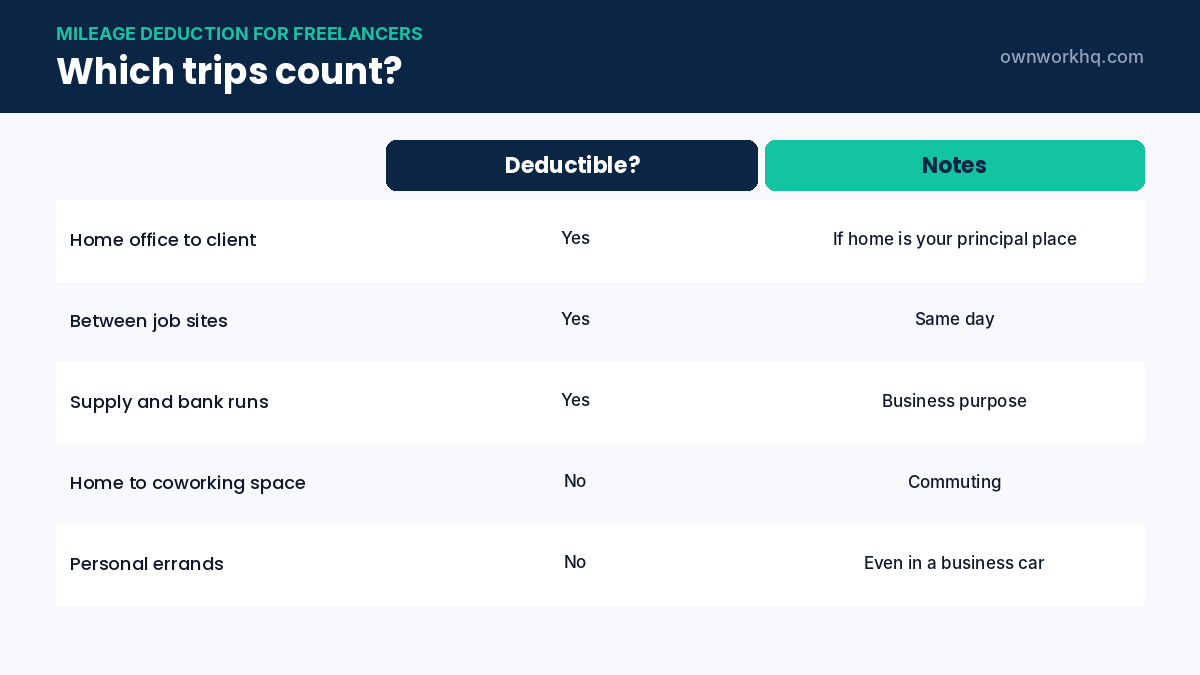
- Driving to meet clients or prospects.
- Driving between client sites or job locations during the day.
- Trips to buy business supplies or equipment.
- Driving to the bank, post office or print shop for business.
- Travel to conferences, workshops and networking events.
- Driving to a temporary work location, such as a client’s office for a short project.
Commuting doesn’t count. Driving from home to a regular office or coworking space is personal commuting. But if your home office is your principal place of business, trips from home to clients and other business stops count as business travel. That’s one more benefit of qualifying for the home office deduction.
Example: a photographer’s 2026 mileage
| Period | Business miles | Rate | Deduction |
|---|---|---|---|
| January – June | 3,200 | $0.725 | $2,320 |
| July – December | 4,100 | $0.76 | $3,116 |
| Parking and tolls | $410 | ||
| Total vehicle deduction | 7,300 | $5,846 |
With a combined marginal rate of about 30%, that deduction saves this photographer roughly $1,750 in federal, self-employment and state tax. Our income tax calculator shows your own marginal rate.
Quick estimate: what your miles are worth
If your business driving is spread evenly across 2026, half your miles fall in each rate period. Here’s what that looks like before parking and tolls:
| Business miles in 2026 | Mileage deduction | Tax saved at a 30% marginal rate |
|---|---|---|
| 2,000 | $1,485 | About $446 |
| 5,000 | $3,713 | About $1,114 |
| 8,000 | $5,940 | About $1,782 |
| 12,000 | $8,910 | About $2,673 |
Your own numbers will differ if more of your driving happened before or after July 1, which is why the log should record dates. Even a few thousand miles is worth a meaningful amount of tax, so it pays to log consistently.
What your mileage log needs
| Field | Example |
|---|---|
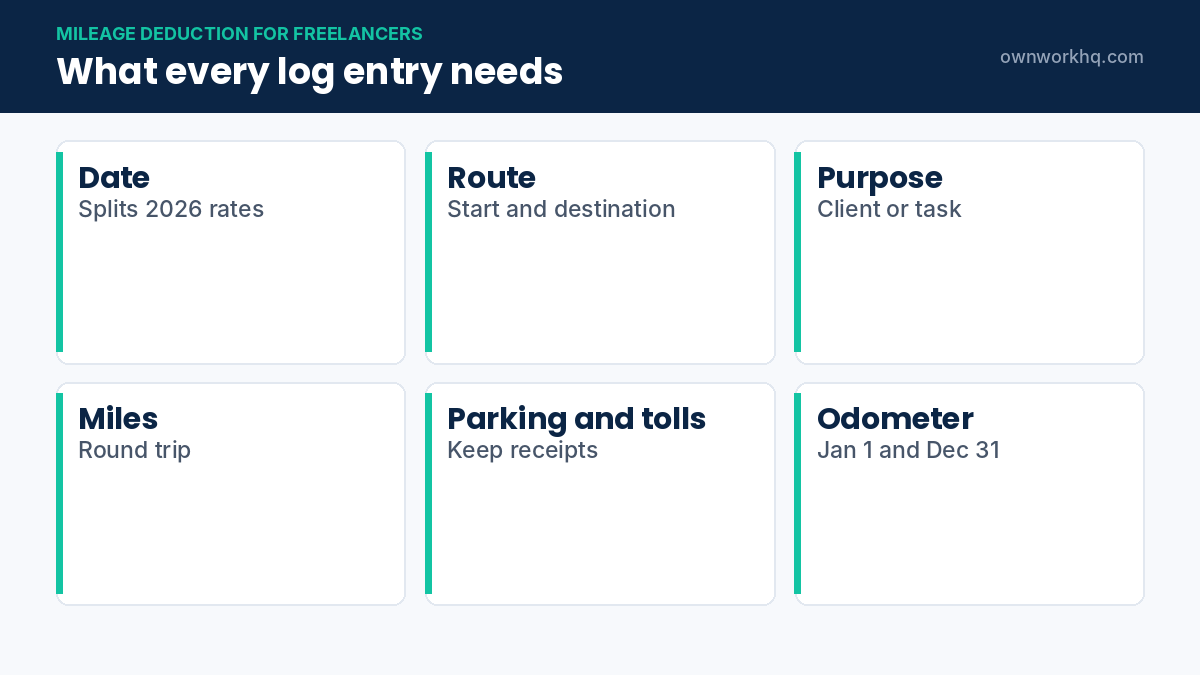
| Date | March 12, 2026 |
| Starting point and destination | Home office → client office, downtown |
| Business purpose | Project kickoff with Acme Co. |
| Miles | 24 (round trip) |
| Parking and tolls | $8 parking |
Also record your odometer reading on January 1 and December 31 so you can show total miles for the year and the business-use percentage. A mileage app that uses your phone’s GPS can record trips automatically; you just mark each one as business or personal. A paper notebook in the car works too, as long as you fill it in at the time of the trip.
Standard rate rules to know
- First-year choice: for a car you own, you must use the standard rate in the first year the car is used for business if you want the option to use it in later years.
- Leased cars: if you choose the standard rate for a leased car, you must use it for the entire lease, including renewals.
- Fleet limit: you can’t use the standard rate if you operate five or more vehicles at the same time.
- Extras: business parking and tolls are deductible on top; so is the business share of interest on a car loan and personal property tax on the vehicle, for self-employed people.
- Not deductible on top: gas, insurance, repairs and depreciation are already built into the standard rate.
Using the actual expense method
With actual expenses, you add up everything the car cost during the year and multiply by your business-use percentage: business miles divided by total miles. Costs include gas, oil, repairs, tires, insurance, registration, lease payments or depreciation, and garage rent. Depreciation for passenger cars is subject to annual limits, and if business use falls to 50% or less, special rules apply. This method needs every receipt, so it’s best for freelancers who drive an expensive or costly-to-run vehicle mostly for business.
Standard rate vs actual expenses: a comparison
Using the photographer above, who drove 15,000 total miles in 2026, of which 7,300 were for business (48.7%), here’s how the two methods compare for a leased car:
| Actual car costs for the year | Amount |
|---|---|
| Lease payments | $4,800 |
| Gas | $2,400 |
| Insurance | $1,500 |
| Maintenance and repairs | $600 |
| Registration | $200 |
| Total actual costs | $9,500 |
| Business share (48.7%) | $4,623 |
| Plus parking and tolls | $410 |
| Actual expense deduction | $5,033 |
| Standard mileage deduction | $5,846 |
Here the standard rate wins by about $800 and needs far fewer receipts. The actual expense method tends to win when a car is expensive to run, business use is high, or depreciation on a newly purchased vehicle is large. Remember that choosing the standard rate for a leased car locks you in for the whole lease.
Mileage tips by type of freelancer
- Photographers and videographers: shoots, location scouting and equipment rental pickups add up fast; log each one.
- Consultants: client site visits are deductible, but a long-term assignment at one client’s office can become a regular work location.
- Rideshare and delivery drivers: miles driven with a passenger or order, and usually miles driving to pickups and between trips, are business miles; app summaries can help but may not include all of them.
- Designers, writers and developers: fewer miles, but client meetings, coworking-to-client trips and supply runs still count.
Billing clients for mileage
Some freelancers bill clients for travel. If a client reimburses your mileage, the reimbursement is part of your business income, and you still claim the mileage deduction. Make sure your invoices show mileage as a separate line so the income and the deduction match in your books. Contracts should say how mileage will be billed, for example at the IRS rate.
S corp owners: use an accountable plan
If you operate as an S corporation, you’re an employee of your company, and employees can’t deduct mileage on their personal federal return. Instead, the company reimburses you under an accountable plan: you submit a mileage log, and the S corp pays you the business mileage at the IRS rate. The reimbursement is deductible for the company and not taxable to you. See S corp vs LLC for freelancers for how S corps work.
Electric and hybrid cars
The standard mileage rate is the same for gas, hybrid and electric vehicles, so drivers of efficient or electric cars often come out ahead with the standard rate. If you charge an electric car at home and use the actual expense method, you’d need to estimate the business share of home charging costs, which is another reason many freelancers prefer the standard rate.
Overnight business travel
Driving to a client in another city and staying overnight is business travel. You can still use the mileage deduction for the drive, and you may also deduct lodging and 50% of meals while away from home. Keep the client contract or agenda with your receipts so the business purpose is clear.
If you didn’t keep a log
If you’re reading this in December without a log, don’t guess. Rebuild the year from records created at the time: your calendar, client invoices, emails confirming meetings, and phone location history. Use a mapping tool to measure each trip’s distance and note the source for each entry. A reconstructed log is weaker than a contemporaneous one, so start a proper log today and keep it going for the rest of the year and next year.
Paper log or mileage app?
| Paper notebook | Mileage app | |
|---|---|---|
| Cost | Free | Free to a few dollars a month |
| Effort | Write each trip down | Tap to mark trips as business |
| Accuracy | Depends on discipline | GPS distances, automatic dates |
| Reports | Total by hand | Annual report by period and vehicle |
Whichever you choose, export or photograph the records at year-end and store them with your tax files. Apps that split 2026 totals at July 1 save time with the two-rate year.
Two cars or a change of car
If you use more than one vehicle for business, keep a separate log and choose a method for each one. If you replace your car mid-year, track the miles for each car separately and apply the standard rate rules for the new car from its first business use. A spouse’s car you use for business counts too, as long as you log the miles.
State taxes
Because the mileage deduction reduces your Schedule C profit, it usually lowers state income tax as well in states that start from federal income. A handful of states have their own depreciation rules that can affect the actual expense method, but the standard rate generally carries through without adjustment.
Freelancing on the side of a W-2 job
If you have a job and a side business, trips for the side business are deductible, but commuting to your job isn’t. Driving from your job directly to a client for your side business is generally a business trip for the miles between the two locations. Driving from home to a side-business client on a day you also go to work follows the same rules as for any freelancer: it depends on whether your home office is your principal place of business for the side business.
How long to keep mileage records
Keep your mileage log, parking and toll receipts and odometer readings for at least three years after you file the return, and longer if you claim depreciation under the actual expense method, because the records support the car’s basis when you sell or trade it. Digital copies are fine as long as they’re complete and readable. Store each year’s log with that year’s tax return so everything is in one place if the IRS ever asks.
If you need a simple system for receipts and logs across all your expenses, see our guide on how to track freelance expenses.
Where to report it
- Complete Part IV of Schedule C with vehicle information, or Form 4562 if you claim depreciation.
- Enter the vehicle deduction on line 9 of Schedule C, “Car and truck expenses.”
- Enter parking and tolls with car expenses as well.
- Keep the mileage log with your tax records; you don’t send it to the IRS.
Common mileage mistakes
- Claiming commuting miles to a regular office or coworking space.
- Using one rate for the whole year instead of splitting 2026 at July 1.
- Reconstructing the log in April from memory.
- Deducting gas on top of the standard rate, which double counts.
- Rounding up to round numbers on every trip, which looks unreliable.
Frequently asked questions
What is the 2026 mileage rate for freelancers?
72.5 cents per business mile from January 1 to June 30, 2026, and 76 cents per mile from July 1 to December 31, 2026.
Can I deduct mileage from home to a client?
Yes, if your home office is your principal place of business, or if you’re driving to a temporary work location. Driving to a regular office or coworking space is commuting and isn’t deductible.
Do I need receipts for the standard mileage rate?
You don’t need gas receipts, but you do need a mileage log with the date, destination, purpose and miles for each trip, plus receipts for parking and tolls.
Can I switch from actual expenses to the standard rate?
Generally not for a car you own, if you used the actual expense method with accelerated depreciation in an earlier year. If you used the standard rate in the first year, you can switch to actual expenses later.
Can I claim mileage if I drive a family car?
Yes. You deduct only the business miles, regardless of who owns the car or how much it’s used personally, as long as you’re the one paying for the business use and you keep a log.
Does the mileage deduction reduce self-employment tax?
Yes. Vehicle expenses are deducted on Schedule C, so they lower your net profit and therefore both income tax and self-employment tax.
What if most of my driving was before July 1?
Use each trip’s date. Miles driven from January through June use 72.5 cents and miles from July through December use 76 cents, so a log with dates gives the accurate total.
Is mileage deductible for W-2 employees?
No. Employees can’t deduct unreimbursed vehicle expenses on their federal return. The mileage deduction is for self-employed people and certain other groups.
Sources
- IRS: 2026 business standard mileage rate
- Thomson Reuters: 2026 midyear mileage rate increase
- IRS Publication 463: Travel, gift and car expenses
Disclaimer: This article is for informational purposes only and is not tax, legal or financial advice. OwnWork HQ is not a CPA or tax advisor. Tax rules change and depend on your situation, so confirm details with the IRS or a qualified tax professional before you act.
About OwnWork HQ Editorial
We write plain-English guides for US freelancers and check every rate, limit and deadline against IRS and state agency publications. We are not CPAs or financial advisors; for advice on your situation, talk to a qualified professional.